As an Amazon Associate, Akermin earns from qualifying purchases. Product links on this page are affiliate links.
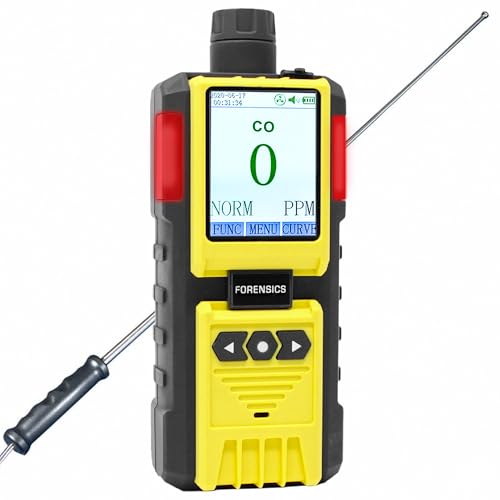
Short answer: For furnace servicing, the two picks that carry the most usable data are P7 and P8, because both publish a pump, a stated calibration trace and computer logging, which is what you need to prove a reading before and after an adjustment. P6 is the strongest all-round handheld for a technician who wants a stated certification and a fast response without a pump. P3 is the value pick for a rugged point-and-read meter. P1 is the budget option and P2 is the simplest alarm-threshold meter. The residential alarms in the source list, P9, P10, P11 and P12, were excluded: they are life safety alarms for occupants, not instruments for combustion analysis, and P12 is a low level monitor rather than a servicing meter.
A meter is not an alarm, and the difference is the whole category
An alarm is a device that decides for you. It sits on a wall, it watches continuously, and when carbon monoxide crosses a threshold it makes a noise loud enough to wake somebody. A meter is a device that tells you a number while you are standing there holding it. Those are different jobs, and confusing them is the most common mistake in this category.
In furnace servicing the meter is the working instrument. You use it to find out whether the appliance is producing carbon monoxide, how much, and whether the number changes when you adjust the air. The alarm is what protects the household after you leave. If you carry a meter and no alarm, the house has no protection. If you carry an alarm and no meter, you cannot diagnose anything. Most technicians need both, and they are not substitutes for each other. If you want the alarm side of the decision, the carbon monoxide detector comparison covers that ground, and the difference between a gas leak detector and a CO detector is worth reading before you buy anything for a call that might be either.
What the numbers mean in combustion work
Carbon monoxide from a furnace is a combustion problem, and the reading is a diagnostic signal. A clean burning appliance produces very little CO, and the number should be low and stable. A number that climbs as the appliance warms, or that rises when the fan starts, points at a specific problem: a cracked heat exchanger, a blocked flue, or an air setting that is starving the flame. The meter does not tell you which of those it is, but the shape of the reading narrows it down.
This is why resolution matters more than range for most servicing work. A meter that reads in 1 ppm steps lets you watch the number move as you make an adjustment. A meter with a coarse display can sit on the same value while the appliance is still producing CO, which is worse than useless because it looks like a pass. Range matters for the other direction: you need enough headroom to read a badly spilling appliance without the instrument maxing out. The meters here that publish a range mostly state 0 to 1000 ppm, and P6 states 1 to 1999 ppm.
The thresholds you will see quoted, 35 ppm and 200 ppm, are occupational reference points rather than household alarm thresholds. They are useful as working lines: 35 ppm is a level at which you should be paying attention, and 200 ppm is a level at which you should be acting. But they are not the same as the thresholds a residential alarm uses, and a meter set to those levels is not a substitute for an alarm.
Calibration, and why the certificate matters more than the feature list
An electrochemical CO sensor drifts. It responds to the gas, but its output also changes with temperature, humidity and age. A meter that was accurate when it left the factory will not stay accurate forever, and the instrument does not know it has drifted. That is why calibration is the feature that separates a working instrument from a toy.
There are two levels of it. Factory calibration with a stated trace, which P3, P7 and P8 publish, gives you a documented starting point. A zero and span menu, which P1 and P8 publish, lets you adjust the instrument in the field against a known gas. If you do combustion work regularly, the span menu is the more valuable of the two, because it lets you check the instrument before a job rather than trusting a certificate from months ago. If you only need a spot check now and then, factory calibration is enough, provided you replace or recalibrate the instrument on the manufacturer’s schedule.
What none of these listings publish is a calibration interval. That is not a gap in the comparison; it is a gap in the listings. Follow the manufacturer’s instructions for the specific instrument, and if you are using the meter for work that has to be documented, keep the calibration record with the job.
The maintenance nobody mentions
The sensor gets all the attention and the sample path gets none. On a pumped instrument, the pump, the tubing and the probe are between the gas and the sensor, and anything that blocks or absorbs the gas will make the reading low. A low reading on a furnace is the dangerous direction, because it looks like a clean appliance. Check the flow before every job, and replace tubing that has been wet or contaminated.
On a non-pumped meter the equivalent problem is the sensor inlet. Dust, lint and moisture collect on it, and a blocked inlet slows the response. A meter that used to react in a few seconds and now takes half a minute is telling you something about its inlet, not about the gas. Keep the instrument in its case, keep it out of the rain even if it is rated for it, and do not store it in a hot van if you can avoid it.
Batteries are the other quiet failure. A rechargeable meter that was not charged is a meter that does not work, and the failure is silent until you need it. Lithium primary cells, like the 9V in P3 and the sealed cells in the alarms, avoid that problem but introduce a different one: they fail without warning at the end of their life. Whichever you choose, check the instrument before the call, not on the doorstep.
Where the category stops being the right answer
A carbon monoxide meter measures one gas. That is its strength and its limit. If the call is a gas smell, a refrigerant leak, or a suspected sewer gas problem, the CO meter will read zero and tell you nothing. For those jobs you need a different sensor, and the combustible gas detector comparison covers the leak search side. If the job is entering a confined space, a single gas meter is not enough: entry requires a multi gas instrument that also watches oxygen and the other hazards, which is a different category entirely.
And if the job is protecting a household, the meter is the wrong instrument. It measures while you are there and does nothing when you leave. The right answer for that job is an alarm, installed and maintained, and the meter is a tool you carry alongside it. Buying a meter to do an alarm’s job is the mistake this whole page is written to prevent.