As an Amazon Associate, Akermin earns from qualifying purchases. Product links on this page are affiliate links.
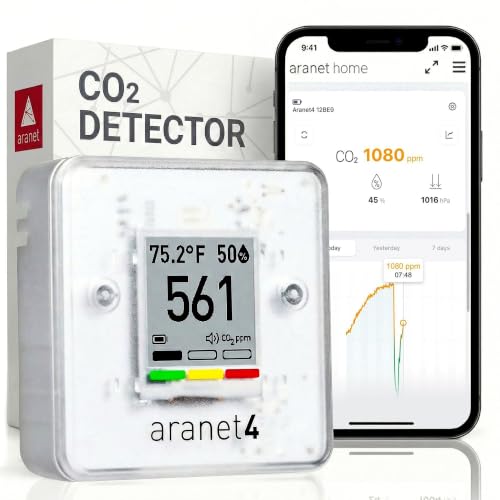
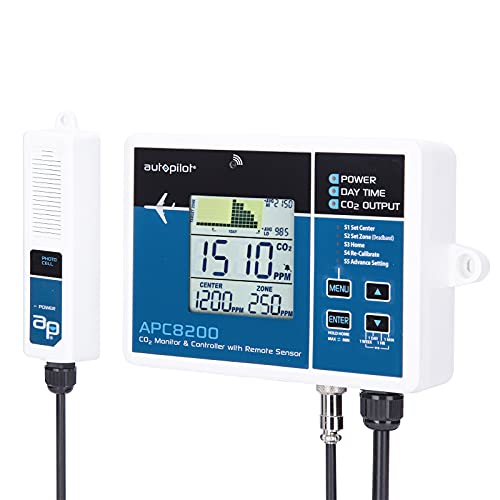
For most home and project studios, the SAF Aranet4 (P1) is the pick because it is the only monitor here that combines a stated four-year battery life on an e-ink display with a phone app that keeps 90 days of history, which is what you need to see whether the room recovers between takes. The Airthings 2960 View Plus (P2) is the better choice if you also want radon and particulate readings in a basement studio, at the cost of a mains-tethered, app-dependent device. The WEIRUSE TW22 (P4) is the one to buy if you want the monitor itself to switch a ventilation fan on when CO2 crosses a threshold, since it is the only listing here that publishes a relay-style socket output with adjustable limits. The Autopilot unit (P5) is a grow-room controller with a remote probe and is included only because its remote-sensor design is genuinely useful in a studio where the monitor would otherwise sit behind a rack.
Why a studio is not just a small room
A music studio is usually a small room with a lot of absorptive material on the walls, a closed door, and no opening window. That combination is close to a sealed box. Two people talking quietly produce far less CO2 than one person singing, and a singer exhales several times the resting volume of air. In a room of fifteen cubic metres, a single vocalist can push the concentration past the point where most people notice stuffiness within twenty minutes, and a full band can do it faster.
The practical consequence is that CO2 in a studio is not a slow background trend, it is a session-length variable. A monitor that samples every five minutes and shows a live number is useful. A monitor that stores history is more useful, because the interesting question is not what the number is now but whether the room recovers between takes and how long it takes to clear after the door is opened. That is a logging question, and it is why the picks below are separated mainly by how they record and how they alarm.
If you are also tracking particulates from old valve gear or from a neighbouring workshop, the same room may need more than CO2 sensing. The broader air quality monitor comparison covers that ground.
What the listing numbers actually tell you
Only one of the four listings publishes an accuracy figure in the way a technician would want. The WEIRUSE TW22 (P4) states a range of 400 to 5000 ppm and an accuracy of 50 ppm or 5 percent of the actual reading, whichever is greater. That is a normal specification for a non-dispersive infrared sensor, and it means that at 1000 ppm the tolerance is about 50 ppm, while at 3000 ppm it is about 150 ppm. The other three listings do not publish an accuracy figure at all, which is common for consumer monitors and does not mean they are inaccurate, only that the manufacturer has not committed to a number.
The Aranet4 (P1) listing does not state a measurement range or an accuracy figure. It states battery life, display type, the parameters measured, and the app history window. The Airthings 2960 View Plus (P2) states an operating temperature range of 4 to 40 degrees Celsius and describes its sensor type as electrochemical, which is the technology used for its gas sensors generally rather than a CO2-specific statement. The View Plus listing does not publish a CO2 range or accuracy either.
This matters because a studio buyer is often trying to decide between a cheap display and a reference instrument. None of these four is a reference instrument. They are all indicative monitors, and their value is in showing change and trend, not in certifying a room. If you need a calibrated reading for a compliance purpose, none of these listings supports that claim.
Comparison table, using only what the listings publish
| Pick | Parameters stated | Power | Logging stated | Alarm or control | Accuracy stated |
|---|---|---|---|---|---|
| P1 SAF Aranet4 | CO2, temperature, relative humidity, atmospheric pressure | Battery, up to 4 years, e-ink display | App, up to 90 days | Optional buzzer and colour coding | Not stated in the listing bullets |
| P2 Airthings 2960 View Plus | Radon, PM2.5, CO2, VOC, humidity, temperature, pressure | Battery powered, WiFi connected, app required | Cloud storage, continuous | App notifications | Not stated in the listing bullets |
| P4 WEIRUSE TW22 | CO2, temperature | USB Type-C 5V/1A, or 3 x AAA backup, about 3 hours | 260,000 points on device, USB export | Adjustable over-limit thresholds, switches a connected socket | 50 ppm or 5 percent of reading, whichever is greater |
| P5 Autopilot | CO2 | Not stated in the listing bullets | Trend chart per minute, hour, day, week | Adjustable set point and deadband | Not stated in the listing bullets |
The table shows the real split in this group. Two picks are monitors that tell you things, and two are controllers that act on what they measure. That distinction should drive the purchase more than any single specification.
Four CO2 monitors for a room where people sing
SAF Aranet4
The only pick here with a stated four-year battery and a 90-day app history, which suits a studio that is used in bursts.
Airthings 2960 View Plus
Adds radon, PM2.5 and VOC sensing to CO2, useful in a basement or converted garage studio, but it needs mains power and an account.
WEIRUSE TW22
Publishes adjustable CO2 and temperature thresholds that switch a connected socket, so it can run an extractor fan without human intervention.
Autopilot CO2 Monitor & Controller
A remote sensor on a 15 foot cable lets you place the probe at mouth height while the controller sits out of the way.
Logging, alarms, and the fan you forget to switch on
A monitor that only shows a live number depends on somebody looking at it. In a studio, nobody looks at a monitor while tracking. The Aranet4 (P1) addresses this with a colour-coded display and an optional buzzer, and its app keeps up to 90 days of history. That history is what lets you answer the question after the session: did the room clear, or did the last hour sit above 1500 ppm? The Airthings 2960 View Plus (P2) pushes notifications to a phone and stores data in the cloud, which suits a studio owner who is not always in the room.
The two controllers work differently. The WEIRUSE TW22 (P4) lets you set a CO2 threshold and a temperature threshold, and when either is crossed it switches a connected socket on, then off again when the condition clears. The listing states that the socket linkage control is disabled by default and must be turned on in the device settings, and that the maximum resistive load is 2500 watts while the inductive load is 300 watts. That inductive figure matters because fans and blowers have motors, and a motor is an inductive load. A 300 watt limit is enough for a small extractor but not for a large ventilation unit.
The Autopilot unit (P5) is a grow-room controller with a remote sensor on a 15 foot cable, a photocell, and an adjustable set point and deadband. The deadband is the gap between the point where the fan switches on and the point where it switches off, and a wide deadband stops the fan hunting on and off around a single threshold. That is a genuinely useful feature in a studio where a fan cycling every few seconds would be audible on a recording. The listing describes it as a grow room product, and it is, but the remote probe is the reason it appears here at all.
Placement and the maintenance nobody mentions
CO2 is heavier than air, so it tends to pool low in a still room, but body heat and movement mix it quickly. The practical rule is to place the monitor at breathing height, roughly seated head height, and away from the door, the window, and any air conditioner outlet. In a studio, that usually means not on top of a rack and not on the floor behind a drum kit. The Autopilot (P5) exists because its probe can be run on a cable to the right height while the controller sits elsewhere, which is the cleanest solution when the only free surface is a shelf.
The maintenance point is calibration. Non-dispersive infrared CO2 sensors drift, and most consumer monitors handle this with a baseline correction that assumes the room sees fresh air at some point in a defined window. A studio that is sealed and occupied every day may never see a clean baseline, and the monitor can slowly shift its zero. The listings here do not publish a calibration interval or a manual calibration procedure, so the honest guidance is to air the room fully and regularly, and to treat a monitor that reads unusually low after months of sealed use with suspicion.
For studios that also need to record and review data over longer periods, the exportable CO2 data comparison covers devices built around that workflow.
Where a studio CO2 monitor stops being the right answer
A CO2 monitor tells you about ventilation and occupancy. It does not tell you about sound isolation, and it does not tell you about carbon monoxide, which is a separate hazard produced by combustion and not measured by any of these devices. If your studio has a gas heater or an attached garage, a CO2 monitor is not a substitute for a CO alarm.
It also stops being the right answer when the problem is not ventilation. If the room smells of solvent, if there is new acoustic foam, or if there is soldering, the airborne risk is volatile organic compounds and particulates, not CO2. The Airthings 2960 View Plus (P2) covers VOCs and PM2.5 as well as CO2, and the renovation air quality guide explains why new materials change what you should be measuring. For a studio that is being treated or rebuilt, a CO2-only monitor will miss the thing that is actually in the air.
Finally, if the room is large, open, and well ventilated by a mechanical system, CO2 may never reach a level worth monitoring. In that case the money is better spent on a sound level meter or on acoustic treatment, and the monitor is a solution to a problem you do not have.
Recommended Tools


Products shown because their documented specifications fit this guide. Price and availability are on Amazon and can change.
Frequently Asked Questions
How long does a CO2 monitor last in a studio?
The SAF Aranet4 (P1) listing states a battery life of up to four years on its e-ink display. The WEIRUSE TW22 (P4) states about three hours on its three AAA backup cells, but that is a backup mode; its normal power is USB Type-C. The Airthings 2960 View Plus (P2) and the Autopilot unit (P5) do not publish a battery life figure in their listings.
Can these monitors switch on a ventilation fan automatically?
Two of them can. The WEIRUSE TW22 (P4) states that its over-limit thresholds for CO2 and temperature can be enabled and that a connected socket switches on when a threshold is crossed, up to 2500 watts resistive or 300 watts inductive. The Autopilot unit (P5) has an adjustable set point and deadband for control. The Aranet4 (P1) and the Airthings 2960 View Plus (P2) alert you but do not switch a load.
Do I need a CO2 monitor if my studio has air conditioning?
Air conditioning moves heat, and most domestic systems recirculate air rather than bringing in fresh air. Recirculation does not reduce CO2. A monitor is the only way to know whether the system is actually ventilating the room or just cooling it.
What CO2 level should I aim for in a studio?
None of these listings publishes a target level, so there is no manufacturer figure to quote. The general guidance used in indoor air quality work is that concentrations below about 1000 ppm are associated with good ventilation, and that levels above 1500 ppm are associated with reduced cognitive performance. Treat those as domain guidance, not as claims from the product listings.
Which of these is best for a basement studio?
The Airthings 2960 View Plus (P2) is the only pick here that also measures radon, which is a basement concern, and it also covers PM2.5 and VOCs. The trade-off is that it requires mains power, WiFi, and an account. If you only care about CO2, the Aranet4 (P1) is simpler.
Do any of these listings publish a CO2 accuracy figure?
Only the WEIRUSE TW22 (P4), which states 50 ppm or 5 percent of the actual reading, whichever is greater, over a range of 400 to 5000 ppm. The other three listings do not publish an accuracy figure, so no accuracy comparison between them is possible from the supplied data.
Affiliate disclosure: Akermin earns a commission from qualifying Amazon purchases made through links on this page. Our editorial picks are based on documented specifications and owner feedback, not commissions.
Related Guides
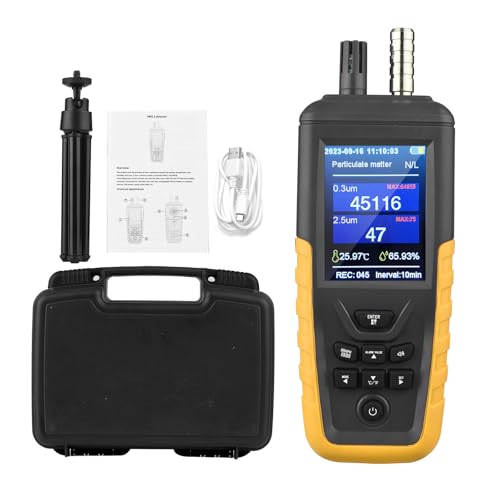
WapoRich Particle Counter Review: The Accuracy Figure Is the Honest Problem
A three channel laser particle counter with 999 record storage, PDF export and a published accuracy of plus or minus 12 micrograms per cubic metre.
Read More→
Sacnahe Air Quality Monitor Review: Seven Readings, No Sensor Named, No Accuracy Given
A WiFi monitor claiming AQI, CO2, PM2.5, PM1.0, PM10, TVOC and HCHO with Tuya app logging, reviewed from a listing that never says how any of it is measured.
Read More→
POWERTEC AD1001 Review: An NDIR Monitor Aimed at the Workshop, With Ranges but No Accuracy
A seven inch multi sensor monitor with an NDIR CO2 sensor, electrochemical formaldehyde, semiconductor TVOC and laser particle sensing, reviewed from the listing.
Read More→