As an Amazon Associate, Akermin earns from qualifying purchases. Product links on this page are affiliate links.
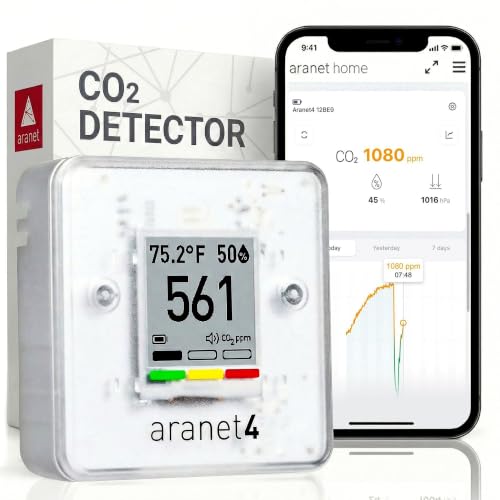
Only one product in this batch is an e-ink CO2 monitor: the SAF Aranet4 Indoor Air Quality Monitor. Its listing states a power-efficient e-ink display and a battery life of up to 4 years, which is the whole reason to choose e-ink over a backlit LCD. The Airthings View Battery is an air quality monitor with a colour display but the listing does not state e-ink, so it is not an e-ink pick. The Inkbird ICC-510, the TEKCOPLUS CO2 Controller and the DANOPLUS CO2 Controller are CO2 controllers for grow rooms, not e-ink monitors, and are excluded from the comparison. If you want an e-ink CO2 monitor, the SAF Aranet4 Indoor Air Quality Monitor is the pick by default in this batch, and the honest answer is that a one-product field is not a ranking.
Why an e-ink screen changes the CO2 monitor you can live with
An e-ink display works by moving charged pigment particles inside tiny capsules. Once the particles have moved, they stay where they are with no power applied. That is why the image persists when the battery is removed, and why the display only draws current during a refresh. A backlit LCD, by contrast, needs a light source running continuously or a backlight pulse every few seconds. The practical consequence is battery life measured in years rather than days.
The listing for the SAF Aranet4 Indoor Air Quality Monitor states a power-efficient e-ink display and an extended battery life of up to 4 years. That is the mechanism, not a marketing claim: the display is the dominant load in a CO2 monitor, so removing it removes most of the drain. The CO2 sensor itself is a small continuous load, and the radio for the app is a larger intermittent one, but neither comes close to a backlight.
The second consequence is legibility. E-ink is reflective, so it gets easier to read as the room gets brighter. A backlit LCD in a sunny room can wash out. For a monitor you glance at across a room, that matters more than most specifications.
What the e-ink listing actually publishes, and what it leaves out
The SAF Aranet4 Indoor Air Quality Monitor publishes four measured quantities: CO2, temperature, relative humidity and atmospheric pressure. It publishes a battery life of up to 4 years and a free app that shows up to 90 days of history. It does not publish a CO2 accuracy figure, a sensor type, a measurement range, or a refresh interval. Those are the numbers a buyer would most want, and they are absent.
That is not a reason to reject the product. It is a reason to know what you are buying. If your question is “is this room ventilated enough right now”, a monitor that trends correctly and holds its calibration is sufficient. If your question is “is this reading traceable to a reference”, you need a published accuracy specification and a calibration route, and this listing does not give you either.
The listing does state colour coding on the display and an optional buzzer. Colour coding is a display convention, not an accuracy claim. The buzzer is the only active alert the listing mentions, and it is optional, which means you have to enable it.
The Airthings View Battery is worth mentioning here because it is the other battery-powered indoor air quality monitor in the batch. Its listing states a colour display but does not state e-ink. It also states that the monitor requires the app to function, that an account is required, and that both the monitor and the app need internet access with data stored in the cloud. Those are real constraints on where it can be used.
The E-Ink CO2 Monitor in This Batch
SAF Aranet4 Indoor Air Quality Monitor
The listing states an e-ink display and up to 4 years of battery life, which is the defining combination for this category.
Where an e-ink CO2 monitor is the wrong instrument
E-ink is slow. A full refresh takes a noticeable fraction of a second, and most e-ink devices refresh on a timer rather than continuously. If you need a reading that updates several times a second, for example while adjusting a gas regulator, e-ink is the wrong display technology. That is a grow-room control task, and it is why the controllers in this batch use backlit LCDs.
E-ink is also poor at catching attention. A flashing red backlight is an alarm; a colour change on a reflective screen is a hint. If the monitor is for a room where nobody is watching, and the point is to be alerted rather than to check, you want a device with an audible or app-based alert, and you should test that alert before you rely on it.
Finally, e-ink monitors are still CO2 monitors. They measure one gas. They do not measure carbon monoxide, they do not measure radon, and they do not measure particles. If your concern is combustion, you need a CO detector; if it is radon, you need a radon monitor. The Airthings View Battery is the only product here that lists radon, and its listing states an electrochemical sensor type for that function.
For a wider view of what a CO2 monitor can and cannot do in a home, see the general CO2 monitor comparison.
The three controllers in this batch are not e-ink monitors
The Inkbird ICC-510, the TEKCOPLUS CO2 Controller and the DANOPLUS CO2 Controller are CO2 controllers for grow rooms and greenhouses. They switch mains-powered equipment on and off. They are not monitors you put on a desk, and none of them states an e-ink display.
The Inkbird ICC-510 is a dual-plug controller with a light sensor that adjusts CO2 output based on light intensity. Its listing does not state a sensor type, a range or an accuracy. The TEKCOPLUS CO2 Controller uses an NDIR sensor with a stated range of 0 to 5000 ppm and a 4.5 metre probe, and its listing calls the measurements “laboratory-grade”, which is a strong claim for a listing that does not publish an accuracy figure. The DANOPLUS CO2 Controller states a dual-beam NDIR sensor with an accuracy of plus or minus 50 ppm and two independently programmed outlets.
These belong in a grow-room controller comparison, not here. If you are trying to decide between a controller and a monitor for a greenhouse, the relevant page is CO2 monitors for greenhouses. If you want a monitor for a room you occupy, the e-ink argument above applies and the controllers are irrelevant.
Placement, drift and the habits that keep the number honest
An NDIR CO2 sensor measures the absorption of infrared light by the gas in a small chamber. Over months, dust and the ageing of the light source shift the zero point. Most consumer monitors handle this with automatic baseline correction, which assumes the sensor sees fresh outdoor air at some point in a defined period. If the monitor never sees fresh air, the correction drifts and the readings become wrong in a way that looks plausible.
The habit that prevents this is simple: put the monitor somewhere it will occasionally see outdoor-equivalent CO2. A sealed bedroom with the door closed for weeks is the worst case. A living room that gets a window opened most days is fine. If you cannot guarantee that, look for a monitor with a manual calibration option, and note that SAF Aranet4 Indoor Air Quality Monitor’s listing does not state one.
Placement matters for the reading itself. CO2 is exhaled, so it is highest near heads and in still air. A monitor on a high shelf in a corner reads lower than one at breathing height in the middle of the room. Neither is wrong; they answer different questions. For a bedroom, breathing height near the pillow is the useful position, which is why battery power and no cable matter more there than anywhere else. See bedroom CO2 monitors for that specific case.
The SAF Aranet4 Indoor Air Quality Monitor’s listing states a free app with up to 90 days of history. That history is what turns a single number into a ventilation decision: you can see whether the overnight peak is 900 ppm or 2500 ppm, and that changes what you do about it.
Recommended Tools
Products shown because their documented specifications fit this guide. Price and availability are on Amazon and can change.
Frequently Asked Questions
Is the SAF Aranet4 Indoor Air Quality Monitor really the only e-ink CO2 monitor here?
Yes. The SAF Aranet4 Indoor Air Quality Monitor's listing states an e-ink display. The Airthings View Battery's listing states a colour display but does not state e-ink, so it cannot be described as one. The Inkbird ICC-510, the TEKCOPLUS CO2 Controller and the DANOPLUS CO2 Controller are grow-room controllers with no stated e-ink display. A one-product field is not a ranking, and this page does not pretend it is.
Does e-ink mean I never have to charge it?
No. The SAF Aranet4 Indoor Air Quality Monitor's listing states a battery life of up to 4 years, which is a long time but not indefinite. The sensor and the radio still draw current. The display is simply not the dominant load, which is why the figure is years rather than days.
Why is the CO2 accuracy not published for the SAF Aranet4 Indoor Air Quality Monitor?
The listing does not publish it. It publishes the measured quantities, the battery life and the app history, but no accuracy figure and no sensor type. If accuracy is your deciding specification, this listing does not give you enough to decide on.
Can I use the Airthings View Battery as an e-ink monitor instead?
Only if the colour display turns out to be e-ink, and the listing does not say so. More importantly, the Airthings View Battery's listing states that the monitor requires the app to function and that both the monitor and the app require internet access. That is a different product proposition from a standalone e-ink monitor.
Should I buy a controller like the TEKCOPLUS CO2 Controller or the DANOPLUS CO2 Controller for a home office?
No. They switch mains equipment. They are designed for CO2 enrichment in plant environments, not for telling you whether to open a window. The TEKCOPLUS CO2 Controller and the DANOPLUS CO2 Controller also have no stated e-ink display, so they do not belong on this page at all.
What does an e-ink CO2 monitor not do?
It does not detect carbon monoxide, radon or particles. It does not replace a smoke or CO alarm. And it does not force ventilation; it only tells you the CO2 level. The decision to open a window is still yours.
Affiliate disclosure: Akermin earns a commission from qualifying Amazon purchases made through links on this page. Our editorial picks are based on documented specifications and owner feedback, not commissions.