Skip to content
AkerminMeasure. Monitor. Improve. Compare Products

Best Hygrometers for Camera and Lens Storage: 7 Picks

Lens fungus grows in the dark at moderate humidity, and the fix is not simply to dry the air as hard as possible. Below about 30 percent relative humidity, lubricants and rubber seals on older lenses begin to suffer. This page compares seven dry cabinets that measure and hold humidity in the band that protects glass without harming the mechanics.

  • Independent Research
  • Verified Specifications
  • Honest Recommendations

Measure It
Compare It
Buy Once

As an Amazon Associate, Akermin earns from qualifying purchases. Product links on this page are affiliate links.

Our Top Picks

This comparison uses only the product data supplied in the listings. Where a listing does not publish a figure, the table and the review say so rather than estimating. Accuracy claims marked as laboratory data are reported as the manufacturer's description. Products that did not belong to the camera and lens storage topic were excluded, and the count in the heading reflects only the cabinets written about here.

Best overall
SLINGER 125L Dry Cabinet

SLINGER 125L Dry Cabinet

Large capacity, programmable 30 to 60 percent RH, and a combination lock.

  • Thermoelectric desiccation cooling technology for humidity control.
  • Adjustable range stated as 30% to 60% RH.
  • Combination lock for security against unauthorized access.
  • LED dual screen shows temperature and humidity.
View on Amazon Read Full Review→
Best for power outages
Xoiasth 26L Electronic Dry Cabinet

Xoiasth 26L Electronic Dry Cabinet

Battery-free mechanical hygrometer keeps reading when the power fails.

  • Built-in electronic polymer dehumidifier reaches target in 3 to 6 hours.
  • Rotary knob sets humidity in the 30% to 60% RH range.
  • Battery-free mechanical hygrometer readable during power outages.
  • 26 litre capacity with clear visible door.
View on Amazon Read Full Review→
Best stated accuracy
TECHTONGDA 100L Dry Cabinet

TECHTONGDA 100L Dry Cabinet

Tempered glass door and a stated plus or minus 5 percent humidity tolerance.

  • Stated humidity control range of 25% to 60% RH.
  • Stated accuracy of plus or minus 5 percent.
  • Tempered glass door with magnetic sealing.
  • 100 litre capacity with five tiers.
View on Amazon Read Full Review→
Best mid-size analog
Xoiasth 74L Electronic Dry Cabinet

Xoiasth 74L Electronic Dry Cabinet

The 26 litre design scaled up to 74 litres, with the same battery-free gauge.

  • Polymer dehumidifier reaches target in 3 to 6 hours.
  • Rotary knob sets humidity in the 30% to 60% RH range.
  • Battery-free mechanical hygrometer readable during power outages.
  • 74 litre capacity with adjustable shelves.
View on Amazon Read Full Review→
Compact digital
AUTENS 30L Dry Cabinet

AUTENS 30L Dry Cabinet

Small digital cabinet with a stated 25 to 60 percent RH range.

  • Thermoelectric cooling design with microprocessor control.
  • Stated humidity range of 25% to 60% RH.
  • Stated accuracy of plus or minus 1 percent RH from laboratory data.
  • Stated power consumption of 8 watts.
View on Amazon Read Full Review→
Best value large
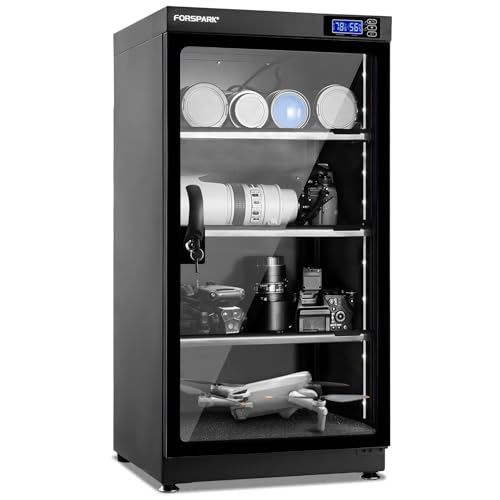
FORSPARK 100L Dry Cabinet

FORSPARK 100L Dry Cabinet

100 litres, 4-zone layout, and a stated 25 to 60 percent RH range.

  • Stated 25% to 60% RH range with auto-activation at 3% above preset.
  • Stated 10,000 plus hours of protection without maintenance.
  • Cold-rolled steel frame and 4mm tempered glass with magnetic sealing.
  • 3 adjustable shelves create 4 zones.
View on Amazon Read Full Review→
Widest stated range
Zuomeng 30L Dry Cabinet

Zuomeng 30L Dry Cabinet

Adjustable 25 to 70 percent RH, the widest range here.

  • Microprocessor monitors humidity in real time.
  • Stated accuracy of plus or minus 1 percent RH.
  • Adjustable range of 25% to 70% RH.
  • Silent and vibration-free operation.
View on Amazon Read Full Review→

Comparison Table

View Full Comparison→
PickCapacityStated RH rangeStated accuracyDisplayLock
125 L30% to 60%Not statedLED dual screenCombination lockView
26 L30% to 60%Not statedAnalog mechanicalNot statedView
100 L25% to 60%Plus or minus 5%LEDNot statedView
74 L30% to 60%Not statedAnalog mechanicalNot statedView
30 L25% to 60%Plus or minus 1% (laboratory data)LED dual screenNot statedView
100 L25% to 60%Not statedLED stripNot statedView
30 L25% to 70%Plus or minus 1%LEDNot statedView

Cells show only what each listing publishes. Where a listing is silent, the cell says Not stated. Accuracy figures marked as laboratory data are the manufacturer's description, not an independent measurement.

How to choose a dry cabinet for camera storage

The cabinet is the instrument. The hygrometer inside it is what you actually rely on, so the questions below are about control band, capacity, and what happens when the power fails.

Set the band, not the minimum

Aim for 35 to 45 percent RH. Below 30 percent, lubricants and rubber seals on older lenses can dry and crack. Above 60 percent, fungus spores that are already on the glass can grow.

Match capacity to your kit

A 26 to 30 litre cabinet holds a body and two or three lenses. A 74 to 100 litre cabinet holds a full working kit. Air must be able to move between items, so do not pack shelves tight.

Read the accuracy claim carefully

A stated plus or minus 1 percent is tighter than plus or minus 5 percent, but check whether the listing says the figure is from laboratory data. Field accuracy in a humid room is usually worse.

Check whether it can humidify

Most dry cabinets can only remove moisture. If your room is already below your target, the cabinet cannot raise the humidity. One listing here states this limitation plainly.

Know what the lock does

A combination lock prevents casual access. It is not a safe and will not stop a determined thief. If security matters, treat the lock as a convenience, not a guarantee.

Plan for power cuts

A mechanical, battery-free hygrometer keeps reading when the power fails. A digital display goes dark. If your area has unreliable power, that difference matters for long-term storage.

Frequently Asked Questions

View All FAQs→
What humidity should I store camera lenses at?

The usual recommendation is 35 to 45 percent relative humidity. Below 30 percent, lubricants and rubber seals can dry out over time. Above 60 percent, fungus can grow on the glass and coatings. The cabinets here mostly offer a 25 to 60 percent range, so the safe band sits comfortably inside what they can hold.

Will a dry cabinet stop fungus that is already on a lens?

No. A dry cabinet prevents new growth by keeping humidity below the level fungus needs. Existing fungus is a physical growth on the glass and coatings, and it needs professional cleaning. Lowering humidity can slow it, but it will not remove it.

Can I use a standalone hygrometer instead of a dry cabinet?

A standalone hygrometer measures the air but does nothing about it. If your room is already dry enough, a hygrometer tells you so and you may not need a cabinet. If the room is humid, you need a dehumidifying cabinet or a sealed box with desiccant. The products on this page are cabinets with built-in hygrometers.

Is a plus or minus 1 percent accuracy claim realistic?

It is possible for a good sensor under laboratory conditions. In a cabinet that is opened regularly, in a humid room, the real accuracy is usually worse. Treat a stated plus or minus 1 percent as an indication of sensor quality, not a guarantee of what the display shows. A plus or minus 5 percent claim is more conservative and often more honest.

Reviews

SLINGER 125L Dry Cabinet

SLINGER 125L Dry Cabinet Best overall

The SLINGER 125L works by thermoelectric cooling. A cold plate inside the cabinet condenses moisture out of the air, and the controller cycles the plate to hold the relative humidity at whatever you program. The listing states the adjustable range as 30% to 60% RH, which is the useful band for camera storage: high enough to avoid drying out lubricants and seals, low enough to stop fungus. The 125 litre capacity and five layers mean you can store several bodies and a row of lenses without stacking them against each other, and air can move between shelves.

The combination lock is a genuine differentiator if the cabinet sits in a shared studio or a home with children. It is not a safe, and it will not stop a determined thief, but it prevents casual access. The listing describes the unit as noiseless and energy saving; thermoelectric dehumidifiers are quiet because they have no compressor, but they do run continuously in humid conditions, and the listing does not publish a power figure.

What the listing does not publish is the accuracy of the humidity sensor. It gives a control range but no tolerance, so you cannot tell from the listing whether the display is within one percent or five percent of the true value. For fungus prevention that is usually acceptable, because the target band is wide. If you need to certify a storage environment, look for a cabinet that states an accuracy figure, or add a separate calibrated hygrometer inside.

Strengths

  • 125 litre capacity with five layers suits a large kit.
  • Stated 30% to 60% RH range covers the safe storage band.
  • Combination lock adds physical security.
  • Thermoelectric design has no compressor noise.

Limitations

  • Sensor accuracy is not stated in the listing bullets.
  • Power consumption is not published.
  • Large footprint for a small collection.
  • No stated time to reach target humidity.
View on Amazon
Xoiasth 26L Electronic Dry Cabinet

Xoiasth 26L Electronic Dry Cabinet Best for power outages

The Xoiasth 26L uses a polymer dehumidifier rather than a cold plate. A polymer element absorbs moisture from the air and is regenerated by a small heater, which is why the listing can state a 3 to 6 hour time to target. That is faster than many thermoelectric cabinets, and it matters if you have just brought a wet lens in from the rain and want it stabilised before fungus has a chance to start.

The unusual feature is the analog hygrometer. It is mechanical and battery-free, so it keeps showing the internal humidity even when the cabinet is unplugged. That is useful in two situations: a power cut, when you want to know whether the box is still dry, and a long-term storage arrangement where the cabinet is powered intermittently. The rotary knob is simpler than a digital controller, and the listing states the range as 30% to 60% RH.

The trade-off is capacity. 26 litres holds a body and two or three lenses, not a working photographer's full kit. The listing does not publish the accuracy of the analog hygrometer, and mechanical gauges of this type are typically less precise than a good digital sensor, though they are stable. The listing also does not state a power figure. If your collection outgrows 26 litres, the same design is offered in larger sizes as P4.

Strengths

  • Mechanical hygrometer works without power.
  • Stated 3 to 6 hour time to target humidity.
  • Simple rotary control, no menus.
  • Clear door lets you inspect contents without opening.

Limitations

  • 26 litre capacity is small for a full kit.
  • Analog hygrometer accuracy is not stated.
  • No digital display or logging.
  • Power consumption not published.
View on Amazon
TECHTONGDA 100L Dry Cabinet

TECHTONGDA 100L Dry Cabinet Best stated accuracy

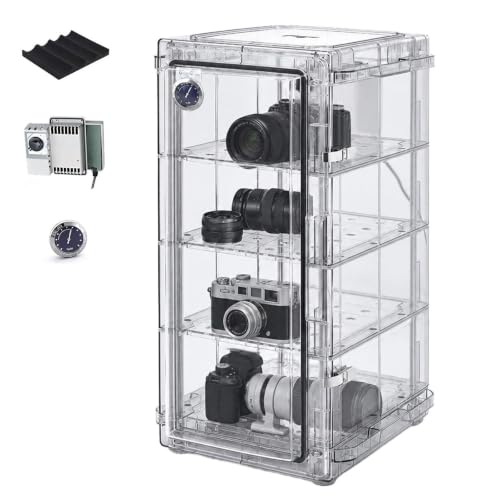
The TECHTONGDA 100L is one of the few listings here that publishes an accuracy figure: plus or minus 5 percent RH. That is a wide tolerance, and it tells you something important. A cabinet set to 40 percent might actually be anywhere from 35 to 45 percent. For fungus prevention that is fine, because the safe band is broad, but it means you should not treat the display as a precision instrument. The listing also states the control range as 25% to 60% RH, and notes plainly that the cabinet can only dehumidify, not humidify. If your room is already drier than your target, this cabinet cannot raise the humidity.

The door is tempered glass with magnetic sealing, and the listing emphasises dust and moisture exclusion. The shelves are described as thickened and load-bearing. The LED display can be dimmed or switched off, which is a small but real consideration if the cabinet lives in a bedroom.

Where this cabinet stands out is transparency. It tells you the tolerance, the range, and the limitation. Where it falls short is the same place as most of the others: no published time to reach target, no power figure, and no detail on how the sensor is calibrated or whether it can be recalibrated. The 100 litre capacity and five tiers suit a serious amateur or a small professional kit.

Strengths

  • Stated plus or minus 5 percent accuracy, rare in this class.
  • 100 litre capacity with five tiers.
  • Tempered glass door with magnetic seal.
  • Dimmable LED display.

Limitations

  • Cannot humidify, only dehumidify.
  • Plus or minus 5 percent is a wide tolerance.
  • No stated time to reach target.
  • Power consumption not published.
View on Amazon
Xoiasth 74L Electronic Dry Cabinet

Xoiasth 74L Electronic Dry Cabinet Best mid-size analog

This is the same Xoiasth design as P2, scaled to 74 litres. The mechanism is identical: a polymer dehumidifier that absorbs moisture and regenerates itself, a rotary knob for setting the target between 30% and 60% RH, and a mechanical hygrometer that needs no battery. The listing states the same 3 to 6 hour time to target.

If you are choosing between P2 and P4, the decision is purely capacity. The 74 litre box holds several bodies and a full set of lenses, and the adjustable shelves let you space them for airflow. The 26 litre box is for a small kit. The listing mentions that the design is available in 26, 42, 58, and 74 litres, so the range is a family rather than a single product.

The same caveats apply as to P2. The analog hygrometer accuracy is not stated, and mechanical gauges can drift over time, though they are usually stable enough for this purpose. The listing does not publish a power figure or a calibration procedure. What it does offer is a simple, quiet cabinet with a gauge that keeps working when the power does not.

Strengths

  • 74 litre capacity suits a full kit.
  • Mechanical hygrometer works without power.
  • Stated 3 to 6 hour time to target.
  • Adjustable shelves for different lens sizes.

Limitations

  • Analog hygrometer accuracy not stated.
  • No digital display or logging.
  • Power consumption not published.
  • No stated calibration method.
View on Amazon
AUTENS 30L Dry Cabinet

AUTENS 30L Dry Cabinet Compact digital

The AUTENS 30L is a compact digital cabinet. The listing states a control range of 25% to 60% RH and an accuracy of plus or minus 1 percent RH, with the qualifier that this figure comes from laboratory data. That qualifier matters. A laboratory accuracy figure describes the sensor under ideal conditions, not the cabinet in a humid room with the door being opened. Treat the plus or minus 1 percent as an indication of sensor quality rather than a guarantee of what you will see on the display. Even so, it is a tighter claim than the plus or minus 5 percent of P3.

The listing also states a power consumption of 8 watts, which is low enough to run continuously without concern. The mechanism is thermoelectric cooling, the same cold plate approach as P1, and the microprocessor switches the dehumidifier on when humidity exceeds the set point and off when it falls below.

The 30 litre capacity is small. It holds a body and a couple of lenses, or a single long lens. The listing does not state a time to reach target humidity, and it does not describe how the sensor is calibrated or whether it can be adjusted. For a small kit in a humid climate, it is a sensible entry point.

Strengths

  • Stated 8 watt power consumption.
  • Stated 25% to 60% RH range.
  • Tighter stated accuracy than most in this class.
  • Compact footprint.

Limitations

  • 30 litre capacity is small.
  • Accuracy figure is from laboratory data, not field conditions.
  • No stated time to reach target.
  • No calibration details.
View on Amazon
FORSPARK 100L Dry Cabinet

FORSPARK 100L Dry Cabinet Best value large

The FORSPARK 100L is aimed at a large collection. The listing states a 25% to 60% RH range and says the dehumidifier activates when humidity exceeds the preset by 3 percent. That 3 percent deadband is a useful detail: it means the cabinet does not cycle constantly, which reduces wear and power use. The listing also claims 10,000 plus hours of protection without maintenance, a durability claim rather than a measurement, and one you should treat as marketing until the sensor or the dehumidifier actually fails.

The construction is described as a cold-rolled steel frame with 4mm tempered glass and magnetic sealing, and the listing claims up to 90 percent moisture blockage. That figure describes the cabinet's resistance to outside humidity, not its internal control accuracy. The 4-zone layout with three adjustable shelves is practical for separating bodies, long lenses, and accessories so air can circulate.

What the listing does not publish is the accuracy of the humidity sensor or the power consumption. It gives a range and a deadband but no tolerance. For most users that is enough, because the safe band is wide. If you need a certified figure, this is not the cabinet for that.

Strengths

  • 100 litre capacity with 4-zone layout.
  • Stated 25% to 60% RH range.
  • Auto-activation at 3% above preset reduces cycling.
  • Steel frame and tempered glass.

Limitations

  • Sensor accuracy not stated.
  • Power consumption not published.
  • 10,000 hour claim is not a measured figure.
  • 90 percent moisture blockage refers to the cabinet shell, not control accuracy.
View on Amazon
Zuomeng 30L Dry Cabinet

Zuomeng 30L Dry Cabinet Widest stated range

The Zuomeng 30L is unusual in offering a stated range that goes up to 70% RH. Most cabinets here top out at 60 percent. The extra headroom matters if you store something that prefers a slightly more humid environment, or if you want to run the cabinet at the upper end of the safe band to protect lubricants in older lenses. The listing states an accuracy of plus or minus 1 percent RH, though as with P5 it does not say whether that is a laboratory figure or a field figure.

The control logic is described as automatic: the system starts when humidity rises above the set level and stops when the target range is reached. That is standard for this class. The listing describes the unit as silent and vibration-free, which is a genuine advantage of the thermoelectric approach, and it mentions use in bedrooms, offices, and studios.

The capacity is 30 litres, so this is a small cabinet. The listing does not publish a time to reach target, a power figure, or a calibration procedure. The plus or minus 1 percent accuracy claim is tighter than most, and if it holds in practice it makes this a good choice for a small kit where you want closer control.

Strengths

  • Widest stated range here, 25% to 70% RH.
  • Stated plus or minus 1 percent accuracy.
  • Silent and vibration-free.
  • Automatic start and stop control.

Limitations

  • 30 litre capacity is small.
  • Accuracy figure may be from laboratory conditions.
  • No stated time to reach target.
  • Power consumption not published.
View on Amazon

Buying Guide

Short answer: For most home camera collections, the best balance of capacity and control is P1, a 125 litre cabinet with a stated adjustable range of 30 to 60 percent RH and a combination lock. If you want the simplest possible device with a battery-free mechanical gauge that keeps reading during a power cut, P2 is the smart pick, though its 26 litre capacity suits a small kit only. P8 is the value pick for a large collection on a budget, with a 25 to 60 percent RH range and a stated 4-zone layout. All three are dry cabinets, not standalone hygrometers: the sensor is inside the box and controls the dehumidifier. None of them will tell you the humidity in your camera bag.

What the hygrometer inside a dry cabinet actually measures

A dry cabinet is a sealed box with a dehumidifier and a humidity sensor. The sensor is the part you rely on, because it decides when the dehumidifier runs. Most cabinets here use a thermoelectric cold plate: a small plate is cooled, moisture condenses on it, and the water drains away. Others use a polymer element that absorbs moisture and is regenerated by a heater. Both approaches work, and both are quiet because neither uses a compressor.

The sensor is usually a capacitive polymer film that changes its electrical properties as it absorbs water vapour. That type is stable and cheap, which is why it dominates this market. The weakness is that it drifts over time, and most listings do not say whether the sensor can be recalibrated. If you are storing a valuable lens collection, it is worth putting a separate calibrated hygrometer inside the cabinet once a year to check the built-in display. If you want to understand how standalone instruments compare, see our guide to digital hygrometers.

The band that is too dry for seals

The instinct when you see fungus on a lens is to dry the air as hard as possible. That is a mistake. Lens lubricants and rubber seals contain compounds that need a little moisture to stay flexible. Run a cabinet at 20 percent RH for a year and older lenses can develop stiff focus rings and shrunken seals. The safe band is usually given as 35 to 45 percent RH, and the cabinets here mostly offer a range of 25 to 60 percent, which brackets that band comfortably.

The practical rule is to set the cabinet in the middle of its range, not at the bottom. If your cabinet has a stated range of 30 to 60 percent, set it to 40 or 45. If it has a stated range of 25 to 60 percent, set it to 40. The extra margin protects the mechanics. The exception is a lens that has visible fungus; there, a short period at the lower end of the range can slow the growth while you arrange a professional clean, but do not leave it there indefinitely.

The common mistake: trusting the display without checking it

The most common mistake is to set the cabinet, read the display, and never question it. A display that says 40 percent is only as good as the sensor behind it. A cabinet with a stated accuracy of plus or minus 5 percent could be at 35 or 45 percent and still be within specification. That is usually fine, because the safe band is wide, but it means you should not use the display to make fine judgements.

The second mistake is opening the cabinet constantly. Every time you open the door, humid room air enters and the dehumidifier has to work again. If you want to inspect your gear, look through the glass door. If you must open it, close it promptly. A cabinet with a clear door and a layout that lets you see what you need without moving everything is easier to live with. Our guide to humidity data loggers for museums explains how institutions monitor this over time.

Maintenance nobody mentions

Thermoelectric cabinets produce water. It condenses on the cold plate and drains to a small reservoir or evaporates away. If the drain is blocked, water can pool inside the cabinet, which is the opposite of what you want. Check the drain or reservoir every few months, especially in a humid climate where the cabinet runs constantly.

The sensor also needs attention. Capacitive sensors drift, and most listings here do not describe a calibration procedure. A practical approach is to buy a small calibrated reference hygrometer and compare it with the cabinet display once or twice a year. If the two disagree by more than a few percent, adjust your target setting to compensate. The door seal is the other wear item. A magnetic seal that no longer closes firmly lets humid air in, and the cabinet runs more often. Wipe the seal and the mating surface occasionally. For a broader look at monitoring instruments, see our page on environmental monitoring devices.

Where a dry cabinet stops being the right answer

A dry cabinet is the right answer when you have a collection of lenses that lives in a humid room and you want them protected without thinking about it. It stops being the right answer in three situations.

First, if your room is already dry. In a heated home in a cold climate, indoor humidity can sit at 30 to 40 percent for much of the year. In that case a sealed box with a sachet of desiccant may be enough, and a cabinet is an unnecessary expense. A standalone hygrometer will tell you which situation you are in.

Second, if you need to know the humidity in a camera bag or a location case. A dry cabinet measures only its own interior. For that you need a portable data logger, and our guide to temperature and humidity data loggers covers the type of instrument that travels with the gear.

Third, if you need certified environmental records. A dry cabinet is a storage device, not a monitoring instrument. It will protect your lenses, but it will not produce a calibration certificate or a traceable log. If that is the requirement, you need a separate calibrated hygrometer and a logging system, and the cabinet becomes just the box.

How We Research

This comparison uses only the product data supplied in the listings. Where a listing does not publish a figure, the table and the review say so rather than estimating. Accuracy claims marked as laboratory data are reported as the manufacturer's description. Products that did not belong to the camera and lens storage topic were excluded, and the count in the heading reflects only the cabinets written about here. No laboratory testing was performed, and no measurements of our own are published.

Read our full review methodology→