Best Humidity Data Loggers for Museums and Archives: 6 Picks for Collection Care
Collection care is not about hitting a number today. It is about proving a stable environment over months and catching the excursion that happened at two in the morning on a bank holiday.
Independent Research
Verified Specifications
Honest Recommendations
Watch the Room
Hold the Record
Protect the Collection
As an Amazon Associate, Akermin earns from qualifying purchases. Product links on this page are affiliate links.
Our Top Picks
Loggers were compared on stated measurement ranges and accuracy, whether the humidity sensor is user replaceable, whether a calibration certificate is supplied, memory depth and logging intervals, battery life, and the formats in which data leaves the device. We did not run laboratory tests and publish no measurements of our own.
Best Overall
HOBO USB Temperature and Humidity Logger
A user replaceable humidity sensor and intervals from one second to eighteen hours.
User replaceable relative humidity sensor, per the listing
Only one listing states a user replaceable humidity sensor and only one states a supplied calibration certificate. For collection work those two specifications matter more than any headline accuracy figure.
How to Choose a Collection Logger
Conservation monitoring is judged on the record, not on the reading, and that changes which specifications count.
A Certificate Turns Data Into Evidence
For loans, insurance and accreditation the question is whether the instrument was demonstrably correct. A supplied calibration certificate answers it for the period it covers.
Replaceable Sensors Change the Economics
Humidity sensors drift and eventually fail verification. On a sealed logger that means a new logger. On a repairable one it means a new element.
Dew Point Predicts Damage
Relative humidity moves with temperature even when moisture does not. Dew point is absolute, and any surface colder than it will collect water.
Plan the Interval Around the Deployment
Memory divided by duration gives the interval. Fifteen minutes catches a plant failure and misses a door propped open for ten. Work it out before you start, not after.
Probes Let You Monitor Without Opening
A sealed case should stay sealed. A probe on a lead reports from inside while the logger body stays accessible.
Check the Battery Covers the Period
Memory and battery are separate limits. A logger with a year of memory and six months of battery gives you six months of data.
Target ranges depend on the material, the building and the standards your institution follows, and current conservation thinking has moved toward stability and acceptable ranges rather than a single universal setpoint. Use the guidance that applies to your collection and treat the logger as the tool that demonstrates whatever you have chosen.
Why does a calibration certificate matter?
Because the value of collection monitoring lies in the record, and a record is only as good as the instrument that produced it. For loan agreements, insurance and accreditation, being able to show that the logger was calibrated is the difference between data and an assertion.
How often should loggers be verified?
Manufacturers state calibration intervals and institutions usually set their own policy. A practical minimum is a salt test check at least annually, described in our calibration guide, with formal recalibration on the schedule your policy requires.
Should I measure inside the case or in the room?
Both, and the difference between them is the most informative measurement you can take. A well sealed case buffers the room considerably, and knowing by how much tells you whether case conditions depend on the gallery plant or on the case itself.
What logging interval should I use?
Divide the memory by the deployment length and choose an interval that fits, then check the battery covers the same period. Fifteen minutes is a common compromise for building monitoring. Faster intervals are for characterising specific events such as a gallery opening.
Is dew point better than relative humidity?
It is more informative for diagnosis, because it does not move when only the temperature moves. Relative humidity is what most conservation guidance is written in, so record both. A stable dew point with a swinging relative humidity means the temperature is the thing changing.
Reviews
HOBO USB Temperature and Humidity Logger Best Overall
A user replaceable humidity sensor is the specification that separates a conservation instrument from a consumer one. Capacitive relative humidity sensors drift with age and drift faster in the conditions collections are kept in, and on a sealed logger that means the whole device becomes scrap. Being able to fit a new sensor element turns a five year purchase into a fifteen year one, and it means a logger that fails verification can be repaired rather than replaced.
The interval range from one second to eighteen hours is unusually wide and covers both ends of collection work. At eighteen hours you can leave a logger in a remote store for a very long deployment on one battery. At one second you can characterise what happens to a case when a gallery door opens and a crowd arrives. Most loggers offer one of those, not both.
Strengths
Humidity sensor can be replaced rather than binning the logger
Interval range from one second to eighteen hours
One year stated battery life
On-device readout as well as USB download
Limitations
No calibration certificate stated in the bullets
IP50 means dust protected but not splash resistant
A calibration certificate is what turns a reading into evidence. For a loan agreement, an insurance claim or an accreditation visit, the question is never what the logger displayed, it is whether the logger was demonstrably measuring correctly. A certificate supplied with the unit answers that for the period it covers.
The shadow data function is the cleverer feature and it solves a real problem. Loggers are started and stopped by people, and the moments either side of that, sitting on a loading dock before someone presses start, waiting in a van after someone pressed stop, are exactly when conditions go wrong. Capturing data before and after the formal recording period closes a gap that most loggers leave open. With 64,000 points and a wide range, this suits both a transit case and a long store deployment.
The detail that matters most in this listing is the last one: internal storage that keeps recording when the network is unavailable. Connected loggers that rely entirely on a live link lose data during exactly the events worth knowing about, because a power cut or a network fault often coincides with a plant failure. A logger that buffers locally and uploads later never has a hole in the record.
External sensor probes are the other conservation-relevant feature. A probe on a lead can go inside a sealed display case, behind a painting or into a plan chest while the logger body stays accessible outside, which means a case can be monitored without opening it every time you want the data. Cloud upload at a set interval turns that into something a collections manager can watch across a whole building from a desk.
Strengths
Local buffering means no gap when the network drops
External probes reach inside cases and enclosures
Published accuracy for both parameters
Cloud storage for building-wide oversight
Limitations
Cloud service dependency for the connected workflow
Dew point is the measurement that actually predicts damage in a historic building, and very few loggers report it directly. Relative humidity moves whenever the temperature moves even if the moisture in the air is unchanged, which makes it a poor way to understand a gallery that warms during opening hours. Dew point is an absolute measure, so a stable dew point with a swinging relative humidity tells you the room is fine and the thermostat is busy.
It also identifies condensation risk directly: any surface colder than the dew point will collect water, which is how mould starts on the back of a painting against an external wall. The selectable memory behaviour is a practical detail for unattended deployments. Rollover keeps the most recent data when nobody collects it in time; stop on full guarantees the beginning of the period is preserved. Which you want depends on whether you are monitoring continuously or documenting a defined episode.
Strengths
Dew point reported alongside temperature and humidity
Gain Express USB Logger with Pressure Best Report Output
Barometric pressure alongside temperature and humidity is unusual and genuinely useful for buildings. Pressure changes drive air movement through a leaky historic structure, and a pressure record alongside a humidity record often explains an excursion that otherwise looks inexplicable.
The report output is the other strength. A PDF with graphics generated by the device itself, with no software to install, is exactly what you need when the person receiving the data works somewhere else on a locked-down computer. That matters for loans, where a borrowing institution has to be able to open your record without a negotiation with their IT department. An IP65 rating also makes it usable in a damp store or an outbuilding where an unrated logger would not survive.
Two probes on long leads solves a specific and common conservation problem: you want to know the difference between two places rather than the value in one. Inside a case against the room outside it. The top of a store against the floor. Behind a painting against the gallery air. A single logger recording both removes the question of whether two separate instruments are reading the same way.
Four report formats with no software is the other practical touch. A collections record often has to go into a spreadsheet for analysis and into a PDF for the file, and a device that produces both without an installation makes that painless. The trade for the price is that no accuracy figure is published, so verify it against a reference before trusting small differences between the two probes.
Short answer: the HOBO USB logger is the best long-term buy because its humidity sensor can be replaced instead of the whole instrument; the Elitech RC-4HPro is the one for loans and audits because it ships with a calibration certificate and captures shadow data either side of the log; and the TandD TR72A2-S is the choice for live oversight because it buffers locally when the network drops.
The record is the product
In most measurement work the reading is what you want. In collection care the reading is almost incidental, because nobody makes a decision about a store room based on what the display says at three in the afternoon. What matters is the record: a continuous, trustworthy account of what the environment did over weeks and months, which can be shown to a lender, an insurer, an auditor or a conservator. Everything about choosing a logger follows from that, and it is why a calibration certificate and a replaceable sensor outrank a tighter accuracy figure.
Humidity sensors do not last forever
Capacitive relative humidity sensors drift as they age, and they drift faster when held at the extremes. A logger that has been sitting in a damp basement store for four years is very unlikely to be reading what it read when it was new, and nothing on the display tells you that. This is the argument for the HOBO design: if the sensing element can be replaced, a logger that fails verification is repaired rather than discarded, and a capital purchase keeps working for a decade or more. On a sealed unit, drift is terminal.
Dew point is the measurement that predicts mould
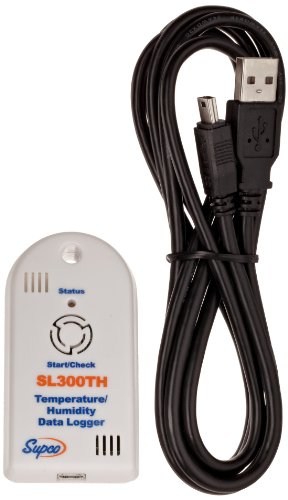
Relative humidity is a ratio, and it changes whenever the temperature changes even if the amount of water in the air is identical. That makes it awkward for diagnosing a gallery that warms up during opening hours and cools overnight. Dew point is absolute: it is the temperature at which the air’s moisture will condense. Compare it with the surface temperature of an exterior wall, the back of a frame or a cold window reveal, and you can predict exactly where water will form before it does. The Supco unit is the only logger here that reports it directly.
Measure the case and the room together
A sealed display case is a buffer, and a good one flattens the room’s daily swing substantially. That is the whole point of it, and it also means a single logger cannot tell you whether your conditions are the product of the building services or of the case construction. Put a probe inside and a logger outside, and the relationship between the two answers the question. Loggers with external probes on leads, the TandD and the Tzone here, make that possible without opening the case every time you want the data.
Plan the interval before the deployment, not after
The commonest way a monitoring exercise is wasted is an interval chosen carelessly. Divide the memory by the number of days you intend to leave it, and pick an interval that fits, then confirm the battery covers the same period, because memory and battery are separate limits. Too slow and a door propped open for ten minutes disappears between samples. Too fast and the memory fills in the first week of a three month deployment, leaving a beautifully detailed record of nothing important. Our page on choosing a temperature and humidity data logger works through the arithmetic.
How We Research
Loggers were compared on published measurement ranges and accuracy, whether the humidity sensor is user replaceable, whether a calibration certificate is supplied, memory depth and available logging intervals, battery life, ingress protection, external probe support and the formats in which reports are produced. We did not run laboratory tests and publish no measurements of our own. No figure appears on this page unless the manufacturer published it.
Five WiFi and LoRa freezer alarms compared on stated probe accuracy, how many alert channels they use, whether they warn you when the hub itself goes offline, and how they handle defrost cycles.
Six loggers split between single-use shipment recorders and reusable units, compared on stated accuracy at cold temperatures, memory depth, calibration certificates and how the report is retrieved.
Two different measurements that plant owners often confuse, and six instruments that cover them: air hygrometers for the room and soil probes for the pot.