As an Amazon Associate, Akermin earns from qualifying purchases. Product links on this page are affiliate links.
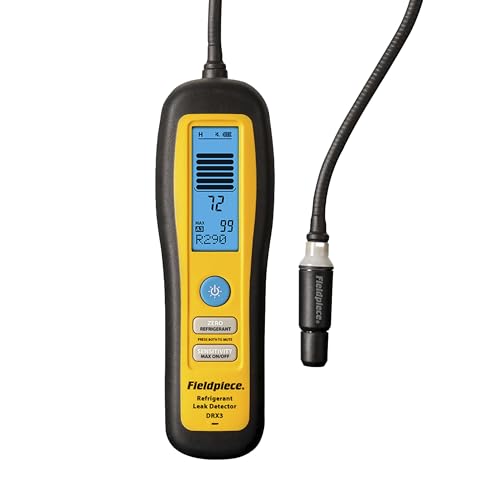
For mini-split service, the Fieldpiece DRX3 (Fieldpiece DRX3) is the pick that covers the widest range of work, because it detects A3, A2L and A1 refrigerants as well as combustible gases, and it uses a heated diode sensor that is field-replaceable. The Fieldpiece DR82 (Fieldpiece DR82) is the pick when the leak is small enough that a heated diode may miss it, since the listing claims infrared detection of leaks below 0.03 oz per year. The Robinair LD9-TGKIT (Robinair LD9-TGKIT) is the pick for a system that is already empty or for a leak that has resisted other methods, because it uses a 5 percent hydrogen in nitrogen tracer gas and a detector built for that mixture. The Primyteion Gas Leak and the zangang Natural Gas are combustible gas sniffers. They detect methane, propane and similar fuels, not CFC, HCFC, HFC or HFO refrigerants, so they cannot find a mini-split leak and are excluded from the comparison.
Why mini-split leaks are a different detection problem
A mini-split system holds a small charge relative to its cooling capacity, and the joints are mostly flare fittings at the indoor unit, brazed joints in the line set, and the service ports. A leak of a few ounces per year can take a system from cooling normally to frosting the evaporator over the course of a season. The detector has to work in a room with a running fan, which moves air across the sensor and dilutes the refrigerant plume, and it has to reach into a plastic housing that may be only a few inches deep.
That combination, small leak, moving air, tight space, is why sensor type matters more here than in almost any other refrigerant job. A heated diode responds to halogenated gases by breaking them apart on a hot ceramic element and measuring the change in ion flow. It is fast and it is sensitive, but it can be poisoned by the oils and moisture found in a system that has been open, and its response drifts as the element ages. An infrared sensor shines light through a chamber and measures absorption at a wavelength the refrigerant absorbs. It is less prone to contamination and it holds calibration longer, which is why the DR82 listing can claim a ten-year sensor life. A hydrogen tracer gas detector is a different principle again: it senses hydrogen, which is a small molecule that escapes through a leak faster than refrigerant does, so a system that is empty can still be pressurized with tracer gas and checked.
None of these three methods is universally better. The choice depends on whether the system still holds charge, how small the leak is, and whether you are willing to introduce a gas that is not the system refrigerant.
What each listing actually publishes about sensitivity and sensor
The table below uses only figures that appear in the supplied listing bullets. Where a listing does not state a figure, the cell says so.
| Pick | Sensor type stated | Refrigerants stated | Sensitivity stated | Sensor life stated | Other stated features |
|---|---|---|---|---|---|
| Fieldpiece DRX3 | Heated diode, field-replaceable | A3, A2L, A1; HC, HFC, HCFC, CFC, HFO, H2/N2 tracer gas, blends | Not stated in the listing bullets | Not stated in the listing bullets | Auto and manual zero; high, medium, low sensitivity; audio and visual feedback |
| Fieldpiece DR82 | Infrared | CFC, HCFC, HFC, HFO, blends | Below 0.03 oz/yr, described as 20 times more sensitive than bubbles | 10 years | IP54; backlit LCD showing size and intensity; LED tip and beep |
| Robinair LD9-TGKIT | Hydrogen gas sensor for 5% H2 / 95% N2 tracer gas | Not stated for refrigerants; designed for tracer gas | Not stated in the listing bullets | Not stated in the listing bullets | Mechanical pump; automatic calibration to ambient air; full colour LCD; UV lights at 395 to 415 nm; inspection light; audio mute |
Two things stand out. First, only the Fieldpiece DR82 publishes a sensitivity figure, and it is expressed in ounces per year, which is a leak rate, not a concentration. That is the correct unit for refrigerant work, but it is a claim about the smallest leak the instrument can find under ideal conditions, not a guarantee in a room with air movement. Second, the Fieldpiece DRX3 and the Robinair LD9-TGKIT publish no sensitivity figure at all. That does not make them worse, but it means you cannot compare them numerically against the Fieldpiece DR82. The heated diode in the Fieldpiece DRX3 is generally capable of finding leaks in the range that matters for mini-splits, and the tracer gas method in the Robinair LD9-TGKIT is usually reserved for leaks that have already defeated refrigerant detection, but neither of those statements comes from a published number.
The two listings that do not belong on a mini-split page
The Primyteion Gas Leak and the zangang Natural Gas are combustible gas detectors. The Primyteion Gas Leak is described as detecting methane, propane, natural gas, butane, alcohol, ammonia, benzene, ethanol, hexane, hydrogen and gasoline, with a stated range of 50 ppm to 1,000 ppm and a response time under two seconds. The zangang Natural Gas is described as detecting liquefied petroleum gas, methane, ethane, propane, butane, natural gas, coal gas and similar fuels, with a three-second response and an audible and visual alarm.
Neither listing mentions any refrigerant, and neither sensor type, a semiconductor or catalytic element in a pen format, responds reliably to the halogenated gases used in mini-splits. A combustible gas sniffer is calibrated for the lower explosive limit of fuels, not for the parts-per-million concentrations at which refrigerant leaks are found. Putting one on a refrigerant line will produce nothing useful. Worse, if a technician carries one to a job and it does not alarm, that tells them nothing about whether the system is leaking.
There is also a safety point. A combustible gas detector is not a refrigerant detector, and a refrigerant detector is not a combustible gas detector. If you work on both gas appliances and mini-splits, you need two instruments, or one instrument that explicitly covers both, which is the case for the Fieldpiece DRX3. The DRX3 listing states that it detects combustible gases as well as refrigerants, so it is the only pick here that crosses that line. For gas-only work, the combustible gas detector page is the right place to look.
Three detectors that suit mini-split refrigerant work
Fieldpiece DRX3
Heated diode sensor, field-replaceable, and it covers A3, A2L and A1 refrigerants plus combustible gases, which makes it the one instrument that follows the trade from R-410A systems to the newer mildly flammable blends.
Fieldpiece DR82
Infrared sensor with a listing claim of finding leaks below 0.03 oz per year, IP54 rated against moisture and oil, and a ten-year sensor life, which suits the small, slow leaks that are common on mini-split flare and brazed joints.
Robinair LD9-TGKIT
A tracer gas kit built around a 5 percent hydrogen and 95 percent nitrogen mixture, with a mechanical pump, automatic calibration to ambient air, and UV lights for dye work, for systems where refrigerant-based detection has already failed.
Tracer gas, and when a mini-split job calls for it
A mini-split that has lost its entire charge and will not hold a vacuum is a candidate for tracer gas. The method is straightforward: pressurize the system with a mixture of 5 percent hydrogen and 95 percent nitrogen, then sweep the joints with a detector tuned to hydrogen. Hydrogen molecules are small, so they pass through a leak faster than refrigerant vapour, and the mixture is non-flammable at that concentration. The Robinair LD9-TGKIT listing describes exactly this: a detector with sensor technology designed for a 5 percent hydrogen and 95 percent nitrogen mixture, a true mechanical pump to draw sample air into the sensor, automatic calibration to ambient air, and a full colour LCD that prompts the technician through the process.
The kit also includes three UV lights at 395 to 415 nm, which is the wavelength band that makes fluorescent dye glow. That combination, tracer gas and dye, covers the two situations where a plain refrigerant sniffer struggles: a system with no refrigerant left to sniff, and a leak so small that it leaves only a faint dye trace. The mechanical pump is worth noting because it gives the sensor a consistent sample flow, which matters when you are holding the probe near a joint in a moving airstream.
If you already own a refrigerant detector and only occasionally need tracer gas, the kit is the more specialised purchase. If most of your work is on systems that still hold charge, a heated diode or infrared detector will earn its place first. The tracer gas detector page covers that method in more depth.
Maintenance, and why the sensor is the whole instrument
A leak detector is only as good as its sensor, and the sensor is a consumable. Heated diode elements degrade with exposure to oil, moisture and the decomposition products that form when refrigerant passes over a hot surface. Infrared chambers cloud over time and the source ages. Hydrogen sensors in tracer gas detectors can be poisoned by exposure to the wrong gases. The listing for the Fieldpiece DR82 states a ten-year sensor life, which is unusually long and reflects the infrared principle, but even that figure assumes the instrument is stored and used within its stated conditions. The listing for the Fieldpiece DRX3 states that the sensor is field-replaceable, which is the practical point: when response falls off, you replace the element rather than the whole tool. The listing for the Robinair LD9-TGKIT does not state a sensor life.
The maintenance nobody mentions is zeroing. The Fieldpiece DRX3 has auto and manual zero modes, and the Robinair LD9-TGKIT calibrates automatically to ambient air. Zeroing matters because a detector compares the sample it draws to a reference. If the reference is contaminated, every reading shifts. In practice, that means you zero the instrument in clean outdoor air, not in the room you are working in, and you re-zero if you move from a space that smells of refrigerant to one that does not. A detector that has been sitting in a van next to a refrigerant cylinder may need several minutes of purging before it reads correctly.
Batteries are the other recurring item. The Fieldpiece DRX3 uses field-replaceable long-life batteries, according to the listing. The Fieldpiece DR82 and the Robinair LD9-TGKIT do not publish battery details in the supplied bullets. A detector that dies mid-job is worse than no detector, because you may be tempted to trust a fading sensor. Carry spares.
Where a detector stops being the right answer
A leak detector finds leaks. It does not tell you whether a system is safe to leave running, and it does not replace a pressure test or a vacuum decay test. On a mini-split, the sequence that actually proves a system is leak-free is: pressurize with dry nitrogen, hold the pressure, then pull a deep vacuum and see whether it holds. A detector is a locating tool, not a proving tool. If you find a leak with a detector, you still have to repair it and then prove the repair with a pressure and vacuum test.
There is also a limit to what any handheld detector can find. A leak inside a wall, under insulation, or in a buried line set may not produce a detectable concentration at any accessible point. In those cases the detector is the wrong instrument, and the right approach is to isolate sections of the system and pressure test them individually. Similarly, a leak that only appears when the system is hot and running may not be detectable when it is cold and off. Some technicians pressurize with nitrogen and use a detector on the joints, which is a way of making the leak present without running the system.
Finally, a refrigerant detector is not a combustible gas detector, and a combustible gas detector is not a refrigerant detector. If your work crosses both, either carry two instruments or choose one that explicitly covers both, as the Fieldpiece DRX3 does. For refrigerant-only work, the heat pump leak detector page covers the same ground with a different emphasis.
Recommended Tools


Products shown because their documented specifications fit this guide. Price and availability are on Amazon and can change.
Frequently Asked Questions
Can I use a combustible gas sniffer to find a mini-split refrigerant leak?
No. The listings for the Primyteion Gas Leak and the zangang Natural Gas describe detection of methane, propane, natural gas and similar fuels. Neither mentions any refrigerant. A combustible gas sensor responds to gases that burn, and the refrigerants used in mini-splits are not fuels in that sense. Using one on a refrigerant line will not tell you anything useful about a leak.
Which pick is best for a system that has lost all its charge?
the Robinair LD9-TGKIT. It is designed for a 5 percent hydrogen and 95 percent nitrogen tracer gas mixture, so you can pressurize an empty system and sweep the joints for hydrogen. A refrigerant detector has nothing to detect if there is no refrigerant in the system. The kit also includes UV lights for dye work.
Does the DR82 really find leaks 20 times smaller than bubbles?
The listing states that it finds leaks below 0.03 oz per year and describes that as 20 times more sensitive than bubbles. That is a manufacturer claim, and it is expressed as a leak rate under ideal conditions. In a room with air movement, the concentration at the probe is lower, so the practical limit is not the same as the published figure. Treat it as a strong indication that the infrared sensor is very sensitive, not as a guaranteed field number.
Do I need both a refrigerant detector and a tracer gas kit?
Not necessarily. If most of your mini-split work is on systems that still hold charge, a refrigerant detector such as the Fieldpiece DRX3 or the Fieldpiece DR82 will handle the majority of jobs. A tracer gas kit earns its place when you regularly deal with empty systems or leaks that have resisted other methods. The two approaches overlap but neither fully replaces the other.
How often should the sensor be replaced?
The listings do not give a replacement interval for the Fieldpiece DRX3 or the Robinair LD9-TGKIT. The Fieldpiece DR82 states a ten-year sensor life, which is a manufacturer figure for the infrared sensor under stated conditions. In practice, you replace a sensor when the instrument no longer responds reliably to a known test leak, or when zeroing becomes difficult. The Fieldpiece DRX3 has a field-replaceable sensor, so the replacement is a service item rather than a reason to buy a new tool.
Is a leak detector enough to prove a mini-split is leak-free?
No. A detector locates leaks. Proving a system is leak-free requires a pressure test with dry nitrogen and a vacuum decay test. A detector that finds nothing does not prove there is no leak, because the leak may be in a location the probe cannot reach or may only appear under conditions you did not reproduce. Use the detector to find the leak, then use pressure and vacuum to prove the repair.
Affiliate disclosure: Akermin earns a commission from qualifying Amazon purchases made through links on this page. Our editorial picks are based on documented specifications and owner feedback, not commissions.