Best Moisture Meters for Drywall: Non-Destructive Picks for Leak Tracing
Drywall is where a moisture meter earns its keep after a leak, and it is also where pins leave holes in a painted wall. This guide compares pinless meters that state drywall on the listing, sorted by depth and reading scale, with a pin meter for the single confirmation reading, using only figures the manufacturers publish.
As an Amazon Associate, Akermin earns from qualifying purchases. Product links on this page are affiliate links.
Our Top Picks
These meters were compared for drywall on whether the listing names drywall or wallboard, stated reading depth, the scale used for building materials, alert features and logging, all from manufacturer listings. We did not run laboratory tests or reference-panel comparisons; figures are the manufacturers' own and blanks are marked as not stated.
Best Overall
Klein Tools ET140 Pinless Moisture Meter
Drywall named on the listing, 3/4 in depth and a nine-bar range display.
Calibrated for drywall, masonry, hardwood and softwood, per the listing
Non-destructive detection to 3/4 in with an electromagnetic field sensor
Reverse-contrast display with nine LED bars for the moisture range
Hold, low battery, auto power-off, 2 m drop protection, 9V battery
All figures are taken from the manufacturers' Amazon listings at the time of research. Drywall readings are relative or reference values on every meter here unless the manufacturer states a drywall-specific percentage, and cannot be compared across brands. Where a listing gives no value the cell reads Not stated.
How to Choose a Drywall Moisture Meter
Four checks decide the purchase:
Drywall Named
Pick a meter whose listing states drywall or wallboard. A wood-only calibration reads gypsum board unpredictably.
Depth Covers the Board
Half-inch and five-eighths panels are covered by a 3/4 in sensor. Deeper is not better on drywall; it reads the stud or pipe behind.
Sweep-Friendly Display
LED bars, a rising tone or an alarm over a set value make it easier to follow a wet edge across a wall than a bare number.
A Record if It Matters
Insurance and restoration jobs need dated readings. The Aquant logs to an app; the rest need a notebook.
What number means drywall is wet on a moisture meter?
There is no fixed number, because drywall readings on these meters are relative or reference values rather than a true moisture percentage. The working method is to read a known-dry area of the same wall, then compare. A reading that climbs well above that reference as the meter approaches a stain is the finding; the absolute value is meaningful only against the reference.
Do metal studs, pipes or wiring behind drywall give false readings?
Yes on pinless meters. The sensor reads capacitance through the board, and metal or a water-filled pipe behind it raises the reading. A high value that repeats at regular stud spacing, or runs in a straight vertical line, is usually the framing or a pipe rather than a leak. A pin reading at the same spot settles it.
Should I use pins on a painted drywall wall?
Only where the two small holes can be hidden or repaired: low on the wall behind baseboard, inside a closet, or in an area already scheduled for cutting out. Use the pinless meter to find the wet zone and the pin meter for one confirmation reading at its wettest point.
How do I tell whether drywall has dried after a leak was fixed?
Take dated pinless readings at marked points on the wet zone and at a dry reference on the same wall, then repeat on later visits. The wet points should fall toward the reference and stay there. A meter that logs with time stamps, such as the Protimeter Aquant, makes that record without transcription.
Can I use a thermal camera instead of a moisture meter on drywall?
A thermal camera shows a cooler evaporative patch where drywall is wet, which is a fast way to find the area, but it shows surface temperature rather than moisture and cannot confirm the finding. Use the camera to locate and the meter to confirm; the two tools answer different questions.
Reviews
Klein Tools ET140 Pinless Moisture Meter Best Overall
The ET140 takes the top slot for drywall because Klein states the material list outright: drywall, masonry, hardwood and softwood, calibrated for those and nothing else. That matters on a wall, where a meter tuned for wood density can read a dry panel as damp. The sensor is described as an electromagnetic field type reading to 3/4 in below the surface, which covers half-inch and five-eighths board with margin.
Readings are relative moisture content shown on a reverse-contrast display with nine LED bars. That is the right presentation for leak tracing: take a reading on a known-dry section of the same wall, then sweep toward the stain and watch the bars climb. The listing describes exactly that use for leaks and flooding.
There is no numeric percentage, no logging and no pin mode, so a reading has to be recorded by hand with its reference. The body has 2 m drop protection, a hold button and auto power-off, and it runs on a 9V battery.
Strengths
Drywall named as a calibrated material
3/4 in stated depth
Nine-bar LED display suits sweep-and-compare tracing
Protimeter Aquant BLD5770 Non-Invasive Moisture Meter Best Professional Pinless
The Aquant is the pinless drywall meter for restoration contractors and inspectors who have to prove a wall is dry, not just judge it. Protimeter states non-invasive detection to 3/4 in (20 mm) on wood, drywall, concrete and fiberglass, and names building surveys, moisture mapping, flood and fire restoration and flooring assessments as its intended jobs.
The reporting features are the reason to pay for it. Readings go over Bluetooth to the Protimeter Connect app with time and date stamps, so a drying log across several visits is built as you go rather than transcribed. The meter runs automatic calibration checks and supports user field calibration, and the manufacturer states battery life around three times that of previous models.
The listing does not state the scale the meter displays for drywall or whether it is relative or a percentage, and there is no pin mode, so a SurveyMaster or a separate pin meter still covers the confirmation reading. A backlit LCD and rugged housing are stated for site use.
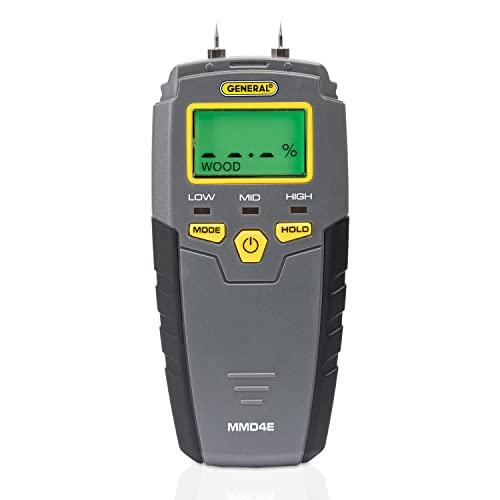
General Tools MMD4E Pin-Type Moisture Meter Best Value
The MMD4E is on a drywall page for one reason: after the pinless sweep finds the wet zone, a pin reading at the wettest point confirms it, and this is the lowest-cost meter here that states a building materials scale. General Tools lists 1.5 to 33% for materials such as drywall and concrete alongside 5 to 50% for wood, with low, medium and high tones so the reading can be heard while looking at the wall.
The pins are 8 mm stainless steel with spares in the box, and the protective cap has a built-in calibration checker, which is worth using before every session since a bent pin reads low. The backlit display uses 0.3 in digits and there is a hold button for readings taken above head height.
The limits are obvious: two holes per reading, no depth beyond the pins, no logging and no species or material mode beyond the two ranges. On painted drywall, take pin readings low on the wall or behind trim, and treat the number as relative rather than a true percentage.
Short answer: the Klein ET140 is the drywall meter for most leak tracing, because it states drywall as a calibrated material, reads to 3/4 in and shows the rise on nine LED bars; the Protimeter Aquant is the professional pinless choice when dated readings have to go into a restoration log; and the General MMD4E is the low-cost pin meter for the one confirmation reading at the wettest point, with a stated 1.5 to 33% building materials scale.
Why drywall needs its own meter choice
Gypsum board is thin, uniform and usually painted, and it sits in front of studs, pipes and wiring. Each of those facts changes what a moisture meter can do. The board is thin enough that a 3/4 in pinless sensor reads through it into whatever is behind, which is useful when the framing is wet and misleading when the framing is metal. It is painted, so pin holes show. And it has a density unlike wood, so a meter calibrated only for lumber gives readings that drift. The step-by-step method is in how to use a moisture meter on drywall; this page is about which meter to hold.
Pinless meters that name drywall
The Klein ET140 is explicit: calibrated for drywall, masonry, hardwood and softwood only, reading to 3/4 in with a nine-bar LED display. The General MMD7NP states 3/4 in (19 mm) and relative readings for wallboard, drywall and masonry with a 3-color LED bar and an audible alert. The Proster states 3/4 in (19 mm) and a 5 to 70% range for wall and masonry, which is a manufacturer scale rather than a gypsum percentage. The Povlen states a wall mode and an alarm that beeps and turns the bar red above a set value, with no depth on the listing. The Extech MO280 states 0.75 in and ten wood types but does not name drywall, so it sits in the table for comparison rather than as a drywall pick. The Protimeter Aquant names drywall, states 3/4 in (20 mm) and adds the Bluetooth logging that the others lack.
How a drywall reading is actually taken
None of these meters gives a true drywall percentage. What they give is a relative or reference number, and the method that makes it useful is the same on every one: find a section of the same wall that is certainly dry, take a reading there, then sweep toward the suspect area and watch the number, the bars or the tone rise. The edge where the rise begins is the boundary of the wet zone, and marking it in pencil gives the repair crew a cut line. A reading on its own, without the dry reference, is not evidence of anything, which is the point made in why moisture meter readings vary by material.
The limits: interference, coverings and pin damage
Three things trip up drywall readings. Metal studs, steel corner bead, pipes and wiring behind the board raise a pinless reading, so a high value that repeats at stud spacing or runs in a straight line is framing, not water. Tile, thick texture and multiple paint layers change the density in front of the sensor; the shallow setting on a dual-depth meter, or a reference reading taken on the same finish, keeps the comparison fair. And pins leave two holes per reading in a finished wall, so the pin meter belongs low on the wall, behind baseboard or in a closet, and its drywall number is itself relative rather than a percentage. Concrete and masonry from the same meters are relative too unless a material mode is stated.
Pairing the meter with a thermal camera
A thermal camera finds the wet area faster than any meter because evaporation cools the surface and the patch shows as a cooler shape on the image. It cannot confirm moisture, because it shows surface temperature and nothing else, and a cold pipe or a draft produces a similar patch. The pairing that works is camera first, meter second, with the meter reading taken at the coolest point and at a dry reference. The thermal cameras for water leaks guide covers the camera side, and our explainer on whether thermal imaging can find water leaks sets out what the image can and cannot prove.
Related guides
For meters that do both scanning and pin confirmation in one body, the home inspector moisture meter guide covers the Protimeter SurveyMaster and the Extech combination units. The pinless guide in this cluster compares depth and material modes across more brands.
How We Research
Products were compared on manufacturer listing text: whether drywall or wallboard is named, sensor type, stated reading depth, building material scale, alert features, logging and power. Owner feedback was reviewed for recurring reports of false highs near studs and pipes. We did not run laboratory tests or panel comparisons and publish no moisture measurements of our own. Amazon data supplies images, availability and links only.