Best Thermal Cameras for Finding Water Leaks: Picks for Ceilings, Walls and Floors
A water leak shows on a thermal camera as a patch that is cooler than the surface around it, because the wet material is evaporating, or warmer if the water came from a hot line. The camera finds the extent; a moisture meter confirms it. These picks were sorted for that job on manufacturer listing figures, with the upscaled numbers labeled.
As an Amazon Associate, Akermin earns from qualifying purchases. Product links on this page are affiliate links.
Our Top Picks
Cameras were compared for leak tracing on native resolution, stated NETD, field of view, visible-light overlay, workflow and form factor for working overhead, all from manufacturer listings. We did not run laboratory tests or wet-wall trials; figures are the manufacturers' own and Not stated marks the gaps.
Best Overall
FLIR C8 Compact Thermal Imaging Camera
Native 320x240 in a pocket body for ceilings, cabinets and crawl spaces.
320 x 240 true thermal imaging, 76,800 pixels
35-degree horizontal field of view stated
MSX embosses visible edges so the wet patch is located on the ceiling or wall
Direct upload to FLIR Ignite cloud; 2-year camera, 10-year detector warranty
Figures are taken from each manufacturer's Amazon listing at the time of research. The Thermal Master P1 listing titled 320x240 describes a 160 x 120 detector upgraded by X3, so it is shown as native 160 x 120. Not stated means the listing gives no value.
How to Choose a Thermal Camera for Leak Tracing
Four points decide it:
Sensitivity for a Damp Patch
A drying leak may be only a fraction of a degree cooler than the ceiling around it. A stated NETD of 40 mK or lower helps; only the phone modules quote one here.
Resolution From the Floor
A ceiling is imaged from 8 feet away. A 320 x 240 detector shows the edge of the patch; 160 x 120 shows a soft blob.
Overlay for the Report
MSX or visible fusion puts the cool patch next to the fixture or valve it is under, which is what an adjuster needs to see.
The Meter Step
Every finding is confirmed with a moisture meter before anything is opened up. Budget for the meter as part of the kit.
Why does a water leak look cold on a thermal camera?
Wet material evaporates, and evaporation cools the surface, so a damp patch of drywall or subfloor reads a little cooler than the dry area around it. If the water came from a hot supply line or a radiant loop the patch reads warmer instead. Either way the camera shows the temperature effect on the surface, not the water itself.
What if the ceiling has a stain but the thermal image shows nothing?
The leak may have dried, the patch may have reached the same temperature as the ceiling, or the difference may be smaller than the camera resolves. Run water in the fixture above for several minutes and scan again, and check the stained area with a moisture meter. A dry stain is a record of a past leak, not proof of a current one.
Can a thermal camera find a leak under a slab or in a radiant floor?
A hot water line or radiant loop warms the floor above it, so the loop pattern and a warmer spot at a leak can show through tile or concrete once the system has run for a while. A cold supply line under a slab is harder because the difference is small. In both cases the camera narrows the search area and a plumber confirms with pressure testing.
Do I need a moisture meter if I have the camera?
Yes. The camera shows a cooler area, which can also be a draft, a missing batt of insulation or a shadow of a duct. A pinless moisture meter over the patch confirms whether the material is actually wet, and a pin meter gives a reading at a specific point. Our pin versus pinless guide explains which to carry.
How does the FLIR ONE Pro inspection guide help with moisture?
FLIR states that the FLIR ONE app contains a step-by-step inspection guide for typical faults, including moisture buildup and air leaks. It walks the user through where to look and what the pattern means, which makes the module usable for someone who has not read thermal images before. The handheld FLIR listings do not describe an equivalent guide.
Reviews
FLIR C8 Compact Thermal Imaging Camera Best Overall
Leak tracing is done overhead, under sinks and in crawl spaces, and a pocket camera with a full 320 x 240 detector is the right tool for it. FLIR states 76,800 pixels of true thermal imaging in the C8, which resolves the edge of a wet patch on a ceiling from the floor, and a 35-degree horizontal field of view that frames a bathroom ceiling from the doorway.
MSX is the reason to prefer it to a plain camera for this job: it draws the visible outline of the light fixture, the shower valve or the cabinet frame onto the thermal image, so the report shows where the cool patch is rather than a blob on a blank field. Ignite cloud upload turns that into a shared image for a client or an insurer.
The listing does not state NETD, which is the figure that decides whether a barely damp patch shows, nor the temperature range or battery life. FLIR publishes NETD in its datasheet; on the listing alone, the TC002C and Thermal Master P1 quote 40 mK.
Strengths
Native 320 x 240 in a pocket body
MSX locates the wet patch on a recognizable surface
Ignite cloud for restoration and insurance records
10-year detector warranty
Limitations
NETD not stated on the listing
Battery life not stated
Small screen for reviewing a ceiling image on site
FLIR E5 Pro Thermal Imaging Camera Best Handheld With Wi-Fi
The E5 Pro is the entry to the FLIR pistol-grip line, and for a restoration contractor its case rests on the workflow rather than the detector. FLIR states Wi-Fi with automatic storage, editing and sharing through the Ignite cloud app and over-the-air updates, which is the same documentation chain as the E8 Pro at a lower tier. A drying job that needs before-and-after images for an adjuster benefits from that more than from extra pixels.
The detector is 160 x 120 native, 19,200 pixels, with no upscaled figure attached, and MSX carries the visible edges onto the image. The range of -20 to 400 C is more than any wet ceiling needs. The larger screen and grip are easier to hold steady overhead for a long scan than a pocket camera.
Against the C8 the trade is clear: a quarter of the detector count for a bigger screen, a grip and Wi-Fi in the body. NETD, field of view and battery life are not stated on the listing.
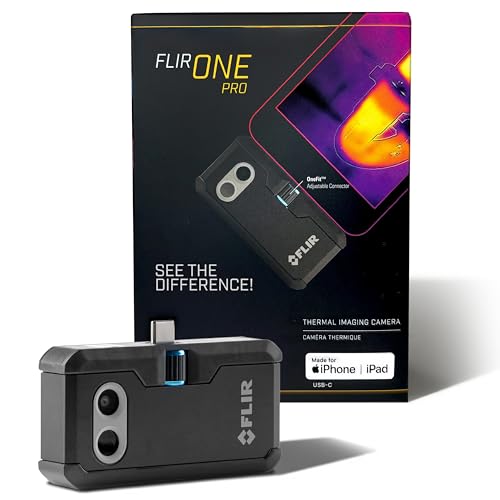
The FLIR ONE Pro is the value pick because the listing describes something the handhelds do not: a step-by-step inspection guide in the FLIR ONE app that walks the user through typical faults, moisture buildup among them. For a homeowner who has never read a thermal image, that guidance is worth more than detector pixels.
The module plugs into the USB-C port of an iPhone 15 or newer, and FLIR states a 160 x 120 detector upscaled to 480 x 360 by Vivid IR, plus MSX blending of the thermal and visible images. The stated accuracy is plus or minus 3 C or 5 percent when the module is within 15 to 35 C and the scene is within 5 to 120 C, which covers a wet ceiling comfortably. The listing rates it for a 1.5 m drop.
It is a 19,200-pixel detector on a phone screen: fine for a stain above a shower, less so for scanning a whole basement ceiling. It needs a compatible iPhone, and the listing states no NETD, range or battery figure. Our FLIR ONE Pro review has more.
Short answer: the FLIR C8 is the leak-tracing camera for a plumber, restoration contractor or inspector, with a native 320 x 240 detector in a pocket body and MSX to place the wet patch next to the fixture it is under; the FLIR E5 Pro is the Wi-Fi handheld for a company that documents drying jobs through Ignite cloud; and the FLIR ONE Pro is the value pick for a homeowner with an iPhone 15 or newer, because its app carries a step-by-step moisture inspection guide.
What a leak looks like on a thermal camera
Water in drywall, plaster, subfloor or insulation changes the surface temperature in a way a thermal camera can see, but it does not show the water. A damp patch evaporates, and evaporation cools it, so a leak under a bathroom typically appears on the ceiling below as an area a fraction of a degree to a few degrees cooler than the dry ceiling around it, often with a shape that follows the joists or the drip path. A leak from a hot supply line or a radiant loop does the opposite and shows warm. The camera therefore finds the extent of the wet area, which is its real value: it tells you which stud bay to open, how far the water has traveled and whether the patch is growing between visits. Can thermal imaging find water leaks covers the principle in more depth.
Ceilings: the most common call
A ceiling is imaged from the floor, so resolution matters more here than in most thermal work. A 320 x 240 detector, 76,800 pixels, resolves the edge of the patch and the joist pattern from 8 feet away; a 160 x 120 detector, 19,200 pixels, shows a soft-edged blob that is harder to measure and harder to compare on a return visit. That is why the C8 is the overall pick over the E5 Pro despite the larger camera’s Wi-Fi: the C8 states 320 x 240 with a 35-degree horizontal field of view, wide enough to frame a bathroom ceiling from the doorway. The E8 Pro brings the same detector count with a grip and a bigger screen for a company that does this daily. Whatever the camera, run the fixture above for several minutes before scanning; a leak that only happens when the shower drains needs the shower to drain.
Walls: behind tubs, under windows, around valves
Wall leaks are scanned at closer range, which brings the smaller detectors back into play. The FLIR ONE Pro on an iPhone, the TOPDON TC002C Duo and the Thermal Master P1 all put a thermal image on a phone screen at a short distance from the wall, and the two phone modules from TOPDON and Thermal Master state 40 mK sensitivity where the FLIR listings state none. Read those resolution figures carefully: the TC002C Duo is a 256 x 192 detector with a 512 x 384 TISR upscale, and the P1 listing titled 320 x 240 describes a 160 x 120 detector upgraded by X3, so its native count is the same as the FLIR ONE Pro. A cool vertical band beside a shower valve, a cool patch below a window sill or a cool line along the base of a wall are the usual findings; each needs a meter reading before the wall is opened.
Floors, slabs and radiant loops
A warm-water leak under a floor is the easiest thermal finding there is once the system has run: the loop pattern of a radiant floor shows through tile and the leak appears as a warmer spot or a warm area spreading beyond the loop. Cold supply lines under a slab are much harder because the temperature difference is small, and a camera with a stated low NETD, such as the TC002C Duo at 40 mK or the TR20 in our sibling guides at under 40 mK, gives the best chance of seeing it. A wet subfloor under a laminate or vinyl floor reads cool from evaporation like a ceiling does. In every floor case the camera narrows the area and a pressure test or a meter reading confirms it.
The moisture meter step
A cool patch on a thermal image is not proof of water. Missing insulation, a draft from an unsealed top plate, the shadow of a cold duct in the ceiling and a section of wall behind a north-facing exterior all read cool. The confirmation is a moisture meter: a pinless meter held against the patch reads relative moisture to roughly three quarters of an inch without leaving marks, and a pin meter gives a reading at one point at the cost of two small holes. Scan first, meter second, and record both in the report. The moisture inspection method walks through the sequence, and pin versus pinless moisture meters covers which meter to carry.
Limits: surface only, emissivity and dry leaks
A thermal camera cannot see through a wall or a floor; it reads the surface, which is why a leak inside a wall only shows once the water reaches the drywall or the framing conducts the temperature through. Shiny surfaces mislead: a tiled shower wall, a glossy painted ceiling or a metal access panel reflects the room and the person holding the camera, and a bare copper pipe reads cold because its emissivity is low. Step sideways and see whether the cool spot moves with you. Leaks that have dried leave a stain and no thermal signature, and a leak that is active only under certain conditions has to be reproduced before scanning. The Thermal Master and FLIR ONE listings both state that the camera detects heat from surfaces and not through walls, which is the single most useful sentence on any thermal listing.
Related guides
Roof leaks and wet roof insulation are a different scan, done from the roof at the right time of day; the roof inspection thermal camera guide covers it. For the broader home walk-through, the home inspection thermal camera guide applies the same cameras to insulation and drafts.
How We Research
Cameras were compared on manufacturer listing figures for leak tracing: native detector resolution, upscaled output where quoted, stated NETD, field of view, visible-light overlay or fusion, form factor for overhead work, workflow and warranty. Owner feedback was reviewed for recurring comments on locating moisture and on app guidance. We did not run laboratory tests or wet-material trials and publish no measurements. Amazon data supplies images, availability and links only.