As an Amazon Associate, Akermin earns from qualifying purchases. Product links on this page are affiliate links.
For locating an active ground fault on a DC array, P1 is the instrument built for that job: the listing describes a transmitter, receiver and clamp that trace a signal to the fault and estimate which module number is closest. For proving a string or module is healthy after the repair, P2 is the all-in-one analyzer, publishing IEC 62446-1 Category 1 and Category 2 coverage, VOC to 1000 V DC, ISC to 20 A DC and on-location I-V curve comparison. P3 and P4 are not fault finders at all. P3 is a 50 A, 300 VDC ground-fault circuit breaker for permanent DIN-rail protection, and P4 is an MC4-to-banana test lead that lets a multimeter reach a panel. Buy P1 to find, P2 to prove, P3 to protect, and P4 only if your existing meter cannot otherwise touch an MC4 connector.
Finding a fault, proving a string, protecting a circuit: three different instruments
The phrase ground-fault testing covers at least three jobs on a PV array, and they are done with different equipment at different times.
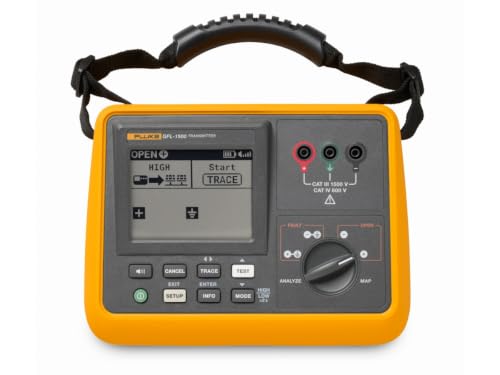
The first job is locating an existing fault. A faulted conductor is still connected to the array, and you need to know which string, and often which module, is involved. That is a tracing task. The instrument injects or follows a signal and you walk the array with a receiver until the signal tells you where the fault sits. P1 is the only product on this page built for that, and its listing says so directly: transmitter, receiver and clamp, identify and locate active ground faults anywhere in a DC system, and estimate what module number is closest to the fault.
The second job is proving the array is healthy after the repair, or before commissioning. That is a measurement task, and it is where an analyzer earns its place. P2 publishes open-circuit voltage to 1000 V DC, short-circuit current to 20 A DC, and IEC 62446-1 Category 1 and Category 2 coverage. It also does I-V curve comparison on the analyzer screen, which is the measurement that shows a string is underperforming even when nothing has failed outright.
The third job is preventing the fault from becoming a fire. That is a protection task, and it is a permanent installation, not a test. P3 is a 50 A, 300 VDC ground-fault circuit breaker on DIN rail with a 10,000 AIC interrupting rating. It is not something you carry to a fault; it is something that trips when one occurs.
P4 is a fourth, smaller job: getting a meter onto an MC4 connector. It is a lead, not an instrument, and the listing describes it as such.
What each listing publishes, and where it goes quiet
The table below uses only figures that appear in the product data. Where a listing does not publish a value, the cell says so rather than guessing.
| Product | Type | Key published figures | What the listing does not publish |
|---|---|---|---|
| P1 | Ground-fault locator | 1500 V class (from title), transmitter, receiver and clamp, graphic LCD with front light, module-number estimate | Not stated in the listing bullets: locating accuracy, signal range, battery type or runtime |
| P2 | PV analyzer kit | IEC 62446-1 Cat 1 and Cat 2, VOC to 1000 V DC, ISC to 20 A DC, I-V curve comparison on screen, supplied irradiance meter and 100 A AC/DC clamp | Not stated in the listing bullets: insulation test voltage, continuity range, data storage capacity |
| P3 | Ground-fault breaker | 50 A, 300 VDC, 10,000 AIC, 20 in-lb torque, listed for US and Canada, 2 lbs | Not stated in the listing bullets: trip threshold in milliamps, trip time curve |
| P4 | MC4 test lead | 1500 V, 20 A, IP68, PC+ABS housing, MC4 to 4mm banana | Not stated in the listing bullets: lead length, conductor gauge, CAT rating |
Two gaps matter more than the rest. P3 does not publish its trip threshold in milliamps, which is the number that tells you whether it will detect a low-level insulation fault or only a hard short. P4 does not publish a safety category rating, which matters because a 1500 V DC array is not the same hazard as a 1500 V AC circuit.
The locator is not an analyzer, and the analyzer is not a locator
These two instruments are often confused because both are used on the same fault, but they answer different questions.
A locator such as P1 answers where. It follows a signal through the DC system until the receiver tells you the fault is near. The listing describes a traceable signal and a module-number estimate, which is the practical output: you end up standing near the right module rather than disconnecting strings one at a time hoping to find the bad one.
An analyzer such as P2 answers whether, and how well. It measures VOC and ISC at the string or module, and it compares an I-V curve against the manufacturer’s published curve. That comparison is what catches a string that is still producing but has lost a fraction of its output, which a simple voltage check will not show. The listing states that the I-V curve comparison happens on the analyzer screen, so you do not need a separate computer to see the result.
Neither instrument replaces the other. If you have a hard ground fault on a 1500 V array, you want the locator. If you have a string that reads low, you want the analyzer. Many technicians carry both, but if you are buying one, buy the one that matches the fault you are most often called to.
For a wider view of what a commissioning kit contains, see PV testing kits for system commissioning.
The four tools, and the job each one does
Fluke GFL-1500 Solar Ground Fault Locator
The only product here that traces and locates an active DC ground fault, with a transmitter, receiver and clamp, a graphic backlit LCD, and a module-number estimate for the closest fault.
Fluke SMFT-1000 Solar Tools Kit
A complete PV test kit that publishes IEC 62446-1 Category 1 and Category 2 coverage, VOC to 1000 V DC, ISC to 20 A DC, and on-screen I-V curve comparison against manufacturer data.
MidNite Solar MNDC-GFP50-300 Ground Fault Circuit Breaker
A permanent 50 A, 300 VDC ground-fault protector on DIN rail, with a published 10,000 AIC interrupting rating and listing for US and Canada.
BOCEUC MC4 Connector Tester Lead
An MC4-to-4mm banana test lead rated 1500 V and 20 A with an IP68 housing, which exists so a multimeter can reach a panel connector.
The MC4 lead: a small accessory with a real voltage question
P4 exists because most multimeters cannot grip an MC4 connector. The listing describes an MC4 connector on one end and a 4mm banana plug on the other, rated 1500 V and 20 A, in a PC+ABS housing with an IP68 rating.
The 1500 V rating is the headline, and it is adequate for the array voltages a modern string reaches. The IP68 rating is about surviving weather, which matters if you are working on a rooftop in damp conditions. The PC+ABS housing is described as providing insulation, impact resistance and UV protection, which is sensible for a lead that lives in a tool bag and spends time in sunlight.
What the listing does not publish is a safety category rating. That is not a small omission. A test lead’s CAT rating describes the transient energy it can survive without failing, and a lead with no published CAT rating should not be assumed to carry one. If your meter is a CAT III or CAT IV instrument, the lead is the weakest link in the chain, and the listing gives you nothing to check.
The other thing to note is what an MC4 lead is for. It is for reaching a connector with a meter you already own. It is not a fault locator, not an analyzer, and not a substitute for either. If you need to know whether a string is faulted, the lead alone will not tell you; it only lets your meter make the measurement.
Protection is a permanent decision, not a test
P3 is the odd one out on this page because it is not a testing tool at all. It is a ground-fault circuit breaker that mounts on DIN rail and stays there.
The published figures are 50 A, 300 VDC, a 10,000 AIC interrupting rating, a 20 in-lb breaker torque value, a 2 lb weight, and listing for the US and Canada. The 10,000 AIC figure is the short-circuit current the breaker can interrupt without being destroyed, and it is the number an inspector will look for. The torque value is the tightening figure for the terminal, and it matters because a loose DC connection on a PV array is a fire risk in its own right.
The 300 VDC rating is the limit that decides where this breaker can go. A 300 VDC device is not suitable for a 1000 V or 1500 V string. If your array operates above 300 VDC, this breaker is not the right protection for that circuit, regardless of its current rating.
The listing does not publish the trip threshold in milliamps or the trip time curve. Those are the two figures that describe how sensitive the ground-fault detection is. Without them, you cannot tell from the listing alone whether the breaker will catch a slow insulation failure or only a hard fault. Ask the supplier for the datasheet before you rely on it for protection.
Matching the tool to the fault you actually have
Start with the symptom, not the instrument.
- If an inverter reports a ground fault and you need to find it, you want a locator. P1 is the only one here.
- If a string reads low or you are commissioning, you want an analyzer. P2 publishes the IEC 62446-1 coverage and the VOC and ISC ranges that commissioning requires.
- If you are installing protection for a circuit up to 300 VDC, P3 is the DIN-rail option, subject to the missing trip data.
- If your only problem is that your meter cannot reach an MC4 connector, P4 solves it, with the CAT rating caveat noted above.
One more point on the analyzer: the listing describes an irradiance meter and a 100 A AC/DC clamp as part of the kit. Irradiance matters because an I-V curve is only meaningful when you know the light level it was taken at. A curve measured at low irradiance will look wrong even on a healthy string. The kit includes the instrument that records that condition, which is why the I-V comparison is usable in the field rather than only in a lab. For more on that relationship, see solar I-V curve tracers.
For the broader question of what belongs in a technician’s bag, solar testing tools for O and M technicians covers the surrounding kit.
Recommended Tools


Products shown because their documented specifications fit this guide. Price and availability are on Amazon and can change.
Frequently Asked Questions
Can I use a multimeter to find a PV ground fault?
A multimeter can measure voltage and continuity, and with a lead like P4 it can reach an MC4 connector. What it cannot do is trace a fault through a live DC system to a location. That is the job P1 is built for, using a transmitter, receiver and clamp to follow a signal. A multimeter tells you a fault exists somewhere on the circuit you are probing; a locator tells you where.
Is the SMFT-1000 a ground-fault locator?
No. P2 is a PV analyzer kit. It measures VOC, ISC and I-V curves and covers IEC 62446-1 Category 1 and Category 2 tests. It will tell you a string is faulted or underperforming, but it does not publish a fault-locating function. If you need to walk the array and find the fault, that is P1.
What does the 10,000 AIC rating on the MidNite breaker mean?
AIC stands for amperes interrupting capacity. It is the maximum short-circuit current the breaker can interrupt without being damaged or failing to clear the fault. The listing publishes 10,000 AIC for P3, which is the figure an inspector checks against the available fault current at the installation point. It does not tell you the ground-fault trip threshold, which the listing does not publish.
Can the MidNite GFP50-300 be used on a 1000 V array?
The listing rates P3 at 300 VDC. A 300 VDC device is not suitable for a 1000 V or 1500 V string. The voltage rating is the limit that decides where the breaker can be installed, and it is separate from the 50 A current rating. If your array operates above 300 VDC, this breaker is not the right protection for that circuit.
Does the BOCEUC MC4 lead have a CAT rating?
The listing does not publish one. It states 1500 V, 20 A, IP68 and a PC+ABS housing, but no safety category. That matters because the lead is the part of the measurement chain that touches the live connector, and a lead with no published CAT rating should not be assumed to carry one. If your meter is CAT III or CAT IV, ask the supplier for the lead's category before relying on it.
Do I need both a locator and an analyzer?
They answer different questions, so many technicians carry both. P1 finds where a fault is; P2 measures whether a string is healthy and how its I-V curve compares to the manufacturer's data. If you mostly respond to reported ground faults, the locator is the priority. If you mostly commission and maintain strings, the analyzer is. Only you know which call you get more often.
Affiliate disclosure: Akermin earns a commission from qualifying Amazon purchases made through links on this page. Our editorial picks are based on documented specifications and owner feedback, not commissions.
Related Guides

UNI-T UT503PV Review: A DC 1000 V Headline on a CAT III 600 V Body
A solar insulation resistance tester that works on energised PV strings up to DC 1000 V, with test voltages of 125, 250, 500 and 1000 V, a range to 4000 megohms, automatic discharge, 1000 stored result sets and USB or Bluetooth transfer.
Read More→
ANCEL BA101 Review: The Exclusion List Is the Most Useful Bullet
A 12 volt battery, cranking and charging system tester covering 100 to 2000 CCA that reports state of health, state of charge, voltage, current and CCA, drawing its own power from the battery under test.
Read More→
Tenmars Solar Power Meter Review: One Accuracy Figure, Two Very Different Jobs
A handheld solar irradiance meter reading 0 to 1999 watts per square metre or 0 to 634 BTU per square foot per hour, with a selectable 199.9 or 1999 scale, maximum and minimum tracking, data hold and manual zeroing.
Read More→