As an Amazon Associate, Akermin earns from qualifying purchases. Product links on this page are affiliate links.
For a full commissioning workflow, P1 is the only kit here that the listing describes as meeting IEC 62446-1 Category 1 and Category 2 tests, and it is the only one that produces on-location I-V curves against manufacturer data. If you already own a suitable multimeter and only need safe string-level current and voltage work, P2 covers the CAT III 1500 V side with MC4 leads. P4 is the budget single-panel option for module-level power checks, and P5 is not a kit at all but an adapter lead that turns a multimeter you already own into an MC4-compatible tester. P3 measures energy and power on the AC side, which is a different job from array commissioning.
What IEC 62446-1 asks you to record, and which kits can produce it
Commissioning a PV system to IEC 62446-1 is not one test. The standard splits the work into Category 1 and Category 2 tests, and the split matters because it decides what your instrument has to do.
Category 1 is the continuity, polarity and insulation resistance work plus the string open-circuit voltage and short-circuit current checks. Almost any decent multimeter with the right leads can do parts of this, which is why P5 exists as a product: an MC4 to banana adapter lets a general-purpose meter reach the connectors. Category 2 goes further and adds the I-V curve measurement, comparing the measured curve against the manufacturer’s curve for the module. That is a different instrument class.
Of the five products here, only P1 is described in its listing as meeting both categories. That is the single most important line in this comparison for anybody who has to hand over a commissioning pack. P2 covers the voltage, polarity and current side but the listing does not state an I-V function. P4 reports the five key module parameters but the listing does not state IEC 62446-1 compliance, so you cannot assume it satisfies a Category 2 record.
If your client or your own QA procedure asks for a printed I-V curve, the decision is made for you. If it asks only for Voc, Isc, polarity and insulation values, you have more room to choose.
The voltage and current ceilings that decide whether a kit fits your array
Every kit here has a ceiling, and the ceilings are not the same. Reading them side by side is the fastest way to rule products in or out.
| Product | Stated DC voltage limit | Stated current limit | I-V curve | IEC 62446-1 stated |
|---|---|---|---|---|
| P1 | 1000 V DC at module/string | 20 A DC at module/string | Yes, on analyzer screen | Yes, Category 1 and 2 |
| P2 | CAT III 1500 V / CAT IV 1000 V | 60 A AC/DC with clamp | Not stated in the listing bullets | Not stated in the listing bullets |
| P3 | Not stated in the listing bullets | 10 A to 3000 A via Rogowski coils | Not stated in the listing bullets | Not stated in the listing bullets |
| P4 | 150 V DC in the title, 80 V DC in the bullets | 45 A | Not stated in the listing bullets | Not stated in the listing bullets |
| P5 | 1500 V | 20 A | No | Not stated in the listing bullets |
Two things stand out. First, P1’s 1000 V DC and 20 A DC limits are module and string limits, not array limits. A string of modern high-voltage modules can sit close to that voltage ceiling on a cold morning, when Voc rises above the datasheet value. The listing states the limit, so the limit is what you work to.
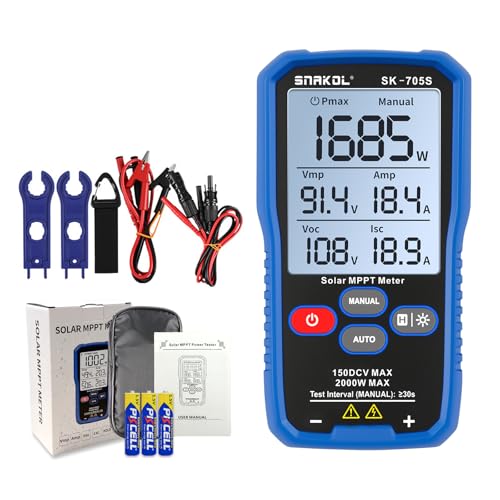
Second, P4’s listing contradicts itself. The title says 2000 W and 150 V DC maximum. The bullet text says 2000 W in the heading but then describes 1000 W output power and 80 V DC maximum. When a listing disagrees with itself, use the more conservative figure for planning and ask the seller which is correct before you buy. A tester that stops at 80 V cannot commission a string whose Voc is above that.
The five kits and what each one actually commissions
Fluke SMFT-1000 Solar Tools Kit
The only kit in this group whose listing states compliance with IEC 62446-1 Category 1 and Category 2 tests, and the only one that plots I-V curves on site against manufacturer data. If your commissioning report has to include an I-V trace, this is the kit that produces it.
Fluke 283FC/PV Kit
A CAT III 1500 V true-RMS multimeter with a wireless 60 A clamp and MC4 test leads. It handles string voltage, polarity and current up to 60 A AC/DC, which covers the electrical safety checks on most commercial strings without the I-V capability of P1.
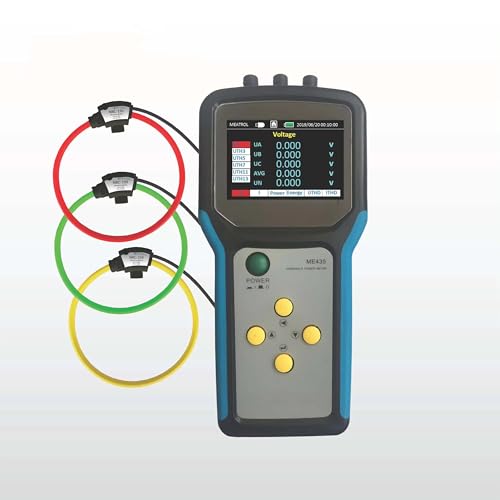
ZLPLSUPEX ME435 Three Phase Power Data Logger
A three-phase power and energy logger with Rogowski coils rated to 3000 A. It measures the AC output side of an inverter or the grid connection, not the DC array, so it belongs in a commissioning bag only if you are also logging production.
Fienzio SK-705S Solar MPPT Power Tester
A module-level tester that reports Pmax, Vmp, Imp, Voc and Isc on a 3.2 inch backlit LCD. The listing states 2000 W and 150 V DC maximums in the title but 1000 W and 80 V in the bullet text, so treat the lower figures as the ones the bullets actually describe.
BOCEUC MC4 Connector Tester Lead
Not a kit. It is a single MC4 to 4 mm banana adapter lead rated 1500 V and 20 A, IP68, for connecting a multimeter you already own to a PV string. Useful as a spare, but it commissions nothing on its own.
I-V curve tracing is the line between a check and a diagnosis
An open-circuit voltage reading tells you the string is connected. A short-circuit current reading tells you current can flow. Neither tells you whether the array is producing the power it should at the irradiance it is actually receiving.
An I-V curve does. The instrument sweeps the operating point from short circuit to open circuit and records the resulting curve, then compares it with the manufacturer’s curve for that module at the measured irradiance and temperature. The shape of the curve is diagnostic: a step or a shoulder suggests mismatch, shading or a failing bypass diode, and a curve that is uniformly low suggests soiling or irradiance loss. This is why P1’s listing pairs the analyzer with a wireless irradiance meter, the IRR2-BT. Without an irradiance reading you cannot normalise the curve, and a curve that looks weak may simply have been taken under a cloud.
P1 is the only product here whose listing states on-location I-V results compared against manufacturer data. If you want that capability, that is the pick. If your commissioning scope stops at Voc, Isc and insulation, you do not need it, and the money is better spent on leads and a clamp that match your array’s current.
For related ground-fault and insulation work, see PV ground fault testing tools, which covers the tests that sit alongside commissioning.
Safety ratings, polarity and the checks people skip
P2’s listing leads with CAT III 1500 V and CAT IV 1000 V safety ratings, and that is not marketing. The CAT rating describes the transient energy the instrument can survive if something goes wrong on the circuit it is connected to. A meter without the right CAT rating for a 1500 V DC string is a hazard to the person holding it, not just to the reading.
P2 also states visual and audio polarity indicators. Polarity mistakes on module wiring are common during first installation and they are easy to miss with a meter you have to watch. An audible indicator lets you keep your eyes on the connectors.
P3’s listing is worth reading carefully. It offers IEC 62053-22 Class 0.5 accuracy for energy measurement and three Rogowski coils with a 150 mm inner diameter, measuring 10 A to 3000 A. That is a three-phase AC power logger. It is a useful instrument for verifying inverter output and building load, but it does not test a DC string, it does not measure Voc or Isc, and it does not produce an I-V curve. If your commissioning scope is the array, P3 is the wrong tool. If your scope includes logging the AC side over time, it is a reasonable addition, and it is the only product here that addresses three-phase power at all.
P5 is a lead, not a meter. Its 1500 V and 20 A ratings are the lead’s ratings, not a measurement capability. It does not measure anything. It connects an MC4 string to a 4 mm banana input on a multimeter you already own. The IP68 rating is about surviving weather, not about accuracy. Buy it as a spare or as a way to use a meter you already trust, and do not count it as a commissioning kit.
Building a commissioning bag that covers the whole job
No single product here covers a full commissioning visit. The realistic bag is a combination.
- A safety-rated multimeter for voltage, continuity and polarity, with MC4 leads. P2 supplies this as a package; 1500 V DC multimeters for solar PV covers the wider field if you want to choose the meter separately.
- A clamp for string current. P2 includes a 60 A wireless clamp; P1’s kit includes a 100 A clamp. Match the clamp range to your string current, and remember that a clamp reads current without breaking the circuit, which is safer and faster than an inline measurement.
- An insulation resistance tester for the Category 1 insulation test. None of the five listings here state an insulation resistance function, so this is a separate instrument.
- An I-V curve tracer if your scope requires Category 2 records. P1 is the only pick here that provides it.
- An irradiance meter, because a current reading without irradiance is not comparable between visits. P1’s kit includes one.
If you are starting from nothing, P1 is the closest thing to a complete commissioning kit in this group, and its listing is the only one that names the standard. If you already own a good multimeter and insulation tester, P2 plus P5 covers the DC string work at lower cost, minus the I-V capability. For a broader view of what belongs in the bag, see how to build a basic solar testing toolkit and PV commissioning testers.
One maintenance point that applies to all of them: MC4 contacts wear and corrode. Inspect the mating faces of your test leads periodically, and keep the connectors dry and capped. A high-resistance lead connection will show up as a voltage drop or an unstable current reading, and it will send you looking for a fault in the array that is actually in your test lead.
Recommended Tools



Products shown because their documented specifications fit this guide. Price and availability are on Amazon and can change.
Frequently Asked Questions
Do I need an I-V curve tracer to commission a PV system?
Not always. IEC 62446-1 Category 1 tests cover continuity, polarity, insulation resistance, Voc and Isc, and a suitable multimeter and insulation tester can handle those. Category 2 adds the I-V curve measurement. Whether you need it depends on what your client, your QA procedure or your grid connection agreement asks for. If nobody asks for a curve, you can commission without one. If a curve is required, P1 is the only kit in this group whose listing states it produces on-location I-V results compared against manufacturer data.
Can I use a normal multimeter with an MC4 adapter lead instead of a dedicated PV tester?
Yes, provided the multimeter's voltage and current ratings cover the string and its CAT rating is appropriate for the circuit. P5 is exactly that adapter: an MC4 to 4 mm banana lead rated 1500 V and 20 A. The limitation is that a multimeter and adapter measure voltage, current and continuity, not I-V curves or insulation resistance. It is a legitimate way to use a meter you already trust, but it does not turn that meter into a commissioning kit.
What does the CAT rating on a PV meter actually mean?
The CAT rating describes the transient overvoltage environment the instrument is designed to survive. CAT III 1500 V and CAT IV 1000 V, as stated for P2, indicate the meter is built and rated for high-energy circuits at those levels. Using a meter with a lower CAT rating on a 1500 V DC string is a safety risk. The rating is about the instrument surviving a fault, not about measurement accuracy.
P4's listing gives two different voltage and power figures. Which is right?
The listing does not resolve it. The title states 2000 W and 150 V DC maximum, while the bullet text describes 1000 W output power and 80 V DC maximum. When a listing contradicts itself, plan to the lower figure, 80 V DC and 1000 W, and confirm with the seller before buying. A tester limited to 80 V DC cannot commission a string whose open-circuit voltage is above that, and Voc rises above the datasheet value in cold conditions.
Is the ZLPLSUPEX ME435 a PV commissioning tester?
No. Its listing describes a three-phase power data logger with Rogowski coils, IEC 62053-22 Class 0.5 energy accuracy and a 10 A to 3000 A measurement range. That is an AC power and energy instrument for the inverter output or building supply side. It does not measure DC string Voc or Isc, and the listing does not state an I-V function. It can be part of a commissioning visit if you are also logging production, but it does not commission the array.
What does a commissioning kit not tell me about a system?
A commissioning test is a snapshot. It confirms the system was correct on the day, at that irradiance and temperature. It does not predict degradation, it does not detect an intermittent fault that appears only under thermal cycling, and it does not replace ongoing monitoring. A passing commissioning record and a monitored system are different things; the first proves the installation, the second catches what changes afterwards.
Affiliate disclosure: Akermin earns a commission from qualifying Amazon purchases made through links on this page. Our editorial picks are based on documented specifications and owner feedback, not commissions.
Related Guides

UNI-T UT503PV Review: A DC 1000 V Headline on a CAT III 600 V Body
A solar insulation resistance tester that works on energised PV strings up to DC 1000 V, with test voltages of 125, 250, 500 and 1000 V, a range to 4000 megohms, automatic discharge, 1000 stored result sets and USB or Bluetooth transfer.
Read More→
ANCEL BA101 Review: The Exclusion List Is the Most Useful Bullet
A 12 volt battery, cranking and charging system tester covering 100 to 2000 CCA that reports state of health, state of charge, voltage, current and CCA, drawing its own power from the battery under test.
Read More→
Tenmars Solar Power Meter Review: One Accuracy Figure, Two Very Different Jobs
A handheld solar irradiance meter reading 0 to 1999 watts per square metre or 0 to 634 BTU per square foot per hour, with a selectable 199.9 or 1999 scale, maximum and minimum tracking, data hold and manual zeroing.
Read More→