As an Amazon Associate, Akermin earns from qualifying purchases. Product links on this page are affiliate links.
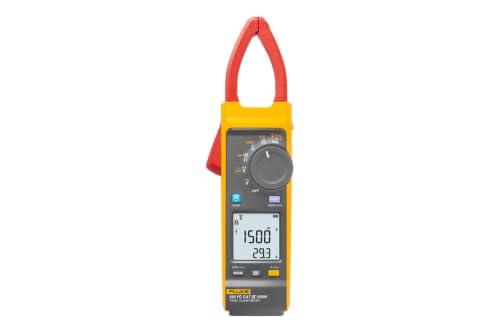
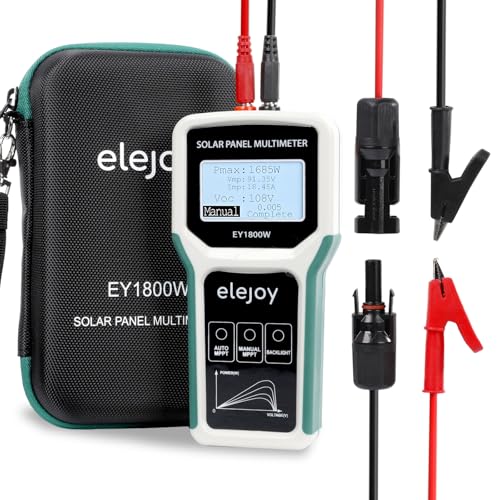
For most O&M technicians, P1 is the first tool to own. It is a clamp meter rated CAT III 1500 V with a thin jaw for crowded combiner boxes, and it measures DC power directly. That combination covers the daily checks: string current, array voltage, polarity and continuity. P2 is the specialist addition, a panel tester that reports Pmax, Voc and Isc at the maximum power point, which is the measurement that tells you whether a module is degrading or just shaded. P3 is a lead set, not an instrument. It exists to connect a meter to MC4 connectors safely, and it is only useful if you already own a meter with 4mm banana inputs. P4 is a crimper kit for making and repairing PV connections. It does not measure anything.
Why the clamp meter comes first and the tester comes second
A clamp meter and a panel tester answer different questions. The clamp meter answers is this string carrying what it should. The panel tester answers is this module producing what its label claims. In a typical O&M visit you ask the first question far more often, which is why P1 leads this list.
P1 is rated CAT III 1500 V. That rating is not decoration. It describes the transient energy the instrument is built to survive if something goes wrong on a live DC circuit. On a 1500 V string, a meter without that rating is the wrong tool regardless of what it measures. The listing also states a thin jaw, which matters because combiner boxes are crowded and a thick jaw cannot close around a single conductor without disturbing its neighbours. The DC power measurement, audio polarity indicator and visual continuity function are the three checks that fill most of a technician’s day.
P2 answers the second question. It measures output power at the maximum power point, plus open circuit voltage and short circuit current. Those three numbers let you compare a panel against its nameplate. The listing states a maximum current rating of 60 A and a rated voltage of 120 V. Read those two figures carefully before you buy: they describe a tester aimed at single panels and small strings, not at a commercial rooftop string running at several hundred volts. If your array operates above that voltage, this instrument is the wrong one for that measurement, however useful it is on a bench.
The accessory trap: leads and crimpers are not instruments
Two of the four products here do not measure anything, and that is the most common mistake in building a solar toolkit. P3 is a lead set. Its listing says it connects test tools that accept 4mm sheathed banana plugs to PV modules and systems, for safe current and voltage measurements. If you own a meter with those sockets, P3 turns it into a PV-capable meter. If you do not, P3 is a set of leads with nothing to plug into. It is an enabler, not a solution.
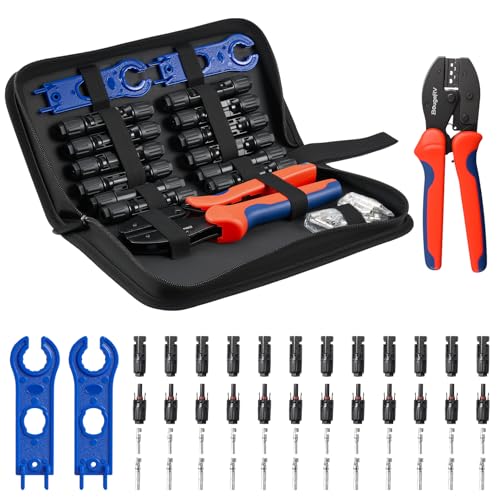
P4 is a crimper kit: a wire crimper for 14 to 10 AWG wire, two spanners, twelve pairs of connectors and a case. The connectors are stated as IP67 and made from PPO material with a waterproof ring. This is the kit you use when a connector is damaged, when a cable has been cut, or when you are terminating a new run. It contributes nothing to diagnosis. A technician who buys P4 expecting to find a fault will be disappointed; a technician who buys it because connectors fail in the field will use it regularly.
The distinction matters because a toolkit assembled without it ends up either full of instruments that cannot connect to anything, or full of connectors and no way to test them. The practical sequence is: a meter to measure, leads to reach the connector, a crimper to repair what the meter found. Those are three different purchases and the listings describe them as such. If you are starting from nothing, the page on building a basic solar testing toolkit walks through that order.
The four tools, and the job each one is for
Fluke 393 FC Solar Clamp Meter
The only instrument here that combines a CAT III 1500 V safety rating, a jaw thin enough for combiner boxes, and direct DC power measurement. That makes it the tool you reach for first on almost every call.
ELEJOY 1800W Solar Panel Tester
Reports Pmax, Voc and Isc at the maximum power point, which is the figure a datasheet quotes. Useful for comparing a panel against its specification, with the caveat that its rated voltage and current ceiling are low for commercial arrays.
Fluke Pomona Solar MC4 to 4mm Test Lead Set
An accessory, not a meter. It lets a test instrument with 4mm sheathed banana sockets connect to PV modules through MC4 connectors. Buy it only if you already own the meter.
BougeRV Solar Crimper Tool Kit
A repair kit: crimper, spanners, connectors and a case. It makes and remakes PV connections. It has no measurement function at all, so it belongs in the van, not in the diagnostic sequence.
Comparison of what each listing actually publishes
| Tool | What it measures | Stated safety or environmental rating | Stated electrical limits | Connector or interface |
|---|---|---|---|---|
| P1 | DC power, polarity, continuity, current by clamp | CAT III 1500 V, IP54 | Not stated in the listing bullets beyond the CAT rating | Clamp jaw, iFlex included |
| P2 | Pmax, Voc, Isc | Not stated | 60 A maximum current, 120 V rated voltage | Direct connection to panel |
| P3 | Nothing; it is a lead set | Not stated | Not stated | MC4 to 4mm banana |
| P4 | Nothing; it is a crimp and connector kit | Connectors stated IP67 | 14 to 10 AWG wire | MC4-type connectors, 2.5/4/6 mm squared |
Two cells in that table say more than the rest. P2’s 120 V rated voltage is the figure that decides whether the tester suits your array, and P1’s CAT III 1500 V rating is the figure that decides whether it is safe to use on one. The lead set and the crimper have no electrical limits because they do not measure; their relevant specifications are mechanical.
Connecting the meter to the module without making a mistake
MC4 connectors are not designed to be probed. They are designed to mate. A technician who tries to push a standard probe into the back of a mated connector is working outside the connector’s design intent and risks a poor contact, a false reading, or an arc. P3 exists precisely because the correct interface is a mating lead, not a probe. The listing states it allows connections to test tools that accept 4mm sheathed banana plugs, which is the standard socket on most handheld meters.
The same logic applies at the other end of the job. When you remake a connection with P4, the crimp quality decides the resistance of that joint for the rest of its life. A poor crimp adds resistance, and resistance under load produces heat, and heat at a connector is the beginning of the failure you will be called back to fix. The listing states a high-precision jaw for 14 to 10 AWG wire and a high-carbon steel body. Those are the two specifications that matter: the jaw determines whether the crimp is correct for the wire size, and the material determines whether the tool survives a season in a van.
Where this becomes a safety issue rather than a quality issue is on live or recently energised circuits. A DC string does not stop being dangerous because the inverter is off. The page on testers for 1500 V utility arrays covers the ratings that apply when the array voltage climbs, and the same principle applies at every scale: the instrument rating has to match the circuit, not the other way round.
What none of these four tools will tell you
Nothing in this list measures irradiance, and without irradiance you cannot say with certainty that a panel is underperforming. A module producing less than its nameplate figure may simply be receiving less light. P2 reports Pmax, which is the right number to compare against a datasheet, but the comparison is only meaningful when you know the conditions. Treat a low Pmax as a prompt to investigate, not as a verdict.
Nothing here performs an insulation resistance test or a ground fault check. Those are separate instruments with separate safety requirements, and they are the tests that actually establish whether an array is safe to leave energised. A clamp meter and a panel tester can tell you a string is producing current; they cannot tell you the insulation is sound. If your work includes commissioning or periodic safety testing, you need tools beyond this list, and the page on PV ground fault testing tools covers that category.
Finally, none of these tools records anything by itself. P1 is described as Fluke Connect software enabled, which the listing states as a feature, but the lead set, tester and crimper produce readings you write down or photograph. O&M work is judged on records: what you measured, where, and when. A tool that helps you capture that record is worth more than one that measures slightly more precisely and leaves you reconstructing the visit from memory.
Recommended Tools

Products shown because their documented specifications fit this guide. Price and availability are on Amazon and can change.
Frequently Asked Questions
Do I need both P1 and P2?
If you do string-level troubleshooting and module-level diagnosis, yes. P1 measures current in a string without breaking the circuit, which is how you find the underperforming string. P2 measures a single panel at its maximum power point, which is how you decide whether that panel is degraded. One does not replace the other. If your budget only stretches to one, buy P1 first; it covers more visits.
Can P2 test a whole string?
The listing states a rated voltage of 120 V and a maximum current of 60 A. A series string on a commercial array will exceed that voltage. Read the array's operating voltage before connecting P2 to anything other than a single panel or a short string. The listing does not publish an upper voltage beyond the 120 V rating.
Is P3 useful on its own?
No. It is a lead set. It only does something when plugged into a test instrument that accepts 4mm sheathed banana plugs. If you do not already own such a meter, buy the meter first and the leads second.
Does the crimper kit include a measurement function?
No. P4 is a crimper, two spanners, twelve pairs of connectors and a case. It makes and repairs connections. It does not measure voltage, current or power, and the listing makes no such claim.
What is the CAT III 1500 V rating on P1 actually for?
It describes the transient energy the instrument is built to withstand on a live circuit. On a 1500 V DC string, a meter without that rating is not the right instrument. The listing states the rating; it does not state a measurement accuracy, so treat the CAT rating as the safety specification and check the manual for accuracy figures.
Can I use these tools to certify an installation?
Not on their own. Certification and periodic safety testing typically require insulation resistance and continuity testing at specified voltages, which none of these four products performs. They are diagnostic and repair tools. The records they help you produce are useful, but they are not a substitute for the safety tests.
Affiliate disclosure: Akermin earns a commission from qualifying Amazon purchases made through links on this page. Our editorial picks are based on documented specifications and owner feedback, not commissions.
Related Guides

UNI-T UT503PV Review: A DC 1000 V Headline on a CAT III 600 V Body
A solar insulation resistance tester that works on energised PV strings up to DC 1000 V, with test voltages of 125, 250, 500 and 1000 V, a range to 4000 megohms, automatic discharge, 1000 stored result sets and USB or Bluetooth transfer.
Read More→
ANCEL BA101 Review: The Exclusion List Is the Most Useful Bullet
A 12 volt battery, cranking and charging system tester covering 100 to 2000 CCA that reports state of health, state of charge, voltage, current and CCA, drawing its own power from the battery under test.
Read More→
Tenmars Solar Power Meter Review: One Accuracy Figure, Two Very Different Jobs
A handheld solar irradiance meter reading 0 to 1999 watts per square metre or 0 to 634 BTU per square foot per hour, with a selectable 199.9 or 1999 scale, maximum and minimum tracking, data hold and manual zeroing.
Read More→