As an Amazon Associate, Akermin earns from qualifying purchases. Product links on this page are affiliate links.
For a 1500 V DC utility array, P1 is the pick because it is the only listing here that publishes a CAT III 1500 V safety rating on both the meter and its leads, which is the minimum qualification for working on a live utility string. P2 is the specialist companion: a ground fault locator that traces an active DC fault to the module, a job no multimeter can do. P3 measures irradiance, not voltage, and is useful for performance ratio work rather than electrical safety. P4 and P5 are low voltage DC power analyzers with a published ceiling well below 1500 V, so they cannot be used on a utility string at all. The short version: one meter, one fault locator, one irradiance meter, and two exclusions.
Why 1500 V changes the instrument list, not just the number on the dial
On a residential roof the string voltage rarely climbs past a few hundred volts, and a 1000 V CAT III meter covers the work. A utility array is different. Modules are wired in long series strings so the array reaches 1500 V DC at the combiner, and that voltage is present whenever the sun is up. The instrument has to survive a transient on that circuit and still read correctly, which is what the CAT III 1500 V rating describes. It is a statement about the meter’s insulation, creepage distance and the transient energy it can absorb, not a marketing figure.
The second half of the rating matters just as much. The test leads are part of the measurement circuit, and a 1500 V meter fitted with 1000 V leads is a 1000 V instrument in practice. P1 is the only listing in this set that publishes the rating on both the meter and the leads, including the Staubli MC4 leads and the TL175-HV set. That is why it takes the top position rather than a generic multimeter. If you are still deciding whether you need a dedicated PV meter or a general one, the reasoning is set out in how to choose a multimeter for solar panels, and the same rating logic applies at every voltage.
What the three qualifying listings actually publish
The table below uses only the figures the listings state. Where a listing is silent, the cell says so, and that silence is itself information: a utility array job usually needs a figure the listing has not supplied.
| Listing | Published safety rating | Voltage or range published | Current measurement | What it is for |
|---|---|---|---|---|
| P1 | CAT III 1500 V / CAT IV 1000 V, meter and leads | Not stated as a single number beyond the CAT rating | Up to 60 A AC/DC with the supplied wireless clamp | String voltage, current, polarity and general electrical checks |
| P2 | Not stated in the listing bullets | 1500 V in the product name | Clamp supplied, range not stated | Tracing an active DC ground fault to the module |
| P3 | Not applicable, it is not an electrical safety instrument | 0 to 2000 W/m2 or 0 to 634 BTU/(ft2 x H) | Not applicable | Irradiance measurement for performance ratio work |
P1’s listing also publishes visual and audio polarity indicators, which matter more than they sound. On a long string, a reversed module connection is easy to make and hard to spot, and the indicator catches it before the array is energised. P2 publishes a graphic LCD with a front light and the ability to estimate the module number closest to the fault. P3 publishes a spectral range of 400 to 1100 nm, a sampling rate of 4 times per second, cosine correction stated as under 5 percent for angles below 60 degrees, and data logging of up to 99 readings.
The three that belong on a 1500 V row
Fluke 283FC/PV Kit
The only listing here that publishes CAT III 1500 V on the meter and on the supplied test leads, with a wireless clamp for string current up to 60 A.
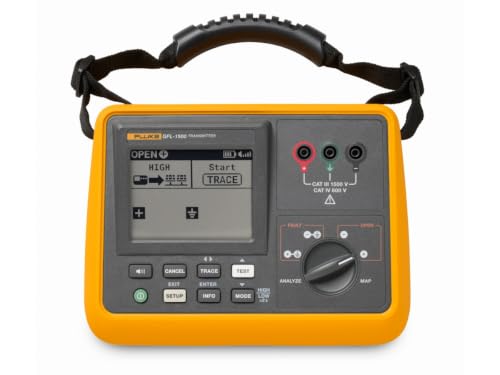
Fluke GFL-1500 Ground Fault Locator
A transmitter, receiver and clamp that trace an active DC ground fault to the module, with a graphic display that estimates the nearest module number.
General Tools DBTU1300 Solar Power Meter
A cosine corrected silicon photodiode meter reading 0 to 2000 W/m2, the irradiance input for performance ratio calculations on a utility array.
The two listings that cannot go on a 1500 V array
P4 and P5 are DC power analyzers. The listings describe voltage ranges of 4.8 to 60 V, an optional auxiliary battery mode of 12 to 100 V, and a current range of 0 to 200 A or 0 to 150 A depending on which listing you read. Both listings carry the same warning: designed for systems below 100 V and 200 A, do not exceed these rated limits. A 1500 V string is fifteen times the published ceiling. Connecting either one to a utility string is not a measurement, it is a fault.
There is a second problem that is easy to miss. The two listings are near duplicates. P4 is titled as a 200 A unit and P5 as a 150 A unit, yet the bullet text in both describes a 0 to 200 A current range with 0.01 A accuracy and identical voltage, power and capacity figures. The listing text does not distinguish them in any way that a buyer can rely on. Treat them as one product in two titles, and if you need a low voltage DC analyzer for a battery or a 48 V system, choose on availability rather than on the apparent difference. They are simply not part of this comparison.
Ground faults, irradiance and the work a multimeter cannot do
A 1500 V array fails in ways a meter alone will not resolve. The first is a ground fault: an insulation failure somewhere in a string of hundreds of modules. The string still produces voltage, the inverter still sees the array, and the fault is a leakage path to earth that may be a few hundred metres away. P1 can tell you the fault exists, because the voltage to earth will be wrong. P2 is built to find it. The transmitter injects a traceable signal, the clamp follows that signal along the DC system, and the receiver’s graphic display estimates the module number closest to the fault. That is a different instrument for a different job, and no multimeter substitutes for it.
The second job is performance. A utility array is judged on performance ratio, and that calculation needs irradiance measured in the plane of the array. P3 does that with a cosine corrected silicon photodiode, which means it reads correctly when the light arrives at an angle rather than straight on. The listing publishes the correction as under 5 percent for angles below 60 degrees, so at low sun angles the reading carries more uncertainty than the headline range suggests. The 99 reading log lets you collect a set of measurements across a row without writing them down. For the wider set of tasks an O and M technician faces, solar testing tools for O and M technicians covers the same ground from the maintenance side.
What the listings do not publish, and why you should ask
Several figures that a utility array job needs are absent from these listings. P1 does not publish a DC accuracy specification for voltage or current, only the safety rating and the 60 A clamp range. P2 does not publish a safety rating at all, which is a gap on a 1500 V system: the product name says 1500 V, but the listing bullets do not state a CAT rating, and those are not the same claim. P3 does not publish an accuracy figure for the irradiance reading, only the cosine correction. None of the three publishes an operating temperature range or an ingress protection rating, and on a utility row both matter, because the instrument sits in the sun and the dust.
None of this makes the listings wrong. It means the buyer has to ask. If you are specifying for a utility-scale site, request the calibration certificate and the CAT rating documentation for the meter and every lead in the kit, and request the accuracy specification for the irradiance meter. A published range is not a published accuracy, and on a performance test the difference between the two determines whether the result is defensible. The same discipline applies to the lower voltage jobs covered in this category and in best solar string testers, where the rating on the leads is the detail most often missed.
Recommended Tools


Products shown because their documented specifications fit this guide. Price and availability are on Amazon and can change.
Frequently Asked Questions
Can I use a standard 1000 V multimeter on a 1500 V array?
No. The safety category rating describes the transient energy the instrument can absorb, and a 1000 V CAT III meter is not rated for a 1500 V DC circuit. P1 is the only listing here that publishes CAT III 1500 V on the meter and on the supplied leads, which is the combination the job requires.
Why are P4 and P5 excluded?
Both listings publish a voltage ceiling well below the array voltage. The text describes a 4.8 to 60 V range, an optional auxiliary battery mode of 12 to 100 V, and a warning not to exceed 100 V and 200 A. A 1500 V string is far outside that. They are low voltage DC analyzers, not utility array testers.
Are P4 and P5 actually different products?
The titles differ, one says 200 A and the other 150 A, but the bullet text in both describes the same 0 to 200 A current range, the same 0.01 A accuracy, and identical voltage, power and capacity figures. The listings do not publish a difference a buyer can rely on. If you need a low voltage analyzer, choose on availability.
Do I need the ground fault locator if I already have the meter?
Yes, if you are responsible for finding faults rather than just detecting them. P1 can show that a ground fault exists. P2 traces the fault to the module using a transmitter, receiver and clamp. They are different jobs, and the listing for P2 also states it estimates the module number closest to the fault, which a multimeter cannot do.
Is the irradiance meter a safety instrument?
No. P3 measures solar power intensity from 0 to 2000 W/m2 with a silicon photodiode and cosine correction. It is an input to performance ratio calculations, not an electrical safety tool. It does not measure voltage, current or insulation, and it should not be used to decide whether a circuit is safe to touch.
What is missing from these listings that I should ask for?
P1 publishes no DC accuracy figure for voltage or current. P2 publishes no CAT safety rating in its bullets, only 1500 V in the title. P3 publishes no accuracy figure for the irradiance reading. None of the three publishes an operating temperature range or an IP rating. Ask the supplier for the calibration certificate and the rating documentation before you buy.
Affiliate disclosure: Akermin earns a commission from qualifying Amazon purchases made through links on this page. Our editorial picks are based on documented specifications and owner feedback, not commissions.
Related Guides

UNI-T UT503PV Review: A DC 1000 V Headline on a CAT III 600 V Body
A solar insulation resistance tester that works on energised PV strings up to DC 1000 V, with test voltages of 125, 250, 500 and 1000 V, a range to 4000 megohms, automatic discharge, 1000 stored result sets and USB or Bluetooth transfer.
Read More→
ANCEL BA101 Review: The Exclusion List Is the Most Useful Bullet
A 12 volt battery, cranking and charging system tester covering 100 to 2000 CCA that reports state of health, state of charge, voltage, current and CCA, drawing its own power from the battery under test.
Read More→
Tenmars Solar Power Meter Review: One Accuracy Figure, Two Very Different Jobs
A handheld solar irradiance meter reading 0 to 1999 watts per square metre or 0 to 634 BTU per square foot per hour, with a selectable 199.9 or 1999 scale, maximum and minimum tracking, data hold and manual zeroing.
Read More→