Best USB Borescopes for Phones: 5 Picks That Use the Screen You Already Own
A phone borescope costs a fraction of one with its own screen because you already own the expensive part. What you inherit instead is a connector question, an app dependency and a cable that has to hold its shape on its own.
As an Amazon Associate, Akermin earns from qualifying purchases. Product links on this page are affiliate links.
Our Top Picks
Cameras were compared on probe diameter, cable length and whether it is semi rigid, stated resolution, waterproof rating, lighting arrangement, lens count and the connectors and operating system versions each listing supports. We did not run laboratory tests and publish no measurements of our own.
Best Overall
DEPSTECH NTC55 2K Dual Lens
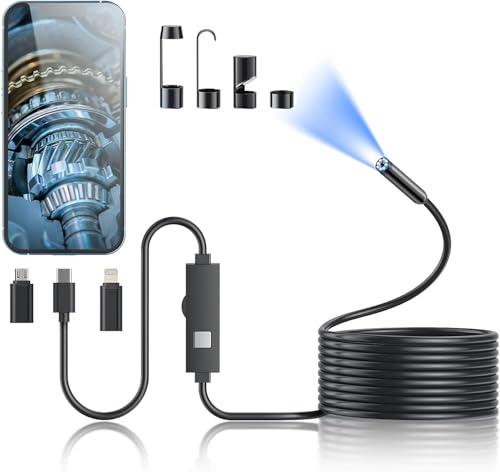
A 7.9 mm dual lens probe at 2560 by 1440 with both Type-C and Lightning supplied.
2560 by 1440 resolution, stated as 3.69 million pixels
Dual front and side lenses on a 7.9 mm probe, switchable in the app
80 degree viewing angle with 2x zoom and 90 degree rotation in the app
Type-C connector and Lightning adapter, iOS 11 and Android 9 or later
Connector and operating system support changes as phones change. Confirm current compatibility with your specific device before buying rather than relying on a listing written some time ago.
How to Choose a Phone Borescope
The connector decides whether it works at all. After that, the cable decides whether it is pleasant to use.
Check the Connector First
Type-C, Lightning and Android support all differ. A borescope that does not fit your phone is not a cheaper borescope, it is a paperweight.
Semi Rigid Cable Holds Its Shape
A floppy cable will not push along a horizontal duct. A rigid one will not turn a corner. Semi rigid bends where you bend it and stays there.
A Side Lens Is What You Actually Need
Inside a bore or a pipe, the surface of interest is beside the probe, not ahead of it. A side view removes the mirror attachment and the reversed image.
Waterproof Means a Stated Rating
Drains and traps mean standing water. Look for an IP rating with a depth and duration, not a claim that the probe is water resistant.
Dimmable Light Beats Bright Light
Close to a shiny wet surface, a bright LED produces glare that hides everything. The ability to turn the light down is what reveals detail.
Your Phone Becomes the Instrument
Battery, screen brightness in sunlight and app updates all become part of whether you can inspect. A unit with its own screen avoids that entirely.
Check three things: the physical connector, the operating system version and whether the manufacturer app supports your device. The DEPSTECH NTC55 listing states Type-C plus a Lightning adapter with iOS 11 and Android 9 or later, which is more detail than most. Compatibility changes as phones change, so confirm before buying.
Phone borescope or one with its own screen?
A phone unit is far cheaper because you already own the screen and processor. A standalone unit has no connector question, no app updates and no flat phone, and gives a consistent image every time. If you inspect regularly, the standalone is less frustrating; if occasionally, the phone unit is better value.
What probe diameter do I need?
It is decided by the smallest hole you must pass through. Spark plug holes, drain access points and wall cavities all impose their own limits. The slimmest probe here is 7.9 mm; check the access before choosing.
Why do my images look washed out?
Almost always glare. Close to a reflective or wet surface, a bright LED bounces straight back into the lens. Turn the lighting down until detail appears, and move slightly further back if you can.
Can I put one down a drain?
Only if it has a stated waterproof rating covering immersion. The Elecshion listing states IP67 with operation underwater to just over a metre for an hour. Anything without a stated rating should be treated as splash resistant at best.
Do I need a side lens?
For anything cylindrical, yes. Inside a bore, a pipe or a duct the surface you want to inspect is beside the probe rather than in front of it, and a forward-only camera shows you the far end instead of the wall. The alternative is a mirror attachment, which reverses the image and tends to fall off.
Reviews
DEPSTECH NTC55 2K Dual Lens Best Overall
Supplying both a Type-C connector and a Lightning adapter removes the single biggest frustration in this category. Phone borescopes are bought, delivered and then discovered to fit the wrong socket, and a household with a mix of devices needs one that fits both. Stating the minimum operating system versions is equally useful and equally rare.
The dual lens arrangement on a 7.9 mm probe is the technical strength. A forward lens shows you where you are going and a side lens shows the wall you are actually inspecting, which inside a cylinder bore or a pipe is the direction that matters. Switching between them in the app rather than with a mirror attachment is faster and keeps the image the right way round. At 2K the resolution is the highest here, which matters when you are looking for a hairline crack rather than an obvious blockage.
A semi rigid cable is the feature that separates a usable borescope from a frustrating one. A fully flexible cable coils and will not push into a horizontal duct or along a pipe; a fully rigid one cannot get round a bend. Semi rigid bends when you bend it and then holds that shape, which lets you form a curve, push it in and have the tip stay pointing where you aimed it.
The IP67 rating with a stated depth and duration is the other reason to choose this one. Drain and pipe work means standing water, and a probe rated only for splashes fails the first time it goes into a trap. Nine adjustable LEDs is generous: inside a pipe there is no ambient light at all, and being able to reduce the output matters as much as increasing it, because a bright LED against a shiny wet surface produces glare that hides everything.
Strengths
IP67 with a stated depth and duration
Semi rigid cable holds the shape you give it
16.5 feet of reach
Nine adjustable LEDs including a dedicated side light
Dual lens capability at the bottom of the price range is the argument here. Front and side views cover the two things inspection actually requires, navigating to the target and then looking at the surface beside the probe, and having both removes the need for mirror attachments that reverse the image and fall off.
Sixteen and a half feet is enough for the overwhelming majority of household and automotive work: a wall cavity, a duct run, an engine bay, a drain to the first bend. Longer cables exist and are harder to push, harder to store and harder to keep clean. For a general purpose phone borescope this length and configuration is the sensible middle, and DEPSTECH is one of the more established names in an otherwise anonymous category.
Adjustable lighting is underrated and it is the difference between a usable image and a white blur. Inside a cylinder bore, a pipe or a wall cavity the probe is often only a few centimetres from the surface, and at that distance a bright LED reflects straight back into the lens. Being able to turn the light down until detail appears is how you actually see a scoring mark or a crack.
Eight LEDs rather than one or two also spreads the light around the head, which reduces the harsh single shadow that makes a rough surface impossible to interpret. At 1920P the resolution is respectable without being class leading, and for the money this is a sensible general purpose choice for anyone whose inspections are mostly close range.
Auto focus is the specification that distinguishes this from almost everything else in the category. Most cheap borescopes have a fixed focus optimised for a few centimetres, which means anything closer or further is soft, and inside a bore you are constantly at the wrong distance. A probe that focuses across a range stays sharp as you move it.
Working with Windows and MacBook as well as Android is the other differentiator, and it matters for anyone documenting inspections. A laptop gives a far larger image than a phone, makes saving and annotating files straightforward, and is already on the bench in a workshop. The listing mentions chip level detail among its uses, which is consistent with a 5 megapixel auto focus module rather than a general purpose fixed focus one.
Short answer: the DEPSTECH NTC55 is the best overall because it is the highest resolution here, has front and side lenses on a slim 7.9 mm probe and ships with both Type-C and Lightning; the Elecshion is the one for drains and wet work thanks to a stated IP67 rating and a semi rigid cable; and the Teslong 5.0MP is the pick if you want auto focus and a laptop sized image.
You are buying a camera, not a camera system
That is the whole economic argument for this category. A borescope with its own screen has to include a display, a battery, storage and a processor, and those are most of the cost. A phone borescope is a probe, a cable and a connector, because you already own everything else. The saving is substantial and the trade is that your phone becomes part of the instrument: its battery, its screen in daylight, the app and the connector all become things that can stop an inspection.
The connector is the first question, not the last
More phone borescopes are returned for fitting the wrong socket than for any other reason. Android phones moved to Type-C, iPhones moved to Type-C from Lightning at a particular generation, and older devices are still in use everywhere. On top of that, an operating system update can change how a USB camera is granted permission, which occasionally breaks accessories that worked yesterday. Two of the listings here state their connector and operating system requirements explicitly, and that is worth prioritising over a modest difference in resolution.
Why cable stiffness matters more than length
A borescope cable has to do two contradictory things: bend to get round a corner and stay rigid enough to push forward. A fully flexible cable simply coils up when you push it into a horizontal duct or along a pipe, and the tip goes nowhere. A fully rigid one cannot enter anything with a bend. Semi rigid is the compromise that actually works: you shape it with your hands, it holds that shape, and it transmits enough push to advance. The Elecshion listing states this directly, and it is the specification most likely to determine whether you enjoy using the tool.
Looking sideways is the normal case
Most inspection targets are cylindrical, and in a cylinder the surface you care about is beside the probe rather than in front of it. Cylinder bores, pipes, ducts, chimneys and wall cavities all work this way. A forward-only camera shows you the far end of the hole in excellent detail and the wall not at all. Historically the answer was a mirror attachment, which reverses the image, halves the light and falls off in the worst places. A second lens pointing sideways, switchable in the app, solves it properly.
Turn the light down
New users assume more light is better, and inside a narrow space the opposite is true. The probe is often only a few centimetres from a reflective or wet surface, and a bright LED at that distance bounces straight back into the lens, producing a white blur that hides exactly the crack or deposit you are looking for. Adjustable lighting is what fixes it. Turn the output down until the surface texture appears, and move slightly back if you have room. For units with their own screen and for articulating probes, see the borescope roundup and articulating borescopes.
How We Research
Cameras were compared on probe diameter, cable length and stiffness, stated resolution, lens count and orientation, lighting arrangement and adjustability, waterproof rating, and the connectors and operating system versions each listing states. We did not run laboratory tests and publish no measurements of our own.
Yes, a pyrometer needs power, but the source depends on the type: batteries for handheld guns, mains or loop power for fixed sensors, and sometimes no local power for passive optical types.