As an Amazon Associate, Akermin earns from qualifying purchases. Product links on this page are affiliate links.

bonoch · bonoch 16 in 1 Air Quality Monitor Indoor 7" HD High-Precision CO2 Monitor
View on AmazonPrice and availability are shown on Amazon and can change at any time.
An indoor air quality monitor with a 7 inch display and externally mounted sensors, reporting CO2, PM2.5, PM1.0, PM10, formaldehyde, TVOC, temperature and humidity, plus an AQI index and a clock, with seven alarm thresholds you set yourself and a mute button. The name promises sixteen in one and the first bullet promises nine parameters. Neither figure decides the purchase. What decides it is that a listing built around a 0.001 precision claim publishes no accuracy tolerance, no measurement range and no sensor type for anything it measures.
Sixteen in one, nine parameters, and one of them is a clock
The product name says 16 in 1. The first bullet says the unit tracks 9 essential parameters in real time. Then it lists them: CO2, PM2.5, PM1.0, PM10, HCHO, TVOC, temperature, humidity, AQI and time.
Count that list. Treat the three particulate sizes as one group and it comes to eight. Count them separately and it comes to ten. It does not come to nine, and nothing on the page comes to sixteen.
The arithmetic is worth doing because of what the last two entries are. AQI is not a measurement. It is an index calculated from particulate and gas readings the instrument already holds, so counting it as a parameter counts the same data twice. Time is a clock. Strip those two and the sensing hardware covers six things: carbon dioxide, particulates, formaldehyde, volatile organic compounds, temperature and humidity.
Six is a reasonable set, it is the set most of this category offers, and there is nothing wrong with it. The problem is that a buyer comparing a sixteen in one against a nine in one against a six in one is comparing marketing multipliers rather than instruments, and the only way out is to read the parameter list and count it yourself.
Where the larger number probably comes from is display tiles and alarm modes rather than sensors. Seven alarms alongside nine parameters makes sixteen items of some kind. That is a guess, and the listing offers nothing to replace it with.
0.001 is a resolution, and it has no unit
The second bullet is headed External High-Precision Sensors (0.001 Accuracy) and promises 0.001-level precision. Two things are wrong with that, and both matter.
First, 0.001 of what? A figure with no unit is not a specification. If it refers to formaldehyde in milligrams per cubic metre then 0.001 is a believable display step. If it is meant to apply to carbon dioxide in parts per million then it is not a quantity any consumer sensor can resolve, and claiming it would be like quoting a bathroom scale to the nearest microgram.
Second, precision and accuracy are different properties and the bullet treats them as one. Resolution is the smallest change the display will show. Accuracy is how far the displayed number can sit from the truth. An instrument can show three decimal places and be wrong by a factor of two, and the three decimal places will look reassuring throughout.
What a buyer needs instead is a tolerance for each channel, expressed as plus or minus so many parts per million, or plus or minus a percentage of the reading. None appears. Nor does a measurement range, so there is no stated upper limit for the carbon dioxide the instrument will report, and no sensing technology is named for any channel. Our note on comparing CO2 accuracy specifications sets out what a usable tolerance looks like, and checking whether a monitor uses a true NDIR sensor explains why the method matters far more than the decimal places.
The perfume warning is the most informative line here
Tucked into brackets at the end of the second bullet is a note asking you to avoid touching the sensors or exposing them to perfumes and strong odours. That line is published against the seller interest and it is the most useful sentence on the page.
It tells you how the volatile organic compound channel behaves. A broadband VOC sensor responds to a mixture of gases and reports a single summed figure, so a spray of deodorant, a cleaning wipe or a scented candle will move it hard. That is not a fault. It is what the measurement is. But it means the TVOC number is a change detector for the room rather than a concentration you can act on in isolation.
It carries a second implication for the formaldehyde channel. Formaldehyde is itself a volatile organic compound, and on instruments of this kind the two readings are frequently produced by related sensing chemistry. A warning that scent throws the sensors is therefore a warning about the HCHO figure as well, and the listing never says which method produces it. Read what TVOC actually reports before treating either number as absolute.
What external sensors fix, and what they expose
The claim that the sensors are external and sample air directly describes a real design decision with a real benefit, and it deserves credit.
Every instrument that measures temperature inside its own case fights its own electronics. A display, a processor and a power supply all produce heat, and a temperature sensor sitting among them reads the enclosure rather than the room. Relative humidity depends on temperature, so a warm sensor also reports a humidity lower than the air around it. Moving the sensing elements outside the body is the standard fix, and on a unit with a 7 inch screen it matters more than usual, because a large backlit panel is a large heat source.
Enhanced airflow, the other phrase in that bullet, addresses the opposite problem. A particulate sensor needs air moved through it, and a gas sensor in a sealed box lags the room badly.
The trade is exposure. Sensing elements outside the case collect dust, get touched, and have nothing protecting them, which is why the bullet asks you not to handle them. Siting becomes a real decision rather than an afterthought: away from a window draught, away from the cooker, not above a radiator, and not where somebody will pick the unit up by the sensor block.
Every published figure, and the accuracy rows that are blank
| Specification | Published in the listing |
|---|---|
| Parameters stated | Nine, listed as CO2, PM2.5, PM1.0, PM10, HCHO, TVOC, temperature, humidity, AQI and time |
| Display | 7 inch, described as HD |
| Alarms | Seven settable AQI alert alarms, with a mute button |
| Sensor placement | External, sampling air directly |
| Precision claim | 0.001 level, no unit given |
| Temperature units | Switchable, by double pressing the power button |
| Clock | 12 and 24 hour formats, set by hand |
| CO2 sensor technology | Not stated in the listing bullets |
| CO2 measurement range | Not stated in the listing bullets |
| CO2 accuracy | Not stated in the listing bullets |
| Formaldehyde method and range | Not stated in the listing bullets |
| Particulate accuracy | Not stated in the listing bullets |
| Temperature and humidity accuracy | Not stated in the listing bullets |
| Warm up time or sensor life | Not stated in the listing bullets |
| Power source, battery, logging or export | Not stated in the listing bullets |
Read the blank half of that table as the specification it is. Eight of the figures a buyer would want to compare are absent, and they are the eight that decide whether a reading means anything. The published half describes an interface: a screen, some buttons, alarm thresholds and a clock. Two of the five bullets are spent entirely on setting the time and swapping Fahrenheit for Celsius.
The buyer this suits, and the buyer it will mislead
It suits somebody who wants a large, readable panel showing whether the air in a room is getting worse, and who will act on the direction of travel rather than the figure. For that job the breadth of channels, the external sensors, the seven alarms and the mute button are all genuinely useful, and the big screen is the point, because you can read it from across a room, which is how a monitor like this actually gets used.
It will mislead anybody who needs a number to defend. If you are investigating a formaldehyde complaint in a new fit out, documenting ventilation performance for a workplace, or deciding whether a room meets a guideline level, you need a tolerance and a named sensor, and this listing supplies neither. A monitor that publishes a stated tolerance in parts per million and names its sensing method is worth more than one that publishes three decimal places.
And if the sixteen in one headline is what attracted you, buy it for the nine on the display instead, because that is what arrives.
Recommended Tools


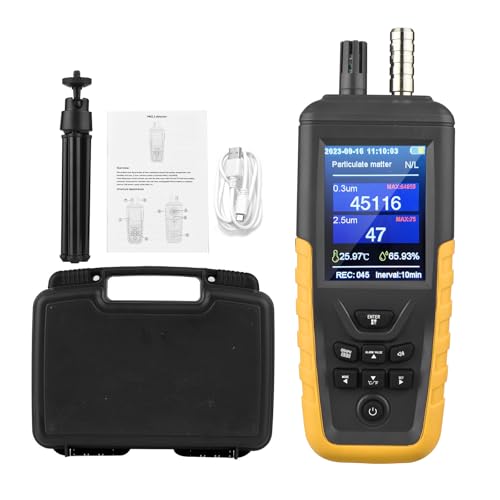
Products shown because their documented specifications fit this guide. Price and availability are on Amazon and can change.
Frequently Asked Questions
Does the 16 in 1 name mean sixteen sensors?
No, and the listing does not claim that either. The first bullet states nine parameters, and the list it gives includes AQI, which is an index calculated from readings the instrument already has, and time, which is a clock. Counting only the things the hardware senses leaves carbon dioxide, particulates in three size bands, formaldehyde, volatile organic compounds, temperature and humidity. The sixteen is most likely a count of display items and alarm modes, and the bullets never explain how it is reached.
What does the 0.001 accuracy figure actually specify?
Nothing checkable, because no unit is attached to it. A step of 0.001 in milligrams per cubic metre would be a plausible display resolution for formaldehyde. A step of 0.001 in parts per million would be an impossible claim for carbon dioxide. More importantly, the bullet uses precision and accuracy as though they were the same property. Resolution is the smallest change the screen can show. Accuracy is how far the displayed number can sit from the truth, and no accuracy figure appears anywhere in this listing.
Why does the listing warn about perfume and strong odours?
Because a broadband volatile organic compound sensor responds to a wide mixture of gases and reports them as one summed figure, so anything scented in the room moves it sharply. The warning is accurate and it is published against the seller interest, which is to its credit. The practical consequence is that the TVOC trace should be read as a before and after indicator rather than as a concentration, and that nothing scented should be sprayed near the sensor block before a reading you intend to rely on.
Is the external sensor design an advantage?
Yes, and particularly for two measurements. A temperature sensor inside a case with a large backlit display reads the warmth of the electronics rather than the air in the room, and because relative humidity depends on temperature, a warm sensor also under reports humidity. Sampling outside the body removes both errors, and it lets air reach a particulate sensor instead of lagging behind the room. The trade is exposure, since the sensing elements collect dust and can be touched, which is why the bullet asks you not to handle them.
What would you need to establish before relying on its CO2 reading?
The sensor technology and the accuracy tolerance, neither of which is stated. The distinction that matters most is whether carbon dioxide is measured optically or inferred from a volatile organic compound sensor, because an inferred figure tracks human activity in a room without measuring the gas at all. The listing calls it a CO2 monitor and never names the method, so that question has to be answered somewhere other than in the bullets.
Affiliate disclosure: Akermin earns a commission from qualifying Amazon purchases made through links on this page. Our editorial picks are based on documented specifications and owner feedback, not commissions.
Related Guides

Temtop Handheld Particle Counter Review: Three Channels and No Published Flow Rate
A pump suction handheld particle counter reading 0.3, 0.5 and 1.0 micron channels alongside PM2.5, PM10 and TSP, with temperature and humidity sensors, 32 GB of internal storage and a 3500 mAh battery.
Read More→
VETOUCH Plug In CO2 Monitor Review: An Alarm the Bullets Never Define
A mains powered three in one monitor showing carbon dioxide, temperature and humidity on a 1.83 inch colour screen, with three brightness settings and a display that flips 180 degrees.
Read More→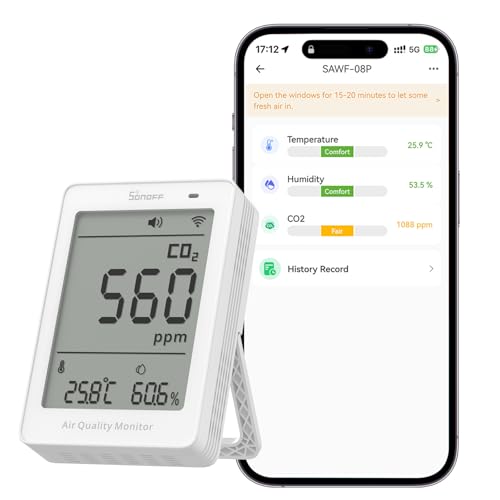
SONOFF AirGuard SAWF-08P Review: NDIR Accuracy Written as a Formula
A mains powered Matter compatible monitor showing CO2, temperature and humidity on one screen, with an NDIR sensor, 5 second updates and 12 months of history in the eWeLink app.
Read More→