As an Amazon Associate, Akermin earns from qualifying purchases. Product links on this page are affiliate links.
For most aircraft engine work, the DXZtoz 3.9mm Ultra-Slim Articulating Borescope is the pick because its 3.9mm stainless steel probe passes the smallest ports and its 220 degree two-way articulation lets you look back at valve faces and cylinder walls without repositioning the probe. The DXZtoz AGC900D 6.5mm Slim Probe is the better all-rounder if you need a side camera and a 5 inch screen for documentation, and its 0.25in probe is close to the DXZtoz 3.9mm Ultra-Slim Articulating Borescope in access. The DEPSTECH Dual Lens Articulating Borescope has the largest probe at 0.33in, which rules it out of the tightest spark plug holes, but its dual lens and joystick make it a reasonable choice for airframe and plenum work where the port is wider.
Why probe diameter decides the aircraft job before anything else
On an aircraft engine, the inspection access is fixed by the manufacturer. You do not get to enlarge a spark plug hole or a borescope port. That makes probe diameter the first specification that matters, not the last. A 0.25in probe is about 6.35mm. A 0.33in probe is about 8.4mm. That difference of roughly 2mm is the difference between passing a small Lycoming or Continental spark plug hole cleanly and not passing it at all.
The listings here state probe diameters of 0.25in for the DXZtoz AGC900D 6.5mm Slim Probe, 3.9mm for the DXZtoz 3.9mm Ultra-Slim Articulating Borescope, and 0.33in for the DEPSTECH Dual Lens Articulating Borescope. The DXZtoz 3.9mm Ultra-Slim Articulating Borescope is the slimmest. The DXZtoz AGC900D 6.5mm Slim Probe is close behind. The DEPSTECH Dual Lens Articulating Borescope is the largest of the three and should be treated as an airframe and plenum tool rather than a cylinder tool. If your work is cylinder inspection, start by measuring the port you actually use, then choose the probe that fits with a little clearance. A probe that touches the sides of the port is hard to steer and easy to scratch.
Articulation is the second diameter-related decision. All three listings claim two-way articulation in the 210 to 220 degree range. That range is what lets you enter through a spark plug hole, then turn the tip back toward the valve faces and the cylinder wall. Without articulation you are looking straight ahead only, which is useful for a bore but not for the far side of a valve. The articulating borescopes for engine inspections page covers this mechanism in more detail.
How the three listings compare on the specifications that affect aircraft work
| Specification | DEPSTECH | DXZtoz AGC900D 6.5mm | DXZtoz 3.9mm |
|---|---|---|---|
| Probe diameter | 0.33in | 0.25in | 3.9mm |
| Articulation | 210 degree two-way | 210 degree two-way | 220 degree two-way |
| Probe length | 5FT | 5FT | 5FT |
| Probe material | Semi-rigid cable | Not stated | Stainless steel |
| Screen | 5in IPS, 1080P | 5.0in, 1080P | 5in IPS |
| Side view | Dual lens, split screen | One-button 90 degree side camera | Not stated |
| Zoom | Not stated | 10X | 10X |
| LEDs | Not stated | 7 | 6 |
| Waterproof rating | Not stated | IP67 | Not stated |
| Heat resistance | Not stated | Not stated | Up to 60 |
| Recording | Photo and video, one-touch | Photo and video with sound, 32GB card | Not stated |
| Close focal range | Not stated | Not stated | 1cm |
Cells marked Not stated are absent from the supplied listing bullets. No figures have been estimated or converted beyond the inch to millimetre relationships shown in the text.
Two things stand out. First, the DXZtoz 3.9mm Ultra-Slim Articulating Borescope is the only listing that states a close focal range, 1cm, and the only one that states a heat resistance figure, 60. For cylinder work where you are close to the piston crown and the barrel is warm, those two figures matter more than screen size. Second, the DXZtoz AGC900D 6.5mm Slim Probe is the only listing that states a waterproof rating and an audio recording capability, which is useful if you are documenting a repair for a customer or a logbook.
The three articulating borescopes
DEPSTECH Dual Lens Articulating Borescope
Dual lens with split screen and a 5 inch IPS display, 210 degree two-way articulation, 0.33in probe on a 5FT semi-rigid cable, joystick control with one-touch photo and video.
DXZtoz AGC900D 6.5mm Slim Probe
0.25in probe with 210 degree two-way articulation, one-button 90 degree side camera, 5 inch 1080P screen with 10X zoom, 7 LEDs, IP67, 32GB card and audio video recording.
DXZtoz 3.9mm Ultra-Slim Articulating Borescope
3.9mm stainless steel probe with 220 degree two-way rotation, 1cm close focal range, 10X zoom, 6 LEDs, 5 inch IPS screen, heat resistant to 60.
What the side-view camera actually buys you in a cylinder
A forward-facing camera looks down the bore. That is enough to see the piston crown and the top of the cylinder wall, but it is a poor way to inspect a valve face or the area behind a valve guide, because those surfaces face sideways relative to the probe axis. A side camera, or a second lens that looks sideways, lets you see those surfaces without bending the probe into a shape it cannot hold.
The DEPSTECH Dual Lens Articulating Borescope uses a dual lens with split-screen viewing, so the forward and side feeds are displayed at the same time. The DXZtoz AGC900D 6.5mm Slim Probe uses a one-button switch to a 90 degree side camera, so you see one view at a time. Both approaches work. The split screen on the DEPSTECH Dual Lens Articulating Borescope means you never lose the forward reference, which is helpful when you are trying to remember which valve you are looking at. The single side view on the DXZtoz AGC900D 6.5mm Slim Probe is simpler and the button is faster to operate one-handed inside a cowling.
What neither side camera does is measure. A borescope shows you a surface. It does not tell you whether a crack is 2mm or 20mm unless you have a known reference in the frame or a measurement overlay, and none of these three listings states a measurement function. For defect sizing you are still relying on the inspector’s judgement and, where the manual calls for it, a follow-up dimensional check. The guide to choosing a borescope explains where visual inspection stops and measurement begins.
The access problem nobody mentions until the probe is stuck
A 5FT probe is long enough for most aircraft cylinder and plenum work, but length is not the same as steerability. A semi-rigid cable, which is what the DEPSTECH Dual Lens Articulating Borescope states, holds a bend. That is useful when you want the probe to stay where you put it, and awkward when you need to make a tight turn inside a confined space. A stainless steel probe, which is what the DXZtoz 3.9mm Ultra-Slim Articulating Borescope states, is stiffer and more resistant to taking a set, and the listing claims it is 60 percent more wear-resistant than a standard gooseneck cable. If you are inserting and withdrawing the probe many times a day, that wear resistance is the difference between a tool that lasts a season and one that lasts several.
Heat is the other access problem. An engine that has just been run is hot, and a probe left in contact with a hot surface can be damaged. The DXZtoz 3.9mm Ultra-Slim Articulating Borescope is the only listing that states a heat resistance figure, up to 60. That is not a high number in absolute terms, and it is not a licence to inspect a hot turbine. It is a statement that the probe can tolerate warm surfaces better than a typical plastic-sheathed cable. For anything hotter, wait for the engine to cool to a temperature you can touch comfortably.
Articulation control matters here too. The DEPSTECH Dual Lens Articulating Borescope uses a joystick, which the listing describes as designed for one-handed operation. The DXZtoz AGC900D 6.5mm Slim Probe and the DXZtoz 3.9mm Ultra-Slim Articulating Borescope do not describe their control mechanism in the supplied bullets. If you are working alone inside a cowling, one-handed control is a real advantage, because your other hand is often holding a light or steadying the probe entry.
Where a borescope stops being the right answer for aircraft work
A borescope is a visual tool. It does not detect cracks that are closed and tight, it does not measure wall thickness, and it does not replace a eddy current or dye penetrant inspection where the maintenance manual calls for one. If the task is to find a fatigue crack in a structural member, a borescope can show you the surface, but it cannot tell you how deep the crack goes. That is a different instrument and a different procedure.
A borescope also does not replace a compression test or a leak-down test for cylinder condition. Those tests tell you whether a cylinder is sealing. A borescope tells you why it might not be, for example a burned valve or a scored wall. The two are complementary. Use the borescope to look, and the test to quantify.
Finally, a borescope is not an alarm. It does not warn you of anything. It is a camera on a steerable cable. The judgement about whether a defect is airworthy belongs to the inspector and the approved maintenance data, not to the tool. If you are new to aircraft inspection, the borescopes for aircraft maintenance page sets out the wider selection criteria, and the engine inspection picks go deeper on cylinder work specifically.
Recommended Tools


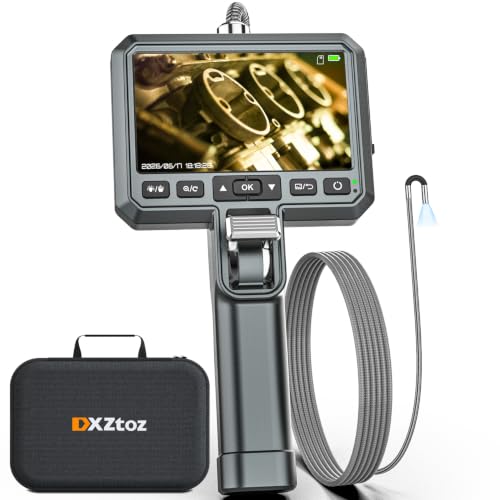
Products shown because their documented specifications fit this guide. Price and availability are on Amazon and can change.
Frequently Asked Questions
Which of these three will fit through a spark plug hole?
the DXZtoz 3.9mm Ultra-Slim Articulating Borescope at 3.9mm and the DXZtoz AGC900D 6.5mm Slim Probe at 0.25in (about 6.35mm) are the slimmest and are the most likely to pass a small spark plug hole. The DEPSTECH Dual Lens Articulating Borescope at 0.33in (about 8.4mm) is the largest and may not fit the smallest holes. Measure your actual port before ordering.
Do I need a side-view camera for cylinder inspection?
It helps. A forward view shows the bore and the piston crown. A side view shows valve faces and the area behind the valve guide, which face sideways. The DEPSTECH Dual Lens Articulating Borescope and the DXZtoz AGC900D 6.5mm Slim Probe both provide a side view. The DXZtoz 3.9mm Ultra-Slim Articulating Borescope does not state one in the listing bullets.
Can these borescopes measure a crack or a defect?
None of the three listings states a measurement function. They show surfaces. Sizing a defect still relies on the inspector's judgement, a known reference in the frame, or a follow-up dimensional check called for by the maintenance manual.
Is the probe heat resistant enough for a hot engine?
Only the DXZtoz 3.9mm Ultra-Slim Articulating Borescope states a heat resistance figure, up to 60. The DEPSTECH Dual Lens Articulating Borescope and the DXZtoz AGC900D 6.5mm Slim Probe do not state one. In practice, let the engine cool to a temperature you can touch comfortably before inserting any probe. Heat resistance is not a licence to inspect a hot turbine.
What does the 210 or 220 degree articulation figure mean?
It is the total range through which the probe tip can be steered, in two directions from straight ahead. A larger range lets you look further back toward the valve faces without rotating the whole probe. All three listings claim a range in this band.
Are these sold as complete kits with a screen?
Yes. All three listings describe a built-in screen, either 5in or 5.0in, and do not require a phone or an app. The DXZtoz AGC900D 6.5mm Slim Probe additionally states a 32GB memory card is included. The DEPSTECH Dual Lens Articulating Borescope and the DXZtoz 3.9mm Ultra-Slim Articulating Borescope do not state a card in the supplied bullets.
Affiliate disclosure: Akermin earns a commission from qualifying Amazon purchases made through links on this page. Our editorial picks are based on documented specifications and owner feedback, not commissions.