As an Amazon Associate, Akermin earns from qualifying purchases. Product links on this page are affiliate links.
A radiometric thermal file stores a calibrated temperature value for every pixel, so you can move a cursor over the saved image later and read the number that was there at the moment of capture. A plain thermal picture stores only the false-colour rendering, which is a picture of heat, not a measurement of it. If your work involves reporting, re-checking, or defending a finding to somebody else, the radiometric file is the one that keeps its value. If you only need to see where heat is, a plain image is enough. Among the products here, the MiLESEEY TR20 and the AMPBANK M192 both publish temperature measurement ranges and accuracy figures, which is the precondition for radiometric output being meaningful; the Bosch GTC600C publishes image storage and voice notes but does not state in the listing bullets whether its files carry radiometric data, and the Soliluxelink is a visible-light borescope, not a thermal instrument at all.
What a radiometric file actually contains, and what a picture contains
A thermal sensor is a grid of detector elements. Each element produces a signal proportional to the infrared energy falling on it. Inside the camera, that signal is converted, using a calibration curve and the emissivity and ambient temperature settings, into a temperature estimate. The camera then has two things: a grid of temperatures, and a rendering of that grid into colours.
A radiometric file keeps the grid. A plain picture keeps the rendering. That is the whole difference, and it is larger than it sounds. When you open a radiometric file in analysis software, you can move the cursor to any pixel and read the temperature that was recorded there at capture. You can change the colour palette, adjust the level and span, draw an isotherm, or place a spot meter after the fact. None of that is possible with a plain image, because the numbers were discarded when the file was written.
The practical consequence is this: a radiometric file is a measurement you can revisit. A plain picture is a measurement you can only look at. If the inspection is a one-off visual check, the picture is sufficient. If the inspection produces a report, a comparison, or a decision somebody else will rely on, the radiometric file is the one that survives scrutiny.
It is worth being precise about what radiometry does not do. It does not make the camera more accurate. A radiometric camera with poor calibration produces a grid of wrong numbers just as faithfully as a good camera produces a grid of right ones. The thermal camera versus borescope comparison makes a related point: the instrument class determines what you can measure, not how well you measure it.
Why the measurement range and accuracy figures decide whether radiometry is worth having
Radiometric output is only as useful as the temperature figures behind it. If a camera publishes a measurement range and an accuracy figure, the per-pixel numbers in the file mean something. If it does not, the file may still be radiometric in format but the numbers are unverified.
The MiLESEEY TR20 publishes a range of -4 degrees Fahrenheit to 1022 degrees Fahrenheit and an accuracy of plus or minus 2 percent. The AMPBANK M192 publishes -4 degrees Fahrenheit to 842 degrees Fahrenheit with a maximum error of plus or minus 2 degrees Celsius or 2 percent, whichever is greater. Those are the standard figures for this class of instrument, and they tell you what a saved radiometric file is worth: at a reading of 100 degrees Fahrenheit, a 2 percent error is 2 degrees Fahrenheit, which is fine for finding a missing insulation batt and marginal for confirming a component is within its rated operating band.
The Bosch GTC600C publishes image storage, up to 500 thermal images, and voice note storage up to 350 notes, but does not state in the listing bullets whether the saved files are radiometric or plain. That is not a criticism of the camera; it is a statement about what the listing tells you. A buyer who needs radiometric files should confirm that detail before purchase, because the storage figure alone does not answer the question.
The Soliluxelink is a visible-light borescope with a 1080P screen and a 16.4 foot semi-rigid cable. It is not a thermal camera and does not produce thermal files of any kind. It appears here only to mark the boundary of the category: if the question is about seeing inside a cavity, the borescope inspection camera explainer is the right page, not this one.
The export step is where the two classes diverge in daily use
On the camera screen, a radiometric file and a plain picture look the same. The divergence happens when you export. A radiometric file exported to a report needs software that understands the format, and that software is usually the manufacturer’s. A plain picture exports to anything: a word processor, an email, a printed page. This is the trade the buyer is making.
Consider a wall inspection. The camera shows a cold patch. With a plain picture, you have a record that a cold patch existed. With a radiometric file, you have a record of how cold, at which pixel, and you can compare that number with a second inspection later. The second inspection is where the radiometric file earns its keep, because you can subtract one grid from another and see whether the patch grew.
There is a maintenance cost nobody mentions: radiometric files are larger than plain pictures, and the analysis software is a separate dependency. If the software is discontinued or the licence lapses, the files may still be readable but the workflow is not. Plain pictures have no such dependency. For a technician who inspects the same building every season, that dependency is worth accepting. For a homeowner checking a draught once, it is not.
| Question | Radiometric file | Plain picture |
|---|---|---|
| Can you read a temperature at a pixel after capture? | Yes | No |
| Can you change palette or level after capture? | Yes | No |
| Does it open in ordinary image software? | Usually needs specialist software | Yes |
| Is it useful for a one-off visual check? | Yes, but more than needed | Yes |
| Is it useful for comparing two inspections? | Yes | Only visually |
| Does it depend on manufacturer software? | Often | No |
The AMPBANK M192 illustrates the app-dependent version of this trade. It plugs into a USB-C phone and the app handles the measurement settings, including adjustable emissivity and ambient temperature. That is convenient, but it means the radiometric data lives inside a phone workflow. The listing does not publish whether the app exports a radiometric format that other software can read. Not stated in the listing bullets.
Where the radiometric file stops being the right answer
Radiometric output is the right default for professional inspection, but it is not the right answer for every buyer. If the job is to confirm that a radiator is warm, that a circuit breaker is hotter than its neighbours, or that a window is draughty, a plain thermal picture answers the question and costs less in storage, software and learning time.
The place where the radiometric file genuinely stops being the right answer is when the user cannot interpret a temperature. A number without an emissivity setting, a reflected temperature and a distance is not a measurement; it is a number. The MiLESEEY TR20 publishes an alarm function and a temperature width setting, which suggests the camera is designed for threshold work rather than for forensic analysis. That is a reasonable design for a tradesperson who wants to know whether something is over a limit, not for an engineer who needs to defend a number in a report.
There is also the question of what the camera does not do. None of these instruments is a safety monitor. A thermal camera does not detect carbon monoxide, does not certify a confined space, and does not replace a gas detector. It measures surface temperature, and the listing will not tell you otherwise. The Milwaukee inspection camera versus borescope comparison makes the same point about visible-light instruments: the camera shows you a surface, not a hazard.
Finally, the radiometric file is not a substitute for a second measurement. If a reading matters, take it twice, at two distances, with the emissivity set correctly both times. The file preserves what the camera saw; it does not guarantee that what the camera saw was the right thing to measure.
A practical rule for choosing between the two file types
Ask one question: will anybody need to read a temperature from this image after I leave the site? If the answer is yes, choose the camera that writes radiometric files and confirm that the export format is one your software can open. If the answer is no, a plain thermal picture is sufficient and simpler.
For the products here, that rule resolves as follows. The MiLESEEY TR20 publishes measurement figures and an alarm, which is consistent with a camera intended to produce usable temperature data, though the listing does not state the file format. The AMPBANK M192 publishes measurement settings and alarms inside an app, which is consistent with a phone-based radiometric workflow, though again the export format is not stated. The Bosch GTC600C publishes image and voice note storage without stating whether the files are radiometric, so a buyer who needs radiometry should confirm before purchase. The Soliluxelink is a visible-light instrument and does not enter this comparison.
If the job is inside a pipe or a wall cavity rather than on a surface, neither file type helps, and the endoscope camera review is the more relevant page. Thermal and visible-light inspection answer different questions, and the file format question only arises once you have chosen the thermal class.
The file outlives the camera
A thermal camera is replaced every few years; the files it produced are kept for much longer. That is the argument for radiometric output in one sentence: it preserves the measurement, not just the picture of it. If you will never need the number again, save the storage and the software dependency and take the plain picture. If you will, pay for the radiometric file and confirm the export format before you buy, because the listing bullets do not always say.
Frequently Asked Questions
Can I get temperatures from a plain thermal picture after the fact?
No. A plain thermal picture stores the rendered colours, not the per-pixel temperature values. Once the file is written, the numbers are gone. If you need to read a temperature later, the camera must have written a radiometric file at capture.
Does a radiometric camera measure more accurately than a plain one?
No. Accuracy comes from the sensor calibration and the emissivity and ambient settings, not from the file format. A radiometric camera with poor calibration produces wrong numbers in a radiometric file. The format preserves the measurement; it does not improve it.
The Bosch GTC600C listing mentions image storage but not radiometric files. Does it save them?
The listing does not publish that detail. It states storage for up to 500 thermal images and up to 350 voice notes, but does not state whether the image files carry per-pixel temperature data. A buyer who needs radiometric output should confirm with the manufacturer before purchase.
Is a phone-based thermal camera like the AMPBANK M192 suitable for report writing?
It can be, if the app exports a format your report software can read. The listing publishes the measurement range, accuracy, adjustable emissivity and alarms, but does not state the export format. That is the detail to check, because a radiometric file locked inside one app is less useful than one you can open elsewhere.
Do I need radiometric files for a home energy inspection?
Often not. A plain thermal picture is enough to show where insulation is missing or a draught is entering. Radiometric files become useful when you want to compare the same wall across seasons, or when a contractor needs to defend a finding to a client. For a one-off check, the plain picture is sufficient.
Can a thermal camera detect a gas leak or carbon monoxide?
No. A thermal camera measures surface temperature. It does not detect gases, and it is not a safety monitor. A combustible gas sniffer does not detect carbon monoxide either, and a single gas detector does not satisfy confined space entry. Those are separate instrument classes with separate standards.
Related Guides

Fluke 62 Max Infrared Thermometer Review: What the Listing Does Not Say
A specification-by-specification reading of the Fluke 62 Max that separates what the listing publishes from what it leaves out.
Read More→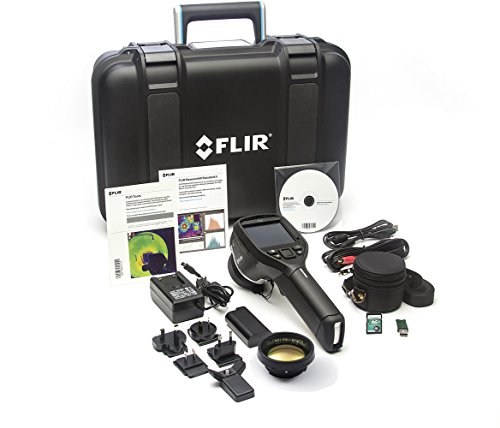
FLIR E50 Review: The 1.82 lb Thermal Camera and the Cost the Listing Hides in Plain Sight
A close read of the FLIR E50 listing, focused on the laser class and the consumable and maintenance implications it carries.
Read More→
Seek Thermal CompactXR Review: The 206 x 156 Sensor Trade-Off
A single-product review of the Seek Thermal CompactXR covering its 206 x 156 sensor, 20 degree field of view, focusable lens and the range-versus-detail trade-off the design forces.
Read More→