As an Amazon Associate, Akermin earns from qualifying purchases. Product links on this page are affiliate links.
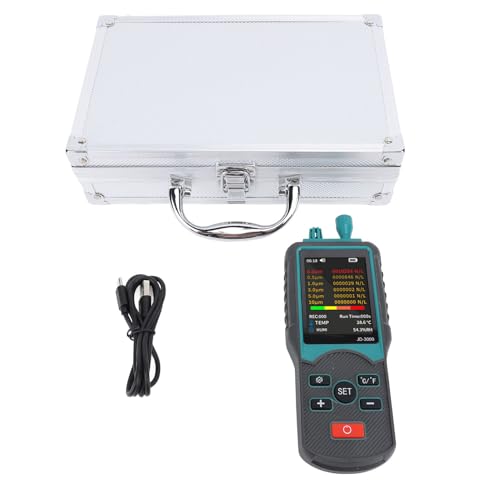
Eujgoov · Dust Particle Counter, 6 Sizes 0.3-10μm PM2.5 PM10 Monitor
View on AmazonPrice and availability are shown on Amazon and can change at any time.
The Eujgoov 03-10m is the only product on this page, so the choice is not between counters but between this counter and a different class of instrument. The listing publishes the six size channels, the PM2.5 and PM10 outputs, two measurement modes, storage for thousands of sets, USB export and a 2.8 inch display. It does not publish counting efficiency, coincidence loss, sample flow rate, zero count or calibration interval. Those omissions mean the Eujgoov 03-10m should be bought as a relative trend instrument for dust events and filter checks, not as a compliance-grade particle counter. If you need a number you can put in a cleanroom report, the Generic 6-Channel is the comparison to read before ordering.
Six size channels are published; the counting efficiency behind them is not
The listing states that Eujgoov 03-10m detects six particle sizes: 0.3, 0.5, 1.0, 3.0, 5.0 and 10 micrometres. It also states that it reports PM2.5 and PM10 concentrations. That is the full extent of the optical specification. The listing does not publish counting efficiency at any of those sizes, and it does not publish the coincidence loss figure, which is the concentration at which two particles pass the laser together and are counted as one.
Both numbers matter in the work this instrument is likely to do. Counting efficiency at 0.3 micrometres is the hardest figure for any optical particle counter to meet, because the scattered light from a particle that small is weak. A counter that reports a 0.3 micrometre channel without publishing efficiency may be reporting a channel that is only partly populated. Coincidence loss matters when you use the counter to find a source: the concentration right at a dust plume or a leaking filter is exactly where a counter without a published coincidence limit starts undercounting.
What can be said from the listing is the mechanism. The built-in micro vacuum pump draws air through the optical cell, and the response speed is described as fast. The listing does not publish the sample flow rate in litres per minute, so you cannot calculate sample volume, and you cannot compare the count to a reference counter that samples at a different rate. For relative work, such as watching a count fall while a purifier runs, that is acceptable. For absolute work, it is not.
The two modes and what a count per volume actually requires
The Eujgoov 03-10m has a particle counting mode and a concentration measurement mode, switched with one key. The listing does not define the units of either mode. In particle counting mode the natural output is counts per cubic foot or per litre, and in concentration mode the output is a mass concentration in micrograms per cubic metre for PM2.5 and PM10. The listing does not publish which unit the count mode uses, nor whether the concentration mode derives PM2.5 and PM10 from the six size channels or from a separate sensor.
That second question is the one a buyer should press on. If PM2.5 and PM10 are calculated by summing the size channels, then the mass figures inherit every uncertainty in the optical count, including the unpublished counting efficiency. If they come from a separate light-scattering sensor, the two sets of numbers may disagree, and the listing gives no guidance on which to trust. Either way, the listing does not publish a calibration factor, so the mass concentration is best read as an index that rises and falls with dust, not as a gravimetric equivalent.
The storage specification is clearer: thousands of sets of data, recorded across different time periods, with USB connection to a computer for printing or backup, and no software download required. For a technician logging a filter test or a homeowner tracking a renovation, that is the useful part of the instrument. The count trend over time is more defensible than any single absolute reading, because the unpublished accuracy applies equally to every point in the series.
The sample path, the pump and the maintenance the listing leaves out
The listing describes a micro vacuum pump inside an ABS and TPU housing, a foldable bracket on the back and a 2.8 inch LCD. It does not describe the sample inlet, the tubing, or any filter on the inlet. That silence matters because an optical particle counter is only as good as the air path reaching the cell. Dust drawn into the inlet can settle in the tubing, and a partially blocked path reduces the sample volume without any warning on the display.
The listing does not publish a zero-count check procedure, a purge routine, or a calibration interval. Those are the three maintenance items that decide whether a count drifts over months. A zero-count check, usually done with a high-efficiency filter on the inlet, tells you whether the optical cell has become contaminated. A calibration interval tells you when the size channels need re-verifying against a reference. Without either published, the owner has to set their own schedule, and the honest default is to treat the instrument as needing a filter check before any series of measurements that will be compared.
The foldable bracket is a practical detail worth noting. It lets the unit stand at a fixed height during a measurement, which reduces the chance of the inlet facing a surface or a person. The listing does not publish the inlet orientation, so the bracket is the only guidance on how the sample is drawn. The ABS and TPU housing is described as hard wearing and scratch resistant, which is a durability claim rather than a measurement claim, and the listing publishes no drop rating.
Where the published data stops and another instrument begins
The listing does not publish a battery, a runtime, or a charging method. It does not publish weight or dimensions. It does not publish an operating temperature range, which matters if the counter is used in a cold basement or a hot loft. It does not publish a warranty period. None of these gaps change what the instrument measures, but together they mean the buyer is choosing on the published channel list and the storage and export features, and accepting the rest on trust.
For buyers whose question is about general indoor air rather than particle size distribution, the six-channel count is more resolution than the job needs. A monitor that reports PM2.5 and CO2 together answers the ventilation question more directly, and the guide to CO2 versus PM2.5 for ventilation explains why the two numbers answer different questions. For renovation dust, the size channels are genuinely useful, because the coarse channels show the difference between sanding dust and background air, and the guide to air quality monitoring for renovation projects sets out how to use a count series across a build.
The comparison that matters most is with the Generic 6-Channel, a six-channel 0.3 to 10 micron counter aimed at cleanroom and HVAC work. The Generic 6-Channel is the product to read if you need a counter that is marketed for regulated environments, because the questions the Eujgoov listing leaves open are the questions a cleanroom buyer asks first. The FABISENSE PM25 is a PM2.5 and PM10 monitor without the six size channels; if you only need mass concentration, it is the simpler instrument. The AirWhisper 16-in-1 is a multi-parameter indoor monitor with a different measurement basis entirely. None of them is a substitute for a calibrated reference counter, and the Eujgoov listing does not claim to be one.
What the silence means for the buyer standing at the order page
Read the listing as a description of a trend instrument with unusually good channel resolution. The six sizes and the two modes let you distinguish a coarse dust event from a fine one, and the storage and USB export let you build a series without software. The foldable bracket and the LCD make it usable on a bench or a floor. Those are real capabilities, and they are stated.
Do not read it as a compliance instrument. The unpublished counting efficiency, coincidence loss, flow rate and calibration interval are precisely the figures that a regulated measurement depends on, and their absence is not a gap that can be filled by assuming typical values. If your work needs a number that goes into a report with a method statement, the Generic 6-Channel is the closer starting point, and even then the listing must be checked for the same figures. If your work needs a relative answer, such as whether a filter change reduced the dust in a workshop, the Eujgoov 03-10m gives you enough to see the change, provided you keep the measurement conditions constant and treat the first reading as a baseline rather than a truth.
The practical rule is to use the count mode for comparison and the concentration mode for communication. Report the PM2.5 and PM10 figures as indices, not as gravimetric measurements, because the listing does not publish the calibration behind them. And check the inlet and the zero count before any series you intend to compare, because the listing does not tell you when to do it.
The verdict on the Eujgoov six-channel counter
The Eujgoov 03-10m is a well-specified trend instrument with a published channel list and a long list of unpublished metrology. Buy it for relative dust measurement, source finding and filter checks, where a changing count answers the question. Do not buy it for a compliance number, and do not assume the missing accuracy, flow and calibration figures are typical of the class. The listing does not publish them, and that silence is the most important specification on the page.
Recommended Tools


Products shown because their documented specifications fit this guide. Price and availability are on Amazon and can change.
Frequently Asked Questions
Does the listing publish the counting efficiency or accuracy of Eujgoov 03-10m?
No. The listing publishes the six size channels and the PM2.5 and PM10 outputs, but it does not publish counting efficiency at any size, coincidence loss, sample flow rate or a calibration interval. Those figures determine whether a count is absolute or relative, and their absence means the count should be treated as relative.
What units does the particle counting mode use?
The listing does not state the unit for the counting mode. It also does not state whether the PM2.5 and PM10 concentrations are derived from the six size channels or from a separate sensor. Buyers who need a specific unit should confirm it before ordering.
Can the Eujgoov 03-10m be used for cleanroom certification?
The listing does not present it for that use. It publishes no counting efficiency, no coincidence loss limit, no flow rate and no calibration interval, which are the figures a cleanroom report depends on. The Generic 6-Channel is the product on this site marketed for cleanroom and HVAC work, and its listing should be checked for the same figures.
Does the listing state a battery, runtime or weight?
No. The listing publishes the ABS and TPU housing, the micro vacuum pump, the 2.8 inch LCD, the foldable bracket and the USB connection, but it does not publish a battery, a runtime, a charging method, weight or dimensions.
What maintenance does the listing describe?
None. The listing does not publish a zero-count check, a purge routine, an inlet filter specification or a calibration interval. Owners have to set their own schedule, and a filter check before a compared series is the sensible default.
Is the Eujgoov 03-10m the same as the FABISENSE PM25 or the Generic 6-Channel?
No. The Eujgoov 03-10m has six size channels from 0.3 to 10 micrometres plus PM2.5 and PM10. The FABISENSE PM25 is a PM2.5 and PM10 monitor without the six size channels. The Generic 6-Channel is a six-channel counter marketed for cleanroom and HVAC use. They are different instruments with different published specifications.
Affiliate disclosure: Akermin earns a commission from qualifying Amazon purchases made through links on this page. Our editorial picks are based on documented specifications and owner feedback, not commissions.