As an Amazon Associate, Akermin earns from qualifying purchases. Product links on this page are affiliate links.

Extech · Extech 407026 Heavy Duty Light Meter, Lux/Foot-Candle, RS-232, 4 Modes | Tungsten/fluorescent/sodium/mercury, min/max/avg, data hold, holster, photo diode, sensor, case
View on AmazonPrice and availability are shown on Amazon and can change at any time.
Verdict
The 407026 is a light meter from the era of high-bay discharge lighting, and it still has a job. It reads lux and foot-candles, offers four light-type settings including sodium and mercury so that readings under discharge lamps are corrected, and uses a photodiode with a colour correction filter to match the human eye’s response. Min, max and average recall, data hold and a relative mode support audits, and the body comes with a protective holster and a large LCD. The RS-232 interface allows logging to a PC. For warehouses, factories and greenhouses with sodium or metal halide lighting, it is well matched. For offices and LED retrofits, the lighter LT300 or the LED-specific LT45 are more relevant.
Who It Is For
- Facilities engineers auditing warehouses and production floors lit by sodium or metal halide lamps.
- Greenhouse and nursery managers checking light levels under supplementary lighting.
- Safety officers documenting workplace illuminance for compliance records.
Documented Specifications
| Item | Documentation |
|---|---|
| Units | Lux and foot-candles |
| Light-type settings | Four, including sodium and mercury |
| Sensor | Precision photodiode with colour correction filter |
| Functions | Min, max, average recall; data hold; relative mode |
| Interface | RS-232 to PC |
| Build | Heavy-duty with protective holster, large LCD |
Why Light-Type Settings Matter
Light meters are calibrated against a standard tungsten source. Discharge lamps such as high-pressure sodium and mercury vapour emit spectra concentrated at particular wavelengths, and even a colour-corrected photodiode responds to them slightly differently from the eye. The 407026’s selectable light types apply correction factors for those lamps so the displayed illuminance is closer to true. In a warehouse under sodium lighting the difference can be enough to change whether an aisle passes or fails a recommended level. Our guide to choosing a light meter explains cosine and colour correction in more detail.
Audit Functions and Relative Mode
A lighting audit is a grid of readings at working-plane height. Min, max and average recall let the operator sweep an area and record the three numbers that matter without writing down every point. Relative mode sets a reference and displays subsequent readings as a difference, which is useful when aiming a fixture or comparing a new lamp with an old one. Data hold freezes the reading when the display is out of sight under a shelf.
Build and Handling
The 407026 is larger and heavier than pocket light meters, and the holster and large LCD reflect its intended home on a factory floor rather than in a shirt pocket. The sensor is attached to the body, so the meter is held at the working plane and read in place, which is fine for desks and aisles and awkward for a shelf at head height; a remote-sensor meter such as the LT300 is easier there. Owners who have used the 407026 for years describe it as a durable instrument that has outlasted the lighting it was bought to measure, which is the main argument for a heavy-duty meter. In greenhouses the holster and sealed buttons matter, since the meter is used in humid conditions and gets put down on wet benches.
The RS-232 Interface Today
RS-232 was the standard PC interface when the 407026 was designed. It still works, but a modern laptop needs a USB-to-serial adapter and compatible software to receive the stream. For continuous logging of daylight contribution or greenhouse light through a day, that is workable; for occasional audits, most owners simply read the display. Buyers who want a modern logging interface should look at newer meters or at a dedicated data logger.
Strengths
- Corrections for sodium and mercury lamps.
- Colour-corrected sensor and full audit functions.
- Rugged body with holster.
Limitations
- RS-232 is a legacy interface needing an adapter.
- No LED-specific setting.
- Heavier and larger than pocket light meters.
How It Compares
The Extech LT300 is the modern general-purpose light meter with a remote sensor and backlit display. The Extech LT45 adds settings for coloured LEDs and a very wide range. The Extech EN300 includes a basic light function alongside four other measurements. Choose the 407026 for discharge-lit industrial spaces and for the relative mode; choose the LT300 or LT45 for offices and LED installations.
How We Research
This review is based on Extech’s published specifications, the Amazon listing and owner reports. We did not run laboratory tests.
Recommended Tools
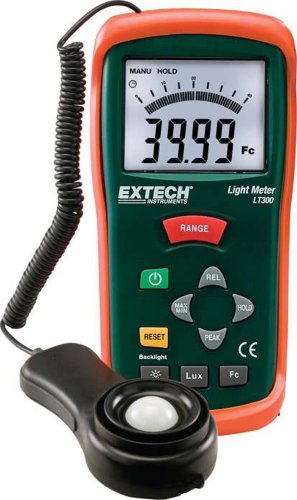


Products shown because their documented specifications fit this guide. Price and availability are on Amazon and can change.
Frequently Asked Questions
Why does a light meter have settings for sodium and mercury?
Discharge lamps have spectra that differ from the tungsten source used for calibration. The light-type settings apply correction factors so readings under those lamps are closer to true illuminance.
What is the RS-232 interface for?
It sends readings to a PC for logging and trend analysis. RS-232 is a legacy serial port, so a modern laptop needs a USB-to-serial adapter.
What is relative mode?
It sets the current reading as a reference and shows subsequent readings as the difference, which is useful when adjusting fixtures or comparing positions.
Is it suitable for LED lighting?
It measures LED light, but it has no LED-specific setting. For LED colour settings Extech offers the LT45.
Affiliate disclosure: Akermin earns a commission from qualifying Amazon purchases made through links on this page. Our editorial picks are based on documented specifications and owner feedback, not commissions.