As an Amazon Associate, Akermin earns from qualifying purchases. Product links on this page are affiliate links.
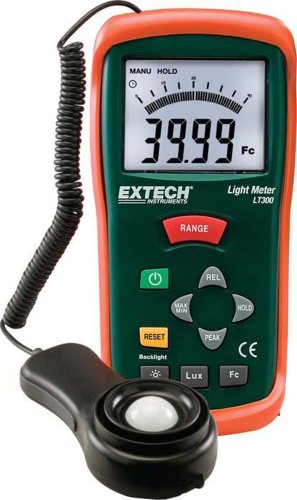
Extech · Extech LT300 Light Meter, Remote Sensor, Peak and Relative Modes | Lux/FC illuminance, remote sensor on 12in coiled cable, peak and relative modes, backlit LCD, bargraph
View on AmazonPrice and availability are shown on Amazon and can change at any time.
Verdict
The LT300 is the light meter to buy when the job is workplace and facility illuminance and nothing more exotic. It reads lux and foot-candles up to 40,000 lux, has a remote sensor on a lead with cosine and colour correction, a backlit LCD, min/max, data hold, zero adjustment, and peak and relative modes. The remote sensor is the reason to choose it over a meter with a built-in cell: the sensor sits flat on the desk or the floor while the display is read from a comfortable position, and the operator’s shadow stays out of the measurement. It is not the meter for full sunlight, which exceeds its range, or for coloured LED sources, which the LT45 handles with specific settings.
Who It Is For
- Facilities managers and safety officers checking workplace lighting against recommended levels.
- Electricians commissioning new lighting installations.
- Photographers, studio and museum staff who need a simple, repeatable illuminance reading.
Documented Specifications
| Item | Documentation |
|---|---|
| Units | Lux and foot-candles |
| Range | Up to 40,000 lux |
| Sensor | Remote, cosine and colour corrected, with protective cover |
| Display | Large backlit LCD |
| Functions | Min/max, data hold, zero adjustment, peak and relative modes |
| Operation | One-handed |
Cosine and Colour Correction
Two corrections separate a light meter from a bare photodiode. Cosine correction is a diffusing dome that makes the sensor respond to angled light in proportion to the cosine of the angle, which is how illuminance on a surface is defined; without it, light from a fixture off to the side is under-read. Colour correction is a filter that shapes the photodiode’s spectral response to match the standard observer curve of the human eye, so that a warm LED, a cool fluorescent tube and daylight are compared on the same basis. The LT300 documents both. Our guide to choosing a light meter explains why cheap meters without these corrections give misleading results.
Working With the Remote Sensor
Illuminance is measured on the working plane: a desk, a bench, a floor. With a built-in sensor the meter body has to lie on that plane and the display is read from above, often with the operator’s head shading it. The LT300’s sensor on a lead is placed on the plane and the display is held to one side. Peak mode captures a momentary maximum, useful for a flash or a passing vehicle light; relative mode sets a reference and shows differences, useful when adjusting a fixture. The protective cover guards the dome when the meter is in a bag.
A Simple Illuminance Audit
A workplace lighting check with the LT300 follows a grid. Divide the area into a regular pattern of points at the working plane, take a reading at each with the sensor flat and the operator standing back, and record the minimum, the average and the ratio between them. The minimum decides whether any position is under-lit; the ratio shows uniformity, which matters for eye strain even when the average is fine. Min/max recall makes the sweep quick. Repeat at night with lights only, and by day with blinds open, since the daylight contribution changes the answer. Zero adjustment before starting, with the cover on the sensor, removes any offset. The same routine applies to a classroom, a warehouse aisle or a workshop bench.
Range and Limits
Forty thousand lux is well above any indoor level and covers bright overcast daylight, but direct summer sun exceeds it. For solar and outdoor daylight work, or for greenhouse supplementary lighting at very high output, the LT45 with its wider range is more appropriate. For discharge lighting in warehouses, the older 407026 has lamp-type corrections that the LT300 lacks. Within its range the LT300 is the more convenient instrument.
Strengths
- Remote corrected sensor for correct working-plane technique.
- Backlit display and full audit functions.
- Compact and simple to use one-handed.
Limitations
- Range stops at 40,000 lux; not for direct sunlight.
- No lamp-type or LED-colour settings.
- No datalogging.
How It Compares
The Extech LT45 adds settings for coloured LEDs and a range to 400,000 lux. The Extech 407026 is the heavy-duty meter with discharge-lamp corrections and a PC interface. The Extech EN300 includes a light function among five measurements. The LT300 is the general-purpose choice between them.
How We Research
This review is based on Extech’s published specifications, the Amazon listing and owner reports. We did not run laboratory tests.
Recommended Tools


Products shown because their documented specifications fit this guide. Price and availability are on Amazon and can change.
Frequently Asked Questions
What range does the LT300 cover?
The listing states readings up to 40,000 lux in lux or foot-candles, which covers indoor lighting and overcast daylight but not full direct sun.
Why does the sensor have a lead?
A remote sensor can be placed on the working plane while the display is held where it can be read, and it keeps the operator's shadow off the sensor.
What is cosine correction?
A diffuser over the sensor that makes its response to light arriving at an angle follow the cosine law, so illuminance on a surface is measured correctly whatever the direction of the source.
Is it suitable for LED lighting?
The listing states the sensor is colour corrected for daylight, fluorescent, LED and industrial fixtures. For coloured LED sources, the LT45 has dedicated settings.
Affiliate disclosure: Akermin earns a commission from qualifying Amazon purchases made through links on this page. Our editorial picks are based on documented specifications and owner feedback, not commissions.