As an Amazon Associate, Akermin earns from qualifying purchases. Product links on this page are affiliate links.
Short answer: the MO50 is the right buy if you already know where to measure and only need a number, and if small pin holes do not matter. The MO265 is the right buy if you need to find the wet area first, or if you must not mark the surface you are testing.
What Each Listing States
| Item | Extech MO265 | Extech MO50 |
|---|---|---|
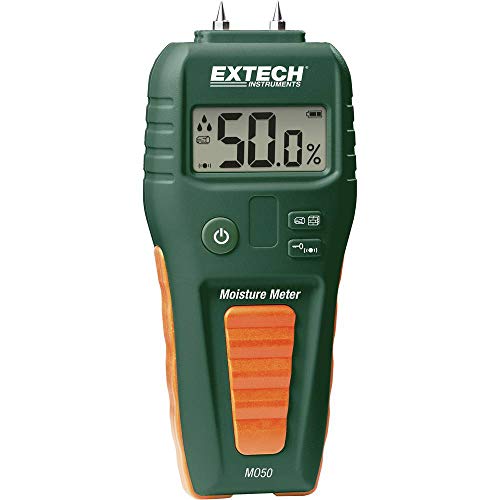
| Method | Pinless plus remote pin probe | Pin only |
| Stated ranges | Not given in the bullets | Wood 5 to 50 percent, building materials 1.5 to 33 percent |
| Display | Backlit LCD with tri-colour LED bargraph | Digital display with moisture droplet icons |
| Audible alert | Not stated in the bullets | Beeper that speeds up as moisture rises |
| Self test | Not stated in the bullets | Contact point in the protective cap |
| Probe reach | Remote probe on an RJ45 lead | Pins in the body of the meter |
Searching and Confirming Are Different Tasks
Almost every moisture job starts with a search. Water has come in somewhere and spread somewhere else, and the shape of the wet area is the thing you need to know before you decide what to open up. Pins are a poor search tool: each reading is one hole, one point, and a wall needs dozens of them. A pinless sensor sweeps the same wall in a minute.
Once the area is mapped, confirming is a different task and pins are better at it. A pin reading at a marked point on Monday can be compared with the same point on Friday, which is how drying is documented. That is why a combination meter exists, and why buyers who only own a pin meter tend to under-map the problem.
Where the Simple Meter Is Genuinely Good
The MO50 publishes its ranges, which the MO265 bullets do not, and it includes two features that matter more than their cost suggests. The self-test contact in the cap lets you confirm the meter and battery before you trust a reading, which is exactly the check people skip and then regret. The accelerating beeper means you can probe along a joist watching your hands rather than the display. For a homeowner checking a suspect patch, a builder checking timber before fixing or anyone confirming that a floor has dried, it does the job.
The Question That Settles It
Can you put two small holes in the surface you are testing? On structural timber, subfloor, framing and unfinished materials, yes, and the MO50 is the sensible economical purchase. On finished floors, decorated walls, veneers, furniture and anything a client will look at afterwards, no, and you need a pinless sensor. The full argument is in pin versus pinless moisture meters.
Who Buys Which
- Homeowner with one damp patch to investigate: MO50.
- Carpenter or builder checking timber: MO50.
- Inspector or restoration technician: MO265.
- Flooring installer working on finished surfaces: MO265, or a pinless-only meter such as the MO257.
How We Research
Figures come from the manufacturer listings. We did not run laboratory tests. Our ranking is in the how to choose a moisture meter.
Recommended Tools


Products shown because their documented specifications fit this guide. Price and availability are on Amazon and can change.
Frequently Asked Questions
What ranges does the MO50 state?
The listing states 5 to 50 percent moisture in wood and 1.5 to 33 percent in building materials such as drywall, plaster and concrete.
Does the MO50 have a calibration check?
The listing states the protective cap has an integrated self-test contact point to verify measurement accuracy and battery health before use. That is a genuinely useful feature at this level and worth using before every session.
Why choose the MO265 instead?
Because pins cannot search. A pin meter tells you about the point you stabbed; it cannot sweep a wall to find where the wet area begins and ends. The MO265 pinless sensor does that, then the pin probe measures the points you found.
Will the MO50 mark a surface?
Yes. Any pin meter leaves two small holes. On a stud or a subfloor that is irrelevant. On a finished floor, a painted wall or a piece of furniture it is not acceptable, which is the whole reason pinless meters exist.
Affiliate disclosure: Akermin earns a commission from qualifying Amazon purchases made through links on this page. Our editorial picks are based on documented specifications and owner feedback, not commissions.