As an Amazon Associate, Akermin earns from qualifying purchases. Product links on this page are affiliate links.
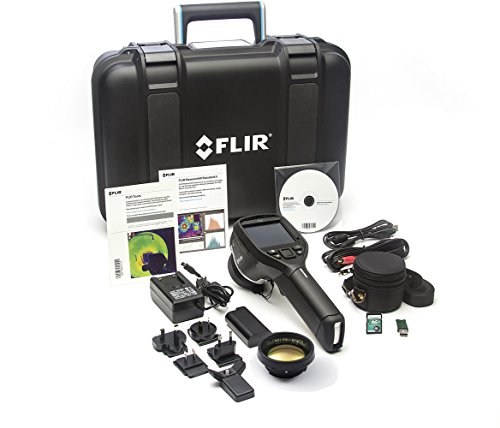
FLIR · FLIR E50 Compact Thermal Imaging Camera with 240 x 180 IR Resolution, MSX and 15 Degree Lens
View on AmazonPrice and availability are shown on Amazon and can change at any time.
The FLIR E50 is a compact handheld thermal imaging camera with a 240 x 180 measurable IR pixel count, MSX image enhancement, a 3.5 inch touch screen and a stated thermal sensitivity of 0.05 degrees Celsius at 30 degrees Celsius. The listing also states it is a Class II laser product at 1 mW output. That laser line is the one that matters most for ownership: it tells you the camera contains a laser source used for image alignment, and a laser source is a component with a defined service life and handling rules. The listing does not publish the laser’s wavelength, the number of diode hours, or whether the module is user replaceable, so the consumable cost cannot be calculated from the page. Buy the E50 if you need a self-contained handheld with a stated sensitivity figure, and read the laser statement as a maintenance question to put to the seller before you commit.
The Class II laser line is the specification that sets your ownership cost
The FLIR E50 listing opens with a line that many buyers skim: item is a Class II laser product, 1 mW power output. That is a safety classification, not a performance figure. Class II covers visible lasers up to 1 mW and relies on the blink reflex for eye protection. In a thermal camera, a visible laser is normally used as a pointer or alignment aid, letting you mark the exact spot the camera is looking at on the wall or panel in front of you.
The ownership consequence is that the camera contains a laser diode, and a laser diode is a component with a finite life. The listing does not publish the wavelength, the expected diode hours, or whether the laser module is replaceable. Those are the three numbers you would need to turn this line into a cost. Because they are absent, the honest position is that the laser is a service item whose cost and life are not disclosed on the page.
What you can do is treat the laser statement as a question to the seller. Ask whether the laser is a separate module, whether it is covered by the warranty, and what the replacement procedure is. If the answers are vague, assume the laser is not user serviceable and price the camera accordingly. That is the only maintenance figure the listing gives you any purchase on.
240 x 180 pixels, 0.05 degrees of sensitivity, and what each figure changes in use
The measurable IR resolution is 240 x 180. That is 43,200 pixels, and it sets how small a target you can resolve at a given distance. A 240 x 180 sensor is enough to see a warm breaker in a panel or a missing insulation patch on a wall, but it will not resolve a component on a densely packed circuit board at close range. The listing does not publish the instantaneous field of view, so the distance at which a given target fills one pixel cannot be calculated from the page.
The thermal sensitivity is stated as 0.05 degrees Celsius at 30 degrees Celsius, written as N.E.T.D. Noise equivalent temperature difference is the smallest temperature difference the camera can show against its own noise floor at that ambient. A lower figure means fainter temperature contrasts are visible. The 0.05 figure is a good number for a handheld in this class, and it means the camera should show the small differences that matter in building and electrical work, such as a slightly warm connection or a thin band of missing insulation.
What the listing does not publish is accuracy. Sensitivity and accuracy are different things: sensitivity is the smallest difference the camera can detect, accuracy is how close the displayed temperature is to the true temperature. Do not read 0.05 degrees Celsius as an accuracy figure. The listing is silent on accuracy, and that gap matters if you plan to report absolute temperatures rather than compare surfaces.
The 15 degree lens is a narrow window, and it changes how you walk a building
The title specifies a 15 degree lens. A narrow lens gives more pixels per degree of scene, which means more detail on a distant target. The trade is field of view: at close range you see a small area, and to cover a large wall or a long panel you step back or pan. The listing does not publish the minimum focus distance, so how close you can get before the image softens is not stated.
For electrical inspection, a narrow lens is often the right choice because you are looking at a specific enclosure from a working distance. For home inspection, where you sweep whole rooms for missing insulation, a narrow lens means more walking. The listing does not offer a lens swap option, so the 15 degree lens is the field of view you live with. If you need a wider view, that is a different camera, not an accessory.
MSX, the touch screen and the 1.82 lb body: what the listing does and does not tell you
MSX is named in the title but the listing does not describe how it works. In general terms, MSX overlays visible-light edges onto the thermal image so that the thermal map is easier to interpret. It is a presentation aid, not a measurement aid: the temperature numbers still come from the IR sensor. The listing does not publish the visible camera resolution, so the sharpness of the MSX overlay cannot be judged from the page.
The 3.5 inch touch-screen LCD is stated. Touch control changes how you navigate menus and place spots, but the listing does not publish the display resolution, the brightness, or whether it is usable in direct sunlight. Those are the details that decide whether the screen is pleasant or frustrating outdoors, and they are not on the page.
The weight is 1.82 lbs. That is light enough to hold one-handed for short inspections, and it is the only physical dimension the listing gives. The listing does not publish the housing rating, the drop rating, or the operating temperature range, so durability and environmental limits are unknown from the page.
Where the E50 stops being the right camera
The E50 is a self-contained handheld. It does not need a phone, and that is its main advantage over the phone-attachment cameras on this site, such as the USB-C thermal camera options. If your work involves climbing, confined spaces, or long days away from a charger, a handheld with its own screen is simpler to deploy.
Where it stops being right is when you need published accuracy, a wide field of view, or a documented laser service life. The listing is silent on all three. If your work requires reporting absolute temperatures to a standard, the missing accuracy figure is a problem. If you need to sweep large areas quickly, the 15 degree lens works against you. And if you need to budget for laser replacement, the listing gives you nothing to budget with.
For buyers who mainly need a phone-based camera for occasional checks, the thermal imaging camera comparison covers the alternatives. The E50 earns its place when you want a standalone instrument with a stated sensitivity figure and a 240 x 180 sensor, and you are prepared to ask the seller the maintenance questions the listing does not answer.
The E50 is a sound handheld, but the laser line is the question to ask before you buy
The FLIR E50 publishes a 240 x 180 IR resolution, a 0.05 degrees Celsius N.E.T.D. figure, MSX, a 3.5 inch touch screen and a 1.82 lb weight. Those are the numbers that describe its performance, and they are enough to place it as a capable compact handheld. The line that decides ownership is the Class II laser statement, because it identifies a consumable component whose life, wavelength and replaceability the listing does not publish. Buy it if you want a standalone camera with a stated sensitivity figure and you are willing to put the laser maintenance questions to the seller. Do not buy it expecting the page to tell you what the laser will cost to service, because it does not.
Recommended Tools


Products shown because their documented specifications fit this guide. Price and availability are on Amazon and can change.
Frequently Asked Questions
What does the Class II laser actually do in this camera?
The listing does not describe the laser's function. In thermal cameras a visible Class II laser is normally a pointer or alignment aid. The listing states only that it is Class II at 1 mW, which is a safety classification, not a description of use.
How much does it cost to replace the laser?
The listing does not publish a replacement cost, a diode life in hours, or whether the laser module is user replaceable. Those figures are not on the page, so the cost cannot be calculated from the listing.
Is 0.05 degrees Celsius the accuracy of the camera?
No. The listing states 0.05 degrees Celsius at 30 degrees Celsius as thermal sensitivity, or N.E.T.D., which is the smallest temperature difference the camera can detect. Accuracy is a separate figure, and the listing does not publish it.
Can I change the 15 degree lens for a wider one?
The listing does not mention a lens swap option or any alternative lenses. The 15 degree lens is the field of view stated in the title, and no other lens is published.
Does the touch screen work in bright sunlight?
The listing states a 3.5 inch touch-screen LCD but does not publish brightness, resolution or sunlight readability. Those details are not on the page.
Is the E50 a good choice for home inspection?
It can be, if you are inspecting specific areas rather than sweeping whole rooms. The 240 x 180 sensor and 0.05 degrees Celsius sensitivity are suited to finding insulation gaps and air leaks, but the 15 degree lens is narrow and the listing does not publish accuracy for reporting absolute temperatures.
Affiliate disclosure: Akermin earns a commission from qualifying Amazon purchases made through links on this page. Our editorial picks are based on documented specifications and owner feedback, not commissions.