As an Amazon Associate, Akermin earns from qualifying purchases. Product links on this page are affiliate links.
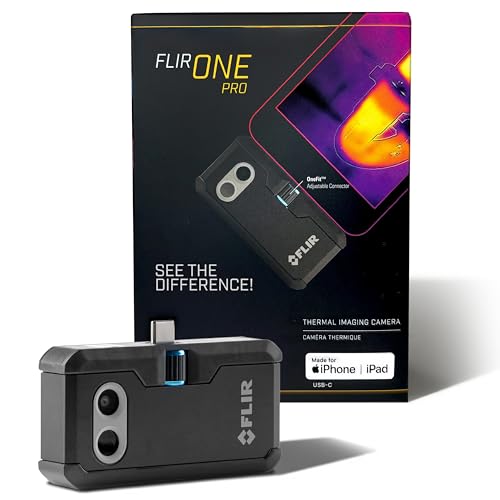
FLIR · Flir One Pro - Thermal Imaging Camera for iOS Smartphones (iPhone 15 and Newer w/USB-C), 480x360 Super Resolution (160x120 Native IR)
View on AmazonPrice and availability are shown on Amazon and can change at any time.
Verdict
The FLIR ONE Pro is the version of the phone-attached FLIR camera that can be used for work rather than curiosity. The detector is 160×120 native, which FLIR upscales to 480×360 with VividIR and sharpens with MSX. The listing states ±3 °C or ±5% accuracy within the usual conditions, a 1.5 m drop rating and the same app with inspection guides as the base model. The USB-C connector fits iPhone 15 and newer. For home inspectors, HVAC technicians on light duty and serious DIY users, the resolution is enough to see individual breakers, duct joints and studs from a comfortable distance. Its limits are the phone-accessory form factor, a separate battery and the lack of the radiometric file handling that a dedicated handheld such as the FLIR E5 Pro provides.
Who It Is For
- Home inspectors and energy auditors who want thermal evidence photos without a second device.
- Electricians and HVAC technicians who need to find a warm connection or a cold duct quickly.
- Owners of a USB-C iPhone who want the FLIR app and MSX rather than a third-party ecosystem.
Documented Specifications
| Item | Documentation |
|---|---|
| Thermal detector | 160×120 native (19,200 pixels) |
| Output image | 480×360 with VividIR upscaling |
| Image enhancement | MSX visual edge overlay |
| Accuracy | ±3 °C or ±5% (unit at 15 °C to 35 °C, scene 5 °C to 120 °C) |
| Connector | USB-C (iPhone 15 and newer) |
| Drop rating | 1.5 m |
| App | FLIR ONE app with inspection guides |
| Power | Internal rechargeable battery |
Resolution and Measurement Range
The jump from 80×60 to 160×120 is the most important difference between the two FLIR ONE models. With 19,200 pixels on target, a domestic consumer unit fills the frame with distinct breakers rather than a warm blur, and a roof viewed from the ground shows individual tiles. FLIR also documents a wider scene temperature range for the Pro than for the base model, which matters when looking at exhaust manifolds, ovens or overloaded motors. Our guide to choosing a thermal camera for electrical work explains why resolution decides the safe working distance from live equipment.
MSX, Palettes and the App
MSX takes edges from the visual camera and embosses them onto the thermal image, so labels, switch plates and outlet edges remain legible. It does not change the temperature data. The FLIR ONE app provides multiple spot meters, palettes including the common ironbow and rainbow, and photo and video capture. The step-by-step inspection guides walk through air leaks, moisture and electrical checks. Emissivity can be set in the app, which is essential if you measure on bare metal; see setting emissivity.
Using It in the Field
The Pro has its own battery and an adjustable-length connector to reach through cases. Owners consistently report that the internal battery is the weak point: runtime per charge is short and the camera will not work from the phone’s battery. Planning a charge before a survey, and keeping a power bank for the phone, is the practical workaround. The camera stores images through the app, and reports are assembled on the phone or through FLIR’s cloud tools rather than the radiometric desktop workflow used with handheld FLIR cameras. For insulation and moisture surveys the practical routine is the same as with any thermal camera: wait for a temperature difference of several degrees between inside and outside, switch off forced-air heating for a while, and photograph each wall from the same distance so images can be compared. Our article on finding insulation gaps with a thermal camera walks through that routine.
Strengths
- 160×120 native resolution in a phone accessory.
- MSX and the FLIR app are mature and easy for a beginner.
- USB-C fits current iPhones; 1.5 m drop rating.
Limitations
- Separate battery with short runtime.
- Accuracy class is the same as the base model; not a substitute for a radiometric handheld.
- Phone-dependent: no use if the phone is needed for something else during the survey.
How It Compares
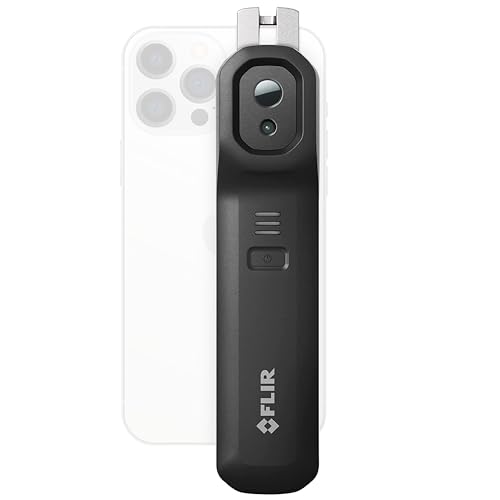
The FLIR ONE Gen 3 is the lower-resolution Lightning version. The FLIR Edge Pro has the same 160×120 detector but connects wirelessly and can be clipped away from the phone. The TOPDON TC002C offers 256×192 native on USB-C and draws power from the phone, so it wins on resolution and battery but lacks MSX. For a purpose-built handheld with radiometric files, the E5 Pro is the next step.
How We Research
This review is based on FLIR’s published specifications, the Amazon listing for the USB-C FLIR ONE Pro and owner reports. We did not run laboratory tests.
Recommended Tools


Products shown because their documented specifications fit this guide. Price and availability are on Amazon and can change.
Frequently Asked Questions
Does the FLIR ONE Pro work with Android phones?
This listing is the USB-C version described for iPhone 15 and newer. FLIR has sold Android USB-C versions of the ONE Pro in the past; check the connector and platform on the specific listing before buying.
How much better is 160×120 than 80×60?
It is four times the pixel count. In practice you can stand roughly twice as far from a target and see the same detail, and small items such as breaker terminals become individually visible.
Does the Pro measure temperature more accurately?
The listing states the same ±3 °C or ±5% accuracy class as the FLIR ONE. The advantage is resolution and range, not accuracy.
Does it need charging?
Yes. Like the rest of the FLIR ONE family it has its own battery, charged through a port on the camera.
Affiliate disclosure: Akermin earns a commission from qualifying Amazon purchases made through links on this page. Our editorial picks are based on documented specifications and owner feedback, not commissions.
Related Guides

PHOEBUS LINK RCX100 Review: 40 mK Is the Figure This Job Needs
A handheld thermal camera with a 160 by 120 infrared detector, a 320 by 240 enhanced image, 40 mK sensitivity, a focus free 40 by 30 degree field of view, a 25 Hz refresh rate and still JPG image capture.
Read More→
Fluke 62 MAX+ Review: The Cold End Is Printed Three Different Ways
A non contact infrared thermometer for electrical, mechanical, HVAC and automotive surfaces, with dual rotating lasers that mark the edges of the measurement area, minimum, maximum, difference and average readings, and an IP54 rating.
Read More→
General Tools MMD7NP Review: Percent on Wood, Relative on Drywall
A pinless non invasive moisture meter that reads up to three quarters of an inch into a surface, with scales of 0 to 53 percent for softwood, 0 to 35 percent for hardwood and relative readings on wallboard, drywall and masonry.
Read More→