As an Amazon Associate, Akermin earns from qualifying purchases. Product links on this page are affiliate links.

Fluke · Fluke 325 True-RMS Clamp Meter with Frequency, Temperature & Capacitance Measurements
View on AmazonPrice and availability are shown on Amazon and can change at any time.
Verdict
The Fluke 325 is the 323 with the functions that HVAC and maintenance technicians ask for: DC current, frequency, capacitance, temperature and resistance to 40 kΩ. The body, the 30 mm jaw, the 400 A and 600 V limits and the CAT IV 300 V, CAT III 600 V rating are shared with the 323. For a technician who checks capacitors, reads drive frequencies, measures DC control circuits or logs a discharge line temperature, the 325 does in one clamp what would otherwise take a clamp and a multimeter. For a residential electrician who only measures AC load and voltage, the 323 is enough. The documentation supports the 325 as the general-purpose choice in this size class.
Who It Is For
- HVAC and refrigeration technicians who test capacitors and read temperatures.
- Maintenance electricians who work on drives and DC control circuits.
- Solar and battery installers who need DC current below 400 A in a compact clamp.
See choosing a clamp meter for HVAC for how those needs map to functions.
Documented Specifications
| Item | Documentation |
|---|---|
| Current | AC and DC to 400 A, True RMS |
| Voltage | AC and DC to 600 V |
| Resistance | To 40 kΩ with audible continuity |
| Additional functions | Frequency, capacitance, temperature |
| Jaw opening | 30 mm |
| Safety rating | IEC 61010-1, CAT IV 300 V, CAT III 600 V |
The manufacturer’s datasheet gives the range limits and accuracy for frequency, capacitance and temperature; we have not reproduced figures that are not stated on the listing.
DC Current Through the Jaw
AC clamps use a current transformer, which cannot respond to DC. The 325 uses a Hall-effect sensor that reads the magnetic field of a DC conductor directly. That opens up automotive circuits, solar strings and battery systems within 400 A, and DC control circuits in industrial panels. The trade-off is drift: temperature changes and residual magnetism in the jaw shift the zero, so the reading with no conductor in the jaw may show a few tenths of an amp. The meter has a zero function for this, and using it before each DC measurement is the single most important habit with any DC clamp. Our article on measuring solar panel current shows the procedure.
Frequency, Capacitance and Temperature
Frequency confirms what a drive is sending to a motor and whether a generator is on speed. Capacitance is the HVAC technician’s daily check: a run capacitor reading well below its rating explains a hard-starting compressor or a fan that hums. Temperature via a type K thermocouple lets the same tool record supply and return air or line temperatures. The 40 kΩ resistance range is ten times that of the 323 and reaches into thermistor and sensor territory, though the Fluke 902 FC goes further for flame rods and thermistors. Together these functions make the 325 a compact substitute for a multimeter on most service calls.
Practical Notes
Capacitor testing must be done with the capacitor discharged and disconnected from the circuit; the meter measures capacitance by charging the component, and an in-circuit measurement is neither accurate nor safe. The temperature function uses the supplied type K thermocouple, and surface readings need a probe designed for surfaces. As with the 323, a two-conductor cable reads near zero in the jaw and needs a line splitter. Owners note that the extra functions add selector positions, so it pays to check the position before probing a live circuit. The 325 shares the 323’s lack of a backlight.
Strengths
- AC and DC current in the same compact body as the 323.
- Capacitance and temperature cover HVAC diagnostics.
- Frequency for drive and generator checks.
- Same clear safety ratings as the rest of the series.
Limitations
- 400 A limit; large feeders and motor centres need a bigger clamp.
- No inrush capture, low-pass filter or wireless logging.
- No backlight on the display.
How It Compares
The Fluke 323 is the AC-only version for electricians who do not need the extras. The Extech MA445 matches 400 A AC/DC and adds inrush and a 40000-count display at a lower price, with a less established reputation. The Fluke 902 FC is the HVAC specialist with microamp DC and a 60 kΩ range. The Fluke 374 FC is the step up in current and adds Fluke Connect wireless.
How We Research
This review is based on the manufacturer’s published specifications, the Amazon product listing and owner reports. We did not run laboratory tests. Related: how to measure current with a clamp meter.
Recommended Tools


Products shown because their documented specifications fit this guide. Price and availability are on Amazon and can change.
Frequently Asked Questions
What does the Fluke 325 add over the 323?
DC current through the jaw, frequency, capacitance, temperature with a thermocouple, and a resistance range of 40 kilohms instead of 4 kilohms. The current and voltage limits, the jaw and the safety rating are the same.
Why would an electrician need frequency?
To confirm the output frequency of a variable frequency drive or a generator, and to check that a circuit is on the mains rather than an inverter.
What is the capacitance range used for?
Motor run and start capacitors in HVAC and pump equipment. Testing them in place is one of the most common uses of a clamp meter in HVAC service.
Does it need zeroing for DC current?
Yes. Hall-effect DC clamps drift, and the meter has a zero function that should be used with the jaw closed on nothing before each DC reading.
Affiliate disclosure: Akermin earns a commission from qualifying Amazon purchases made through links on this page. Our editorial picks are based on documented specifications and owner feedback, not commissions.
Related Guides

Fluke 1AC II VoltAlert Review: Two Detection Thresholds in One Listing
A pocket sized non contact voltage tester whose tip glows red and beeper sounds when voltage is detected, with a continuous self test and a choice of audible or silent operation.
Read More→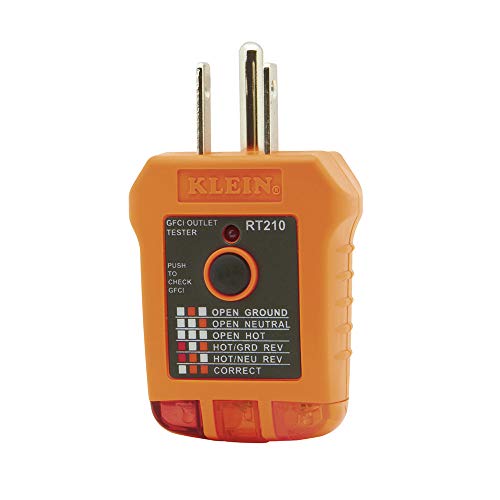
Klein Tools RT210 Review: A Fault Finder That Does Not List Its Faults
A three wire receptacle tester for standard and GFCI North American outlets, specified for 110 to 125 volts AC at 50 or 60 Hz, a 6.6 foot drop and an operating range of 32 to 140 degrees Fahrenheit.
Read More→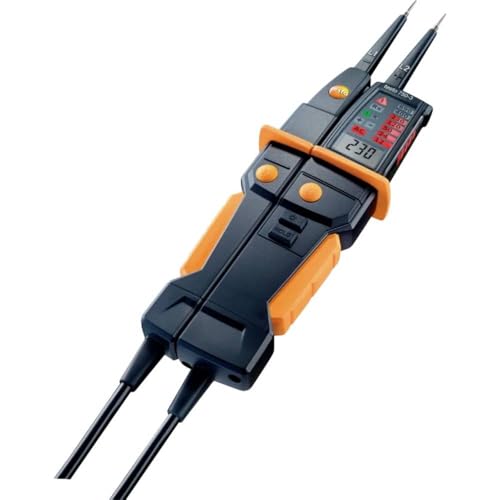
Testo 750-3 Review: Four Bullets, and No Published Category Rating
A two pole voltage tester with a three digit LCD showing measured voltage, a patented LED voltage bar viewable from any angle, polarity detection on DC and a GFCI test function for AC outlets.
Read More→