As an Amazon Associate, Akermin earns from qualifying purchases. Product links on this page are affiliate links.
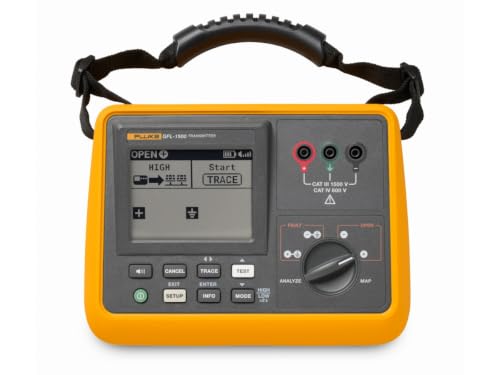
Fluke · Fluke GFL-1500 - Solar Ground Fault Locator (1500V)
View on AmazonPrice and availability are shown on Amazon and can change at any time.
A ground fault locating kit for photovoltaic systems, comprising a transmitter, a receiver and a clamp, which injects a traceable signal so an active ground fault can be located anywhere in a DC system, with a graphic LCD lit from the front, an adjustable trace signal amplitude and an estimate of which module number sits closest to the fault. Five bullets, and the most important word in them is active. This locates a fault that is conducting while you are standing there. It is not the instrument that finds a fault which has not happened yet.
Active is the adjective that decides whether this finds your fault
The second bullet promises to identify and locate active ground faults anywhere in a DC system with an easy to follow traceable signal. The entire purchase turns on that adjective.
A ground fault locator works by injecting a signal and following it. The signal takes the path the fault provides, and the receiver tells you where that path runs. If the fault is conducting, a path exists and the method works. If the fault is not conducting at the moment you are looking, there is no path, and a perfectly functioning instrument will report that nothing is wrong.
That is a real limitation and it covers a large share of the faults people actually chase on an array:
- A fault that appears only when it rains, because water is completing a path through a damaged gland or a chafed cable.
- A fault that appears only in the heat of the afternoon, when expansion opens a split or when rising voltage breaks down a weakened section of insulation.
- Insulation that has degraded but has not yet failed, which is a measurable loss of resistance rather than a fault with a path to trace.
- A fault that has already tripped something out, so the array is isolated and there is nothing live to follow.
The instrument for those is an insulation resistance tester, which applies a high test voltage and measures resistance to earth, producing a number that falls as insulation deteriorates. That finds the problem before it becomes a fault, and it finds intermittent ones if you test while the condition is present. What it does not do is tell you where along the string the problem sits, which is exactly what this does. The two tools answer different questions, and this listing is clear about which one it is. Solar insulation resistance testers cover the other half of the problem.
Estimate is the most honest verb in the listing
The fourth bullet says the instrument will estimate what module number is closest to the fault. Compare that with how this capability is usually described, which is as locating or pinpointing.
Estimate is the accurate word. A trace locator infers position from how the signal behaves along the conductor, and the resolution of that inference is limited by the geometry of the array, by how the strings are routed, by adjacent conductors picking up the signal, and by the nature of the fault itself. What comes out is a region rather than a coordinate: somewhere around the fourteenth module, rather than at the fourteenth module.
That is still a transformation of the job. The alternative on a long string is bisection by disconnection, splitting the string, testing each half, splitting again, which means repeated work at height on live DC and a long afternoon. Narrowing the search to a handful of modules before touching anything is most of the value, and the remaining uncertainty is cleared up by inspection once you are in the right place.
It also tells you something about the output format. A module number only means something if you know the module order, so the instrument expects you to have the string layout in hand, and the answer arrives in the units of the installation rather than in metres of cable.
1500 V is in the name and in none of the bullets
The product name carries 1500V. No bullet repeats it, qualifies it, or places it against a safety rating, and on a listing of five lines that is the notable gap.
1500 V DC is the ceiling for modern utility scale photovoltaic arrays, which is why the figure is in the name. It is also a voltage that behaves badly. A direct current arc has no zero crossing to extinguish it, so an arc struck at 1500 V DC can sustain itself in a way an alternating current arc of the same magnitude does not, and an array in daylight cannot be switched off at the source. Clipping an instrument onto that is a procedure rather than a convenience.
What a buyer needs in order to know the instrument matches the array is therefore a set of ratings, and none is published here. There is no measurement category rating. No named safety standard. No maximum voltage for the transmitter or the receiver as distinct from the system figure in the name. No clamp current rating and no clamp jaw opening, which is what decides whether it fits around the cable bundle in a combiner box. No ingress rating, on an instrument whose whole job is outdoors. No battery type or runtime, no receiver sensitivity and no trace signal frequency.
That is a lot of blank rows for an instrument of this class, and the voltage ones matter most, because a voltage limit on a source you cannot turn off is a safety limit rather than a performance one. Establish the figures in writing against the array you intend to work on. Solar testers for 1500 V utility arrays is the group this belongs to.
A front light instead of a backlight, and why that is right on a roof
The third bullet reads graphic LCD display with front light, and the choice of word is deliberate.
A backlit display is lit from behind, through the panel, and it works beautifully indoors. Outdoors it loses, because sunlight falling on the front of the screen is far stronger than anything the backlight can push through from the rear, and the display washes out to a pale grey. Every technician who has tried to read an instrument on a roof at midday knows the effect.
A front light is how you illuminate a reflective display. The panel itself reflects ambient light, so the brighter the surroundings the better it reads, and the lamp is there for shade, dusk and the inside of a plant room. On an instrument designed to be used on an array in full sun, that is the correct technology, and it is the kind of detail that only appears when the people specifying it have stood on the roof themselves.
Graphic, rather than numeric, is the other half of that bullet. A trace receiver gives you signal strength as you move along a conductor, and a strength indication you can watch rise and fall is easier to follow than a changing number, which is presumably what the second bullet means by an easy to follow traceable signal.
The adjustable trace signal amplitude in the fifth bullet is the other genuine working feature. Turn it up to drive a detectable signal through a high resistance fault. Turn it down when the signal is bleeding onto adjacent conductors and giving a trace that follows the wrong cable. Without that control a locator is either deaf or indiscriminate, and the adjustment is how an experienced user separates the real path from its neighbours.
Five bullets, and the ratings that are not among them
| Specification | Published in the listing |
|---|---|
| Kit contents | Transmitter, receiver and clamp |
| Function | Locates active ground faults in a DC system by traceable signal |
| Fault position output | Estimate of the module number closest to the fault |
| Display | Graphic LCD with front light |
| Trace control | Adjustable signal amplitude |
| System voltage | 1500V, stated in the product name only |
| Measurement category rating | Not stated in the listing bullets |
| Named safety standard | Not stated in the listing bullets |
| Maximum voltage for the instruments themselves | Not stated in the listing bullets |
| Clamp current rating and jaw opening | Not stated in the listing bullets |
| Trace signal frequency | Not stated in the listing bullets |
| Receiver sensitivity | Not stated in the listing bullets |
| Maximum string length or module count | Not stated in the listing bullets |
| Ingress rating | Not stated in the listing bullets |
| Battery type and runtime | Not stated in the listing bullets |
The clamp earns a note of its own. Using a clamp to pick the trace signal off a conductor means reading it through the insulation, with nothing disconnected and nothing opened, which is the entire point on an array that cannot be switched off. The jaw opening is the figure that decides whether that is possible in practice, because a clamp that will not close around a bundle of string cables inside a combiner box is a clamp you cannot use where the cables actually are, and no jaw dimension is published.
Buy it alongside an insulation tester, not instead of one
This is a specialist instrument for people who maintain photovoltaic arrays and spend real time chasing earth faults. If that is the work, the case is strong. It converts a day of disconnecting and retesting strings into a walk along the array with a receiver, it narrows the answer to a few modules, and the amplitude control and the sunlight readable graphic display are the details that separate a method which works on a roof from one that works on a bench. PV ground fault testing tools is a small field and this sits at the serious end of it.
It is the wrong purchase as a first or only solar instrument. It does one thing, it does that thing only while the fault is conducting, and it assumes you already know the array layout well enough for a module number to mean something. An installer or a general electrician doing occasional solar work gets more from an insulation resistance tester and a clamp meter, and should bring in a locator when a fault refuses to be found.
And settle the ratings before it goes anywhere near a 1500 V array. Five bullets with no category rating and no named standard is not a reason to assume the instrument is unsuitable, but it is a reason to get the figures in writing rather than infer them from a number in a product name.
Recommended Tools


Products shown because their documented specifications fit this guide. Price and availability are on Amazon and can change.
Frequently Asked Questions
What does active ground fault exclude?
A great deal of what people actually chase. A locator injects a signal and follows the path the fault provides, so if the fault is not conducting while you are there, no path exists and a perfectly functioning instrument reports nothing wrong. That excludes a fault that only appears when it rains, one that only appears in afternoon heat, insulation that has degraded without yet failing, and an array that has already been isolated by a protective device. Those are insulation resistance tester work.
Why is estimate the right word for the module number?
Because a trace locator infers position from how the signal behaves along the conductor, and that inference is limited by the array geometry, by how strings are routed, by adjacent conductors picking up the signal and by the nature of the fault. What comes out is a region rather than a coordinate: somewhere around the fourteenth module, not at the fourteenth module. The alternative on a long string is bisection by disconnection, so narrowing the search to a handful of modules is most of the value even with the uncertainty left in.
Is the 1500 V figure a safety rating?
It appears in the product name and in none of the bullets, so it is best read as the system voltage the instrument is intended for rather than a published safety rating. What a buyer needs in order to match it to an array is a measurement category rating, a named safety standard, and a maximum voltage for the transmitter and receiver themselves, and none of those is stated. Get them in writing. A voltage limit on a source that cannot be switched off in daylight is a safety limit rather than a performance one.
Why does a front light matter more than a backlight here?
Because the instrument is used outdoors. A backlit display is lit from behind, through the panel, which works beautifully indoors and loses badly in sunlight, since light falling on the front of the screen overwhelms anything the backlight pushes through it. A front light is how a reflective display is illuminated: the panel reflects ambient light, so the brighter the surroundings the better it reads, and the lamp is there for shade, dusk and plant rooms. On an array in full sun that is the correct technology.
What is the adjustable trace signal amplitude for?
Control over how hard the signal is driven. Turn it up to push a detectable signal through a high resistance fault. Turn it down when the signal is bleeding onto adjacent conductors and producing a trace that follows the wrong cable. Without that adjustment a locator is either deaf or indiscriminate, and the control is how an experienced user separates the genuine path from its neighbours.
What is the clamp doing in the kit?
Letting the receiver read the trace signal off a conductor through its insulation, with nothing disconnected and nothing opened, which is the entire point on an array that cannot be switched off. The figure that decides whether that works in practice is the jaw opening, because a clamp that will not close around a bundle of string cables in a combiner box is a clamp you cannot use where the cables are. No jaw dimension and no current rating are published.
Affiliate disclosure: Akermin earns a commission from qualifying Amazon purchases made through links on this page. Our editorial picks are based on documented specifications and owner feedback, not commissions.