As an Amazon Associate, Akermin earns from qualifying purchases. Product links on this page are affiliate links.
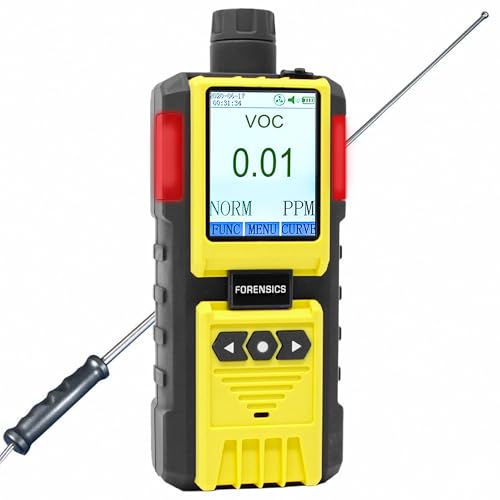
FORENSICS DETECTORS FD · VOC Analyzer by Forensics | 0.01 ppm Sensitive | USA NIST Calibrated & Certificate | 0-10ppm VOC | Built-in Pump & 4ft Probe |
View on AmazonPrice and availability are shown on Amazon and can change at any time.
The FD is the only instrument here built to resolve a VOC concentration to 0.01 ppm. It is a pumped analyzer with a 0 to 10 ppm range, adjustable audio, visual and vibration alarms, an IP65 and explosion-proof housing, and a NIST-traceable calibration certificate from Los Angeles. It is not an indoor air quality monitor in the sense of AirWhisper 16-in-1 or the FABISENSE PM25, and it does not count particles like the Generic 6-Channel. If your question is “is there a small VOC concentration in this specific spot, and is it rising”, the FD is the right class of tool. If your question is “is the air in this room generally good”, it is the wrong one.
A 0.01 ppm floor is a different instrument from a TVOC index
The monitors already covered on this site, the AirWhisper 16-in-1 and the FABISENSE PM25, report particulate matter and a general indoor air package. Their VOC channel, where they have one, is typically a broad response that is useful as a trend indicator but is not a concentration in parts per million. The FD publishes a 0.01 ppm resolution across a 0 to 10 ppm range. That is a narrow window, and the narrowness is the point: the instrument is built to see small changes inside a low concentration, not to sweep a room and give a single comfort score.
Resolution and accuracy are not the same thing. The listing states 0.01 ppm resolution and a NIST-traceable calibration performed in Los Angeles, and it arrives with a calibration and QA certificate. It does not publish an accuracy figure, a response time, or a detection limit beyond the resolution. Those gaps matter. A 0.01 ppm display step tells you the instrument can show a small change. It does not tell you the reading is within 0.01 ppm of the true concentration. If you need a stated accuracy tolerance for a compliance record, this listing does not give you one, and you should ask the manufacturer before relying on it.
The 0 to 10 ppm range also tells you what the FD is not for. It is not a leak detector for a large solvent spill, and it is not a confined space entry meter. A concentration above 10 ppm is outside the published range. For a room-scale question about whether a space is ventilated, a CO2 or TVOC trend monitor is the more appropriate class, and the site’s guide to CO2 versus VOC monitoring explains why the two answer different questions.
The built-in pump and 4ft probe change where you can measure
A diffusion monitor samples the air that reaches its sensor. The FD has a built-in pump and a 4ft probe, so you can draw a sample from inside a duct, behind a panel, or from the headspace of a container without putting the instrument body there. The listing describes the pump as giving super fast detection. It publishes no flow rate and no response time, so the speed claim is qualitative only.
This is the feature that separates the FD from the room monitors in practical use. The AirWhisper 16-in-1 and the FABISENSE PM25 are placed on a shelf and left to report the room. The FD is carried to a point, pointed, and read. If your work involves checking a specific gasket, a printed part, a solvent wipe or a small enclosure, the probe is the reason to choose this instrument. If your work is watching a bedroom or an office over days, the pump adds nothing and the narrow range gets in the way.
The listing does not publish the probe material or whether it is suitable for reactive compounds. That is a question for the manufacturer if you are sampling something aggressive.
The alarms, the graph and the logging are for finding a source, not for judging a room
The FD has adjustable audio, visual and vibration alarms, a colour screen with graph functions, and computer data logging. The combination is aimed at a walk-around: set a threshold, move the probe, and let the alarm tell you when you have found the source. The graph shows the shape of a rise and fall, which is often more useful than a single number when you are trying to work out whether a smell is coming from a process or from the room itself.
The listing does not publish the logging interval, the number of stored records, the export format, or the alarm threshold steps. If you need to hand a data file to somebody else, ask before buying. The site’s guide to choosing an air quality data logger sets out the questions that decide whether a logging feature is usable for your purpose.
An alarm is not a safety function here. The FD is a measurement instrument with alarms, not a certified gas detection system for worker protection. It does not replace a calibrated personal monitor for a regulated exposure limit, and the listing makes no such claim.
IP65 and explosion proof are housing claims, not a statement about the sensor
The listing states shock proof, water resistant to IP65, dust proof and explosion proof, with a belt clip and a charging USB cable. Those are useful in a workshop or on a plant floor, where an instrument gets knocked and rained on. They describe the enclosure. They do not tell you how the sensor behaves after a knock, and they do not extend the calibration interval.
The listing publishes a 1 year limited warranty and a calibration and QA certificate on arrival. It does not publish a recommended recalibration interval. NIST traceability at the point of sale is a starting condition, not a permanent one. VOC sensors drift, and the certificate that arrives with the instrument describes the instrument on the day it was checked. The site’s discussion of whether a monitor measures real VOCs is relevant background if you are comparing sensor types.
Where the FD is the wrong instrument, plainly
If you want a single number for the general quality of the air in a room, the FD will not give it to you. It does not measure particles, it does not measure CO2, and its VOC range is too narrow for a general indoor index. The Generic 6-Channel, the particle counter, is the instrument for cleanroom and HVAC particle work, and the AirWhisper 16-in-1 and the FABISENSE PM25 are the room monitors. The site’s air quality monitor comparisons cover that ground.
If you need to detect a combustible gas or carbon monoxide for safety, the FD is not that device. A VOC analyzer responds to a class of organic compounds and is not a substitute for a carbon monoxide alarm or a combustible gas detector. If you need to enter a confined space, no single handheld meter satisfies the entry requirement on its own.
The FD earns its place when the question is narrow and the location is specific: a low concentration of organic vapour at a point you can reach with a probe. Outside that, the monitors already on this site are the better answer.
The narrow-range analyzer the other monitors cannot replace
The Forensics Detectors FD is a specialist instrument. Its 0.01 ppm resolution, 0 to 10 ppm range, built-in pump and 4ft probe let you investigate a specific point at a concentration the room monitors on this site cannot resolve. Its NIST-traceable calibration certificate and IP65, explosion-proof housing suit industrial walk-arounds. It is not a general indoor air quality monitor, it does not measure particles or CO2, and it is not a safety device. Buy it for point-source VOC investigation. Do not buy it to answer a room-comfort question, where the AirWhisper 16-in-1 or the FABISENSE PM25 is the right class of tool. The listing leaves accuracy, response time and logging details unpublished, so confirm those with the manufacturer if your work depends on them.
Recommended Tools


Products shown because their documented specifications fit this guide. Price and availability are on Amazon and can change.
Frequently Asked Questions
Does the 0.01 ppm resolution mean the reading is accurate to 0.01 ppm?
No. Resolution is the smallest display step. The listing publishes a NIST-traceable calibration certificate but no accuracy tolerance, so the true uncertainty is not stated. Treat 0.01 ppm as the size of the change you can see, not as the error band.
Can this replace my indoor air quality monitor?
No. It does not measure particles or CO2, and its VOC range is 0 to 10 ppm, which is narrow. It is a point-source investigation tool. A room monitor such as the AirWhisper 16-in-1 or the FABISENSE PM25 answers a different question.
Is the explosion-proof rating a safety certification for my workplace?
The listing states explosion proof as a housing property. It does not publish a certification standard or an ATEX or IECEx number. For regulated safety work, use a certified gas detection system and do not rely on this instrument as a personal protective device.
What happens above 10 ppm?
The published range ends at 10 ppm. The listing does not state what the instrument displays or does above that concentration. If your process can exceed 10 ppm, this is the wrong range and you should look for an instrument with a wider published range.
How often does it need recalibration?
The listing does not publish a recalibration interval. It arrives with a calibration and QA certificate and a 1 year limited warranty. Ask the manufacturer for the recommended interval for your use, because VOC sensors drift and the certificate describes the instrument on the day it was checked.
Does the pump make it faster than a diffusion monitor?
The listing says the pump gives super fast detection but publishes no flow rate or response time. A pump lets you sample from a probe rather than waiting for air to reach the sensor, which is a real practical advantage at a point source. The size of the speed gain is not stated.
Affiliate disclosure: Akermin earns a commission from qualifying Amazon purchases made through links on this page. Our editorial picks are based on documented specifications and owner feedback, not commissions.