As an Amazon Associate, Akermin earns from qualifying purchases. Product links on this page are affiliate links.

FORENSICS DETECTORS FD · Chlorine Dioxide Gas Detector by Forensics | USA NIST Calibrated | USB Recharge | Adjustable Sound, Light & Vibration Alarms | 0-20ppm ClO2 |
View on AmazonPrice and availability are shown on Amazon and can change at any time.
A handheld single gas monitor for chlorine dioxide, covering 0 to 20 ppm with 0.1 ppm resolution on an electrochemical cell, stated accuracy of 5 percent of full scale or better, response in under 30 seconds, factory calibration traceable to a NIST source with a certificate in the box, zero and span calibration available to the user, and adjustable audible, visual and vibrating alarms with temperature, battery and time tracking on the display. It publishes an accuracy figure, which most of this category refuses to do. The figure is referenced to full scale, so it works out at a whole part per million across the entire range while the display shows tenths.
Percent of full scale is not percent of reading
Start with credit where it is due. The second bullet states accuracy of 5 percent of full scale or better, and a response time under 30 seconds. Two real figures on a gas detector listing is more than most of this category offers, and a buyer can work with them.
Now work with them. Full scale on this instrument is 20 ppm. Five percent of that is 1 ppm. Because the specification is anchored to full scale rather than to the reading, that 1 ppm band does not shrink as the concentration falls. It is 1 ppm at the top of the range and it is still 1 ppm when the display reads 0.5.
Set that against the first bullet, which states a resolution of 0.1 ppm. The display therefore offers ten distinguishable steps inside one accuracy band. The instrument can show you 0.3, then 0.4, then 0.6, and every one of those figures sits comfortably within the same declared tolerance.
That is not a defect, and it is not unusual for a low range electrochemical monitor. It is a constraint on how you are entitled to use the number. The resolution is for watching direction and change. The accuracy is what governs any statement of the form the concentration is X. Those are different claims, and the short version is that a tenth of a ppm here is a trend rather than a verdict.
Both halves of that sentence are useful. A monitor that shows a rise from a steady baseline the moment something changes is doing the job people buy a monitor for. A monitor whose single reading you intend to quote against a fixed threshold needs its tolerance read first.
NIST traceable, and why the wording is worth something
The first bullet says the unit arrives calibrated to a NIST traceable source, performed in Los Angeles. The fifth adds that a calibration and quality assurance certificate is in the box.
Traceable is a technical word rather than a promotional one. It means the gas standard used to set this instrument has a documented chain of comparisons leading back to a national measurement institute, so the value it was calibrated against is itself defensible. That is a process claim and it leaves evidence, which is exactly what you want in a bullet.
Compare it with what the same space usually holds: high precision, professional, laboratory grade, advanced sensor technology. None of those can be checked, and none of them constrain the seller to anything.
The certificate turns the claim into something you can verify on arrival. It should carry the gas, the concentration, the reference, the date of the work and an identifier for the unit. If what arrives is a generic sheet with no instrument serial number on it, the chain is broken whatever the bullet says. Our guide on reading a calibration certificate sets out what to look for line by line.
Under thirty seconds is a response time with a shape
A response time on an electrochemical sensor is not a delay before it notices. It is the time taken for the reading to climb toward the true value, and the climb has a curve to it.
Gas has to diffuse through the filter and membrane into the electrolyte, react at the sensing electrode, and produce a current the instrument can integrate out of its noise. Response is quick at first and then slows asymptotically as it approaches the final figure, which is why the industry quotes the time to reach a stated fraction of the true value rather than all of it.
The usual convention is the time to 90 percent of the final reading. This listing states response time under 30 seconds without saying which fraction it refers to, which is the one piece missing from an otherwise good figure. Our note on why response time matters explains what changes between a 50 percent and a 90 percent specification.
Either way, the practical consequence is the same and it is worth stating plainly. Half a minute is fast enough to alarm on an accumulating atmosphere and far too slow to use the instrument as a sniffer, waving it along a pipe run looking for a source. If you move the unit faster than the sensor can respond, you will walk past the leak. Chlorine dioxide monitoring is about the air in a space over time, not about pinpointing a joint.
Explosion proof is a certificate, not an adjective
The fourth bullet reads as a list of virtues: shock proof, water resistant, dust proof and explosion proof, with a belt clip and a charging cable. Three of those four are informal claims nobody would take as specifications. The fourth is a regulatory term and it is carrying no paperwork.
Explosion protection means an enclosure has been designed, tested and certified so that it cannot ignite a specified flammable atmosphere. A real claim identifies the scheme, the equipment group or gas group, the temperature class and a certificate number, because those together define which atmospheres the approval covers. There is no such thing as generally explosion proof.
The same bullet also offers water resistant with no ingress protection rating and dust proof with no rating either, when a two digit IP figure would have settled both in four characters.
None of that makes the instrument unsuitable for the work most buyers will do with it, which is monitoring a treated space or a process area. It does mean that if a hazardous area classification applies where you intend to carry it, this bullet is not the evidence. Ask for the certificate, and read the gas group on it.
The published set, and the blanks that decide a purchase
| Specification | Published in the listing |
|---|---|
| Target gas | Chlorine dioxide in air |
| Range | 0 to 20 ppm |
| Resolution | 0.1 ppm |
| Accuracy | 5 percent of full scale or better |
| Response time | Under 30 seconds |
| Sensor technology | Electrochemical cell |
| Factory calibration | NIST traceable, performed in Los Angeles |
| User calibration | Zero and span options available |
| Alarms | Audible, visual and vibrating, all adjustable |
| Also displayed | Temperature, battery, time |
| Supplied with | Belt clip, USB charging cable, calibration and quality assurance certificate |
| Warranty | One year, limited |
| Sensor service life | Not stated in the listing bullets |
| Recommended calibration interval | Not stated in the listing bullets |
| Alarm set points and adjustment range | Not stated in the listing bullets |
| Ingress protection rating | Not stated in the listing bullets |
| Battery capacity and runtime | Not stated in the listing bullets |
| Cross sensitivity to other gases | Not stated in the listing bullets |
| Data logging or export | Not stated in the listing bullets |
| Operating temperature and humidity range | Not stated in the listing bullets |
Two of those blanks carry real weight. Sensor service life is the first, because an electrochemical cell is a consumable. It contains an electrolyte and electrodes that are slowly used up whether or not the instrument is switched on, and when it reaches the end it loses sensitivity rather than failing loudly. A monitor with an exhausted cell reads a reassuring zero. Our guide on why gas detector sensors do not last forever is the background, and the one year limited warranty is the only hint the bullets give about the expected timescale.
Cross sensitivity is the second. Electrochemical cells respond to a family of chemistries rather than one molecule, and in a plant where several oxidising agents are in use, knowing which other gases produce a reading on this cell is part of interpreting it. The specification exists on datasheets of this type. It is simply not in the bullets.
The alarm detail is a smaller gap with a practical edge. Adjustable alarms are genuinely valuable, and a vibrating alert is the one that works where ear protection is worn or the space is loud. But adjustable over what range, and what are the defaults, decides whether you can set the instrument to a threshold that matters to you.
Who needs a monitor for one gas only
This is for someone who already knows chlorine dioxide is the hazard and wants a dedicated instrument for it. That is a narrow group, and it is a group that is poorly served by multi gas detectors, which generally cover combustibles, oxygen, carbon monoxide and hydrogen sulphide and have no cell for this chemistry at all. If the gas is your problem, a general purpose detector does not become a solution by being more expensive.
The reasons to choose it are concrete. It publishes an accuracy figure and a response time, it arrives with traceable calibration and a certificate, it can be zeroed and spanned through its life rather than drifting unchecked, and the three alarm modes include the one that works in noise. Those are the properties of an instrument meant to be used rather than displayed.
Two groups should look elsewhere. Anyone who needs a record of exposure over a shift should not buy on these bullets, because nothing here states that readings are stored or can be downloaded, and the USB connection is described only as a charger. Anyone taking an instrument into a classified hazardous area needs certification documents, not the phrase explosion proof in a bullet, and should settle that in writing before anything is ordered.
Recommended Tools


Products shown because their documented specifications fit this guide. Price and availability are on Amazon and can change.
Frequently Asked Questions
What is the difference between 5 percent of full scale and 5 percent of reading?
Full scale means the percentage is taken from the top of the range and then applies everywhere on it. On a 0 to 20 ppm instrument, 5 percent of full scale is 1 ppm, and that same 1 ppm band applies whether the display says 0.4 or 19. Percent of reading scales down with the measurement, so at 0.4 ppm it would be a tiny fraction. The two phrases look almost identical in a bullet and describe very different instruments at the bottom of a range, which is where a gas monitor spends most of its life.
If the accuracy is 1 ppm, why does it display tenths?
Because resolution and accuracy are separate properties. Resolution is the smallest change the display can show, accuracy is how close the value is to the truth. A tenth of a ppm resolution is genuinely useful for watching a trend, since a reading climbing through 0.3, 0.5 and 0.8 is telling you something real about the direction even if the absolute value carries a wider band. What you should not do is treat a single tenth as a verdict against a threshold.
What does NIST traceable calibration actually mean?
It means the reference used to calibrate the instrument can be followed back through an unbroken chain of comparisons to a national standard. It is a documented process rather than a quality adjective, which is why it is worth more in a bullet than a word like precise. The listing also states the calibration was performed in Los Angeles and that a calibration and quality assurance certificate arrives with the unit, so the claim is checkable on paper when it turns up.
Is explosion proof a meaningful claim here?
Not as written. Explosion protection is a certification regime, not a construction style. A genuine claim names a scheme, an equipment group, a temperature class and a certificate reference, because those together say which flammable atmospheres the enclosure is approved for. This bullet gives the phrase alone, alongside shock proof, water resistant and dust proof, none of which carry a figure either. If the instrument is going anywhere a hazardous area classification applies, that paperwork has to be produced before it crosses the boundary.
What are the zero and span calibration options for?
Electrochemical cells drift. Zeroing in clean air resets the bottom of the scale, and a span calibration with a known gas concentration resets the slope. Having both available on the instrument means it can be brought back to true during its life rather than being trusted indefinitely from its factory certificate, which is a meaningful feature on any monitor you intend to keep using. The listing does not state the recommended interval between calibrations, or what span gas concentration to use.
Does it log readings?
Not stated in the listing bullets, and there is a detail that points the other way. The bullets describe temperature, battery and time tracking, which is live display information, and the USB cable is named specifically as a charging cable. Nothing says readings are stored, and nothing describes an export route to a computer. If the task requires a record rather than an alarm, establish that in writing first.
Affiliate disclosure: Akermin earns a commission from qualifying Amazon purchases made through links on this page. Our editorial picks are based on documented specifications and owner feedback, not commissions.
Related Guides

WiFi Natural Gas Alarm Review: One Unit Reveals the Whole Design
A WiFi natural gas alarm with an LCD showing gas concentration status and temperature, a stated response within 30 seconds, an alarm of at least 85 decibels and notifications to a phone app.
Read More→
Forensics Detectors Cl2 Review: 5 Percent of Full Scale Is 2.5 ppm
A rechargeable chlorine detector with an electrochemical sensor reading 0 to 50 ppm at 0.1 ppm resolution, a response time under 30 seconds, adjustable audible, visual and vibrating alarms and a supplied calibration certificate.
Read More→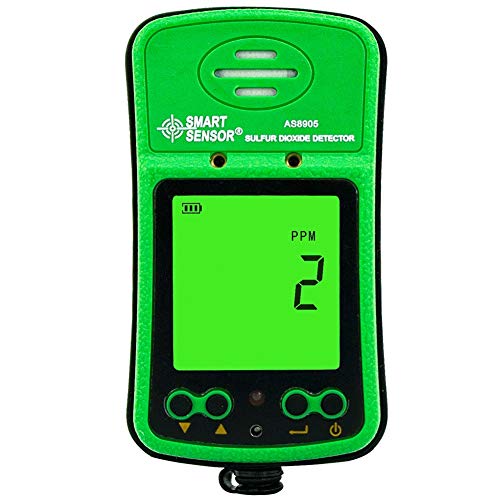
Smart Sensor SO2 Detector Review: 0.1 ppm Steps, No Accuracy Figure
A clip on sulfur dioxide monitor built on an electrochemical sensor, reading 0 to 20 ppm in 0.1 ppm steps, with adjustable high and low alarms signalled by sound, flash and vibration and a rechargeable cell quoted at 8 to 9 hours.
Read More→