As an Amazon Associate, Akermin earns from qualifying purchases. Product links on this page are affiliate links.

FORENSICS DETECTORS FD · Chlorine Gas Detector by Forensics | USA NIST Calibrated | USB Recharge | Adjustable Alarms | 0-50 ppm Cl2 Gas |
View on AmazonPrice and availability are shown on Amazon and can change at any time.
A rechargeable, belt clipped chlorine detector with an electrochemical sensor, a 0 to 50 ppm range at 0.1 ppm resolution, accuracy quoted as within 5 percent of full scale, a response time under 30 seconds, adjustable audible, visual and vibrating alarms and a calibration certificate in the box. Publishing both an accuracy and a response time puts this listing ahead of most of its category. Read the accuracy carefully though, because 5 percent of full scale on a 0 to 50 ppm instrument is 2.5 ppm at every point on the scale, including the part where chlorine decisions are actually made.
Five percent of full scale is not five percent of reading
The second bullet gives accuracy as within plus or minus 5 percent F.S. Those two letters change the meaning of the figure completely, and they are easy to read past.
Five percent of reading would scale with the number on the display. At 40 ppm the allowance would be 2 ppm and at 2 ppm it would be 0.1 ppm, so the error stays proportionate to what is being measured.
Five percent of full scale is fixed. It is five percent of the top of the range, which here is 50 ppm, so the allowance is 2.5 ppm and it applies as much at 1 ppm as at 49 ppm. The display resolves 0.1 ppm, which means the instrument shows steps twenty five times finer than its own stated allowance. That is not a defect, it is simply what the specification says, and the resolution figure must not be mistaken for the accuracy.
Full scale specifications are normal on gas instruments and they are perfectly informative once converted into the absolute figure. The conversion here is one multiplication and the answer is 2.5 ppm.
Where a 2.5 ppm allowance leaves the decision region
Chlorine is a gas people take seriously at low concentrations. Short term occupational guidance is set in the region of one part per million and below, depending on which body publishes it, and the odour is noticeable well under that for most people. The concentrations that drive a decision therefore sit in the first couple of parts per million of a fifty part scale.
A stated allowance of 2.5 ppm lies across the whole of that region. The honest conclusion is that this is a presence and trend instrument rather than a compliance one:
- It will tell you reliably that chlorine is present, because a few parts per million is well clear of the allowance.
- It will tell you which direction the concentration is moving, because a full scale error behaves largely as a fixed offset, so changes read truer than absolute values.
- It will tell you where in a space the concentration is highest, which is how a source gets found.
- It will not tell you that a concentration is below a limit, because the limit is smaller than the allowance.
That is a useful instrument and a clearly bounded one. The alternative for the last job is an instrument with a lower top of range, because the same percentage of a 10 ppm scale is 0.5 ppm, which is a different proposition entirely. If low level work is the reason you are buying, the top of the range is the specification to shop on.
Credit where it is due, a published response time
The same bullet states a response time of under 30 seconds. Almost nothing in this category publishes one, and it changes how the instrument gets used.
Response time is the interval between a step change in concentration and the display reaching most of the final value. Under 30 seconds means the number in front of you may be describing the air of half a minute ago.
Walk through a plant room at a normal pace for thirty seconds and you will have covered a great deal of ground. The display will have been chasing you the whole way and will not have settled anywhere. The technique the figure implies is to stop, wait, read and move, and to treat anything read on the move as an indication rather than a value. Our piece on why gas sensor response time matters goes through how to work with a figure like this.
The bullet pairs the response time with the sensing principle, an electrochemical cell, which is the usual choice for chlorine. That is specific, checkable writing, and most of the rest of the listing holds to the same standard.
NIST calibrated is shorthand for NIST traceable
The product name says USA NIST Calibrated, and the bullets add that the unit comes factory calibrated and arrives with a calibration and quality assurance certificate.
The phrase needs unpacking, because read literally it suggests something that does not happen. The National Institute of Standards and Technology does not calibrate production instruments for manufacturers one at a time. What is meant is traceability: the reference gas or reference instrument used in the calibration has an unbroken chain of comparisons leading back to a national standard, with an uncertainty carried along at each link.
Traceability is genuinely valuable, because it is the difference between a calibration against something and a calibration against nothing in particular. It is also exactly what the supplied certificate should document, which is why the certificate matters more than the phrase in the title. A certificate names the reference, the comparison, the points checked and the uncertainty at each one, and those numbers are what you want. Our guide on reading a calibration certificate sets out what to look for.
The listing also offers zero and span calibration options, which is more than most handhelds in this class allow, and the two halves are very different in practice. Zero calibration needs clean air and nothing else, and it is the one you can and should do regularly. Span calibration needs a known concentration of the target gas, and chlorine is among the most awkward gases to supply: it is reactive, so it attacks the inside of the cylinder, the regulator and the tubing, which means chlorine span mixtures have a short shelf life and need passivated equipment to deliver properly. Nothing in the bullets suggests a gas or a regulator is included, so the span function is good design that most owners will never exercise. The distinction between checking an instrument and adjusting it is worth having clear, and we cover it in calibration against adjustment.
Durability as adjectives, and the rest of the specification
The durability bullet is the weakest line in an otherwise specific listing. It describes the instrument as shock proof, water resistant, dust proof and explosion proof, and supplies none of the figures that would normally accompany those words.
Water resistance and dust resistance are conventionally stated as an ingress protection rating, two digits that say exactly what the enclosure keeps out. There is no rating here. Explosion protection is a certified classification rather than a property: an instrument that has it carries a marking naming the protection concept, the equipment group, the gas group and the temperature class, plus a certificate number from the body that issued it. None of that appears, and the phrase sits in a list of adjectives alongside shock proof.
| Specification | In the listing |
|---|---|
| Target gas | Chlorine |
| Sensing principle | Electrochemical cell |
| Range | 0 to 50 ppm |
| Resolution | 0.1 ppm |
| Accuracy | Within 5 percent of full scale, so 2.5 ppm |
| Response time | Under 30 seconds |
| Calibration | Factory calibrated, zero and span options, certificate supplied |
| Alarms | Adjustable audible, visual and vibrating |
| Also tracked | Temperature, battery and time |
| Charging | USB cable supplied |
| Carrying | Belt clip |
| Warranty | One year limited |
| Ingress protection rating | Not stated in the listing bullets |
| Explosion protection marking | Not stated in the listing bullets |
| Expected sensor life | Not stated in the listing bullets |
| Sensor replaceable by the owner | Not stated in the listing bullets |
| Battery runtime and charge time | Not stated in the listing bullets |
| Default alarm set points | Not stated in the listing bullets |
| Operating temperature and humidity | Not stated in the listing bullets |
| Logging or data export | Not stated in the listing bullets |
The missing sensor life is the row to notice after the durability adjectives. An electrochemical cell is consumed by the reaction it depends on and degrades with age whether or not the instrument is used, so an expected life and a route to replacement are what make a detector of this type ownable rather than disposable.
Who should carry this, and who needs a lower range
This is a well specified instrument for somebody who needs to know whether chlorine is present and where it is strongest: a water treatment or pool plant operator, a technician working around hypochlorite dosing, a responder checking a store room after a spill. The alarms cover a noisy environment properly, the response time is published so you can work with it rather than around it, the certificate gives you a record, and USB charging removes the battery problem that spoils a lot of handhelds.
Think harder if your work turns on low concentrations. A 50 ppm span combined with a full scale accuracy specification puts 2.5 ppm of allowance across the region where chlorine exposure decisions are made, so for assessing whether a space is within a limit you want an instrument with a lower top of range or an accuracy stated as a percentage of reading. And if you work in a classified area, settle the explosion protection marking in writing before relying on the word in the bullet.
Recommended Tools


Products shown because their documented specifications fit this guide. Price and availability are on Amazon and can change.
Frequently Asked Questions
What is the difference between 5 percent of full scale and 5 percent of reading?
It is the difference between a usable low end and an unusable one. Five percent of reading scales with the number on the display, so at 2 ppm the allowance would be 0.1 ppm. Five percent of full scale is fixed at five percent of the top of the range, which on a 0 to 50 ppm instrument is 2.5 ppm, and it applies just as much at 2 ppm as at 48. The display resolves 0.1 ppm, so the instrument shows steps twenty five times smaller than its own stated allowance.
Does that make the instrument useless?
No, it makes it a presence and trend instrument rather than a compliance one. Short term occupational guidance for chlorine is set at around one part per million and below, depending on which body publishes it, so the whole decision region sits inside the stated allowance. What the meter will reliably tell you is that chlorine is present, that it is rising or falling, and where in a space it is strongest. What it cannot do is show that a concentration is below a limit, because the limit is smaller than the uncertainty.
Why does a response time under 30 seconds matter?
Because it sets your walking speed. Response time is normally quoted as the interval needed to reach most of the final reading after a step change in concentration, and under 30 seconds means the display can lag the air by up to half a minute. Sweeping a room at walking pace, you will have moved a long way before the number catches up. The right technique is stop, wait, read, move. The real credit here is that the figure is published at all, which is unusual in this category.
What does NIST calibrated mean?
It is a compressed way of saying NIST traceable. The National Institute of Standards and Technology does not calibrate production instruments one at a time for manufacturers. Traceability means the reference gas or reference instrument used in the calibration has an unbroken chain of comparisons leading back to a national standard, with an uncertainty carried along at each step. It is a real and valuable thing, and the listing backs it up by stating that a calibration and quality assurance certificate arrives with the unit. Read the certificate, because that is where the actual numbers live.
Can I use the span calibration function?
Only if you can get chlorine span gas, which the listing does not mention supplying. Zero calibration needs clean air and is straightforward. Span calibration needs a known concentration, and chlorine is awkward to bottle because it is reactive and attacks the cylinder, the regulator and the tubing, so span mixtures have a short shelf life and need passivated equipment. The option being there is good design. Exercising it is a procurement problem.
Is explosion proof a claim I can rely on?
Not as written. It appears in a bullet alongside shock proof, water resistant and dust proof, with no protection marking, no equipment group, no temperature class and no certificate reference. Explosion protection is a certified classification evidenced by a marking on the instrument, and water resistance is normally stated as an ingress protection figure. Both are given here as adjectives. If a classified area is part of your work, ask for the marking in writing before relying on that sentence.
Affiliate disclosure: Akermin earns a commission from qualifying Amazon purchases made through links on this page. Our editorial picks are based on documented specifications and owner feedback, not commissions.
Related Guides

WiFi Natural Gas Alarm Review: One Unit Reveals the Whole Design
A WiFi natural gas alarm with an LCD showing gas concentration status and temperature, a stated response within 30 seconds, an alarm of at least 85 decibels and notifications to a phone app.
Read More→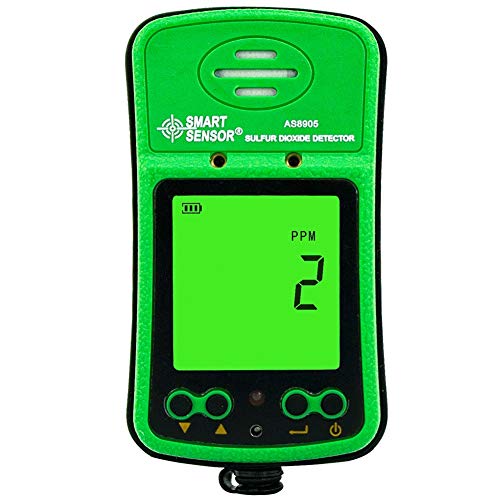
Smart Sensor SO2 Detector Review: 0.1 ppm Steps, No Accuracy Figure
A clip on sulfur dioxide monitor built on an electrochemical sensor, reading 0 to 20 ppm in 0.1 ppm steps, with adjustable high and low alarms signalled by sound, flash and vibration and a rechargeable cell quoted at 8 to 9 hours.
Read More→
Robinair LD9-TGKIT Review: It Senses Hydrogen and Quotes Refrigerant
A tracer gas service kit built around a hydrogen leak detector for a 5 percent hydrogen and 95 percent nitrogen mixture, with a full colour screen, sweep mode, automatic reset to ambient air, a mechanical pump, three UV lights at 395 to 415 nm, couplers, hose and a regulator.
Read More→