As an Amazon Associate, Akermin earns from qualifying purchases. Product links on this page are affiliate links.
Hold a vane anemometer square to the grille face, take readings at nine or more points in a grid, and average them. Measure the grille’s free area (the open area between louvers, often 60 to 80 percent of the face). Multiply average velocity by free area for volumetric flow: velocity in m/s times area in m² gives m³/s (multiply by 3,600 for m³/h); velocity in ft/min times area in ft² gives CFM. Compare with the design flow for the room. For ducts rather than grilles, use a hot-wire probe through test holes on a traverse pattern.
Equipment
- Vane anemometer with a flow (area) mode if possible; see how to choose an anemometer for HVAC work.
- Tape measure.
- Notepad or the meter’s averaging function.
- For ducts: hot-wire anemometer and a drill for test holes (with plugs).
Method at a grille
- Run the system on the setting to be measured for at least 10 minutes.
- Measure the grille: face width and height; count louvers and estimate or look up free-area ratio.
- Divide the face into a grid: 3 × 3 for small grilles, 4 × 4 or more for large ones.
- At each point, hold the vane centered, square to the face, 10 to 25 mm off the grille; wait for the reading to settle (3 to 5 seconds); record it.
- Average the readings.
- Calculate flow: Q = V_avg × free area. Example: average 2.4 m/s, grille 300 × 150 mm with 70 percent free area = 0.0315 m² → 0.0756 m³/s = 272 m³/h (about 160 CFM).
- Compare with the design figure or the room’s requirement.
Method in a duct
- Choose a straight run at least 7 duct diameters downstream and 2 upstream of any bend or fitting.
- Drill test holes; for round ducts two at 90°, for rectangular ducts enough for the traverse pattern.
- Insert a hot-wire probe and take readings on a log-Tchebycheff or equal-area pattern (the standard for the duct shape specifies points).
- Average; multiply by the duct’s internal area.
- Plug the holes.
Errors to avoid
| Error | Effect | Fix |
|---|---|---|
| Single center reading | Often 20 to 40% high or low | Grid traverse |
| Vane at an angle to the flow | Reads low by the cosine of the angle | Hold square; use the meter’s stand |
| Vane head larger than the grille | Blocks flow; reads low | Use a smaller head or a flow hood |
| Using face area instead of free area | Overstates flow by 20 to 40% | Apply the free-area ratio |
| Reading before the reading settles | Random error | Wait a few seconds each point |
| System not at steady state | Drifting readings | Run 10 minutes first |
| Deflected jets at angled louvers | Vane misses the jet direction | Angle the vane with the louvers or use a flow hood |
Flow hoods
A capture hood placed over the grille collects all the air and reads flow directly, removing the traverse and free-area errors. They are the professional balancing tool and expensive; an anemometer traverse done carefully comes within 10 percent for most grilles.
What the result means
Residential guidance often calls for supply flows of a few tens of m³/h per room and extract rates of 15 to 60 L/s for bathrooms and kitchens depending on the code. A CO₂ logger in the room offers a cross-check: the plateau it reaches under occupancy reflects the fresh-air flow actually delivered. See how to use CO₂ data to evaluate ventilation and what an anemometer measures.
Recommended Tools

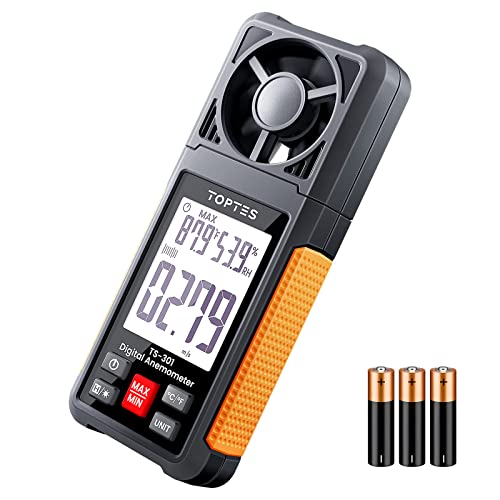

Products shown because their documented specifications fit this guide. Price and availability are on Amazon and can change.
Frequently Asked Questions
How many readings should I take on a vent?
At least nine on a grid for a typical residential grille, more on large commercial diffusers. Average them; the center reading alone can be 30 percent off.
What is the free area of a vent?
The open area through which air actually passes, excluding louvers and frame, typically 60 to 80 percent of the face. Manufacturers publish it; otherwise estimate from the slot dimensions.
Why does my reading change when I move the anemometer slightly?
Air leaves a grille in jets between the louvers. The vane averages over its own diameter; small movements shift which jets it covers. Take more points and average.
Affiliate disclosure: Akermin earns a commission from qualifying Amazon purchases made through links on this page. Our editorial picks are based on documented specifications and owner feedback, not commissions.
Related Guides

CPS LS790B Leak-Seeker Review: Non Combustible Is the Deciding Word
An ion pump refrigerant leak detector individually calibrated to find a leak rate better than a quarter of an ounce per year, with ten selectable sensitivity ranges, a water vapour filter and a bar graph plus tone display.
Read More→
BW Clip BWC2-H Review: Alarm Points Set Before the Clock Starts
A single gas hydrogen sulfide detector with one button operation, hibernation mode, automatic logging of the 35 most recent gas events and bump test results, and compatibility with IntelliDoX and MicroDock II docking.
Read More→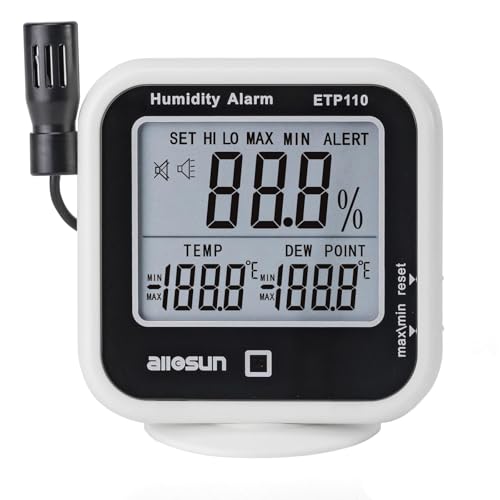
ALLOSUN Thermometer Hygrometer Review: Half a Metre of Lead and No Tolerance
A battery powered thermometer and hygrometer showing temperature, relative humidity and dew point, with a settable humidity alarm, a sensor on a lead of about 50 cm, maximum and minimum memory and a large LCD.
Read More→