As an Amazon Associate, Akermin earns from qualifying purchases. Product links on this page are affiliate links.
Choose a vane anemometer for grilles, diffusers and general HVAC checks, and a hot-wire anemometer for duct traverses, fume hoods, cleanroom benches and any velocity below about 0.5 m/s. Require a velocity range that covers 0.2 to 20 m/s, a flow mode that takes an area and reports m³/h or CFM with averaging, a temperature reading, and a stated accuracy of about ±3 percent of reading. Add data logging for balancing reports, a telescopic probe for hot-wire work, and consider a multifunction environmental meter if humidity, light and sound are also on the job list.
Step 1: Vane or hot-wire
| Task | Instrument |
|---|---|
| Supply and return grilles, diffusers | Vane (large head averages the face) |
| Duct traverse through test holes | Hot-wire (telescopic probe fits the hole) |
| Fume hood and safety cabinet face velocity | Hot-wire (low velocities, point grid) |
| Cleanroom and laminar flow benches | Hot-wire |
| Bathroom and kitchen extract fans | Either; vane at the grille is simplest |
| Outdoor units and condenser airflow | Vane |
| Draft and leakage tracing | Hot-wire |
The physics and trade-offs are in vane vs hot-wire anemometers.
Step 2: Specifications
- Velocity range: 0.2 (vane) or 0.05 (hot-wire) to at least 20 m/s.
- Accuracy: ±2 to 3 percent of reading plus a fixed term; stated, not “high precision”.
- Flow mode: area entry in m² or ft²; output in m³/h, m³/s, CFM; averaging over a traverse (multi-point or timed).
- Temperature: built-in for supply and return temperature checks; hot-wire instruments need it for compensation anyway.
- Humidity, wet bulb, dew point: useful for coil checks; found on environmental meters and some anemometers.
- Units: m/s, ft/min, km/h, mph, knots switchable.
- Data: hold, min/max, average; logging and Bluetooth for reports.
- Probe: vane head 25 to 70 mm (smaller for small grilles, larger for averaging); hot-wire telescopic to about 1 m with a directional mark.
- Build: drop resistance, a case, a stand or tripod thread for hands-free readings.
Step 3: Multifunction or dedicated
Environmental meters such as the Extech EN300 combine a vane anemometer with temperature, humidity, light and sound in one handheld. For a technician who occasionally needs each, they replace several instruments. For daily airflow work, a dedicated anemometer with a larger vane, better low-speed performance and a proper flow mode is more capable. See how to choose an environmental meter.
Step 4: Using it for balancing
- Measure the free area of the grille or the duct cross-section.
- Traverse: for a grille, at least 9 points in a grid; for a duct, the log-Tchebycheff or equal-area pattern the standard specifies.
- Average the velocities; multiply by area; compare with design flow.
- Repeat after damper adjustments.
- Record instrument, method, area and conditions.
Background on the measurement is in what an anemometer measures and the procedure in how to measure air velocity in a vent. Instruments are in the environmental monitoring category.
Recommended Tools


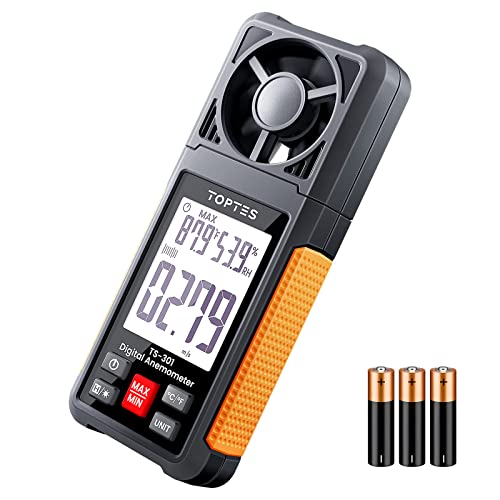
Products shown because their documented specifications fit this guide. Price and availability are on Amazon and can change.
Frequently Asked Questions
Vane or hot-wire for HVAC?
Vane for supply and return grilles and outdoor units; hot-wire for duct traverses through test holes, fume hoods and low-velocity checks. Many technicians carry a vane meter and add a hot-wire later.
Does the anemometer need to calculate CFM?
It saves arithmetic and errors. Enter the free area of the grille or duct and the meter multiplies by the average velocity. Traverse and averaging modes improve the result.
What accuracy is enough?
±3 percent of reading plus a small fixed term is typical of good handhelds and adequate for balancing. Certification of fume hoods and cleanrooms may specify tighter instruments.
Affiliate disclosure: Akermin earns a commission from qualifying Amazon purchases made through links on this page. Our editorial picks are based on documented specifications and owner feedback, not commissions.
Related Guides

CPS LS790B Leak-Seeker Review: Non Combustible Is the Deciding Word
An ion pump refrigerant leak detector individually calibrated to find a leak rate better than a quarter of an ounce per year, with ten selectable sensitivity ranges, a water vapour filter and a bar graph plus tone display.
Read More→
BW Clip BWC2-H Review: Alarm Points Set Before the Clock Starts
A single gas hydrogen sulfide detector with one button operation, hibernation mode, automatic logging of the 35 most recent gas events and bump test results, and compatibility with IntelliDoX and MicroDock II docking.
Read More→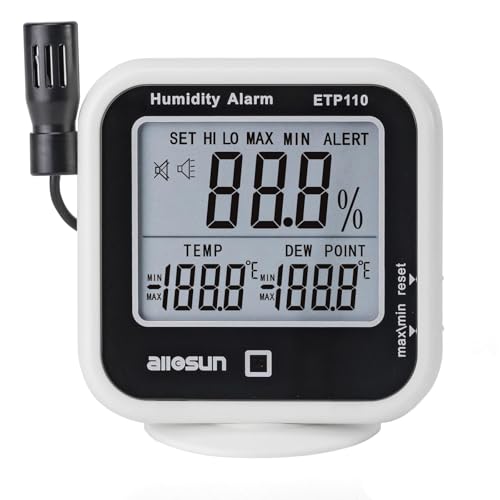
ALLOSUN Thermometer Hygrometer Review: Half a Metre of Lead and No Tolerance
A battery powered thermometer and hygrometer showing temperature, relative humidity and dew point, with a settable humidity alarm, a sensor on a lead of about 50 cm, maximum and minimum memory and a large LCD.
Read More→