As an Amazon Associate, Akermin earns from qualifying purchases. Product links on this page are affiliate links.
For most building work the choice comes down to whether you need a number now or a record later. P1, the Testo 440, is the pick when you are standing at a grille or a duct with a probe in your hand: it publishes vane and hot wire ranges and an integrated differential pressure sensor for filter and Pitot work. P2, the Airthings View Plus, is the pick when the question is what the air does over weeks, including radon, and it is the only product here that measures radon at all. P3, the Sper Scientific 850071, is the pick when you want a logged record you can open in Excel without extra software, and it is the only one here that logs light and accepts Type J and K thermocouple probes. P4 and P5 are the same instrument sold in two piece and four piece packs, so choose on how many units you need, not on capability.
A spot reading and a continuous record are different instruments
The mistake that costs the most money in this category is buying a continuous monitor to answer a spot question, or a spot meter to answer a continuous one. They are not interchangeable, and the listings make the split obvious once you read them properly.
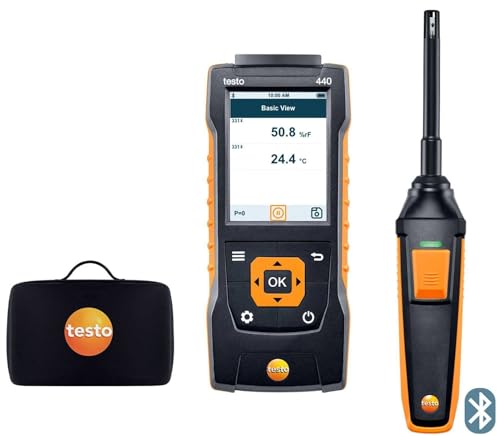
P1 is a handheld. You hold it, you attach a probe, you read a number. The listing states a vane probe range of +0.3 to +35 m/s and -20 to +70 degrees C, and a hot wire probe range of 0 to +50 m/s with air temperature and humidity at -20 to +70 degrees C and 5 to 95 percent RH. Those are working ranges for somebody standing at a duct or a ceiling outlet. The integrated differential pressure sensor is there for filter checks, Pitot tube measurements, and K factor work. Nothing in that description suggests the instrument is meant to sit in a room for a month.
P2 is the opposite. The listing calls it an always-on monitor, WiFi connected, measuring radon, PM2.5, carbon dioxide, VOCs, humidity, temperature, and air pressure. It requires the app to function, and it requires internet access, with data saved in the cloud. That is a different product category wearing a similar name. You do not walk around with it. You leave it in place and read the trend.
P3 sits between them. It is a handheld logger: air speed, ambient temperature, relative humidity, light, and thermocouple temperature, all recorded to a removable SD card. You can carry it, but its purpose is to leave a file behind. The listing states that you remove the card, put it in a computer, and upload pre-formatted data to Excel with no additional software. That is a record-keeping instrument, not a walk-around meter.
What each listing actually publishes, and what it does not
Most of the confusion in this category comes from listings that publish a headline feature set and nothing else. Here is what each one gives you and where it goes quiet.
| Instrument | Measured quantities | Published ranges | Data handling | Power or connection |
|---|---|---|---|---|
| P1 Testo 440 | Air velocity, volume flow, air temperature, humidity, differential pressure | Vane +0.3 to +35 m/s, -20 to +70 degrees C; hot wire 0 to +50 m/s; humidity 5 to 95 percent RH | Not stated in the listing bullets | Not stated in the listing bullets |
| P2 Airthings View Plus | Radon, PM2.5, CO2, VOCs, humidity, temperature, air pressure | Operating temperature 4 to 40 degrees C | Cloud storage via app, internet required | Battery powered, WiFi connected |
| P3 Sper Scientific 850071 | Air speed, ambient temperature, relative humidity, light, thermocouple temperature | Not stated in the listing bullets | Removable SD card, Excel-ready files | Not stated in the listing bullets |
Read that table carefully, because the gaps matter as much as the entries. P1 publishes probe ranges but not its own logging or power arrangement. P2 publishes an operating temperature but no accuracy figure for any sensor. P3 publishes no measurement ranges at all, only the quantities it records. If a number is not in the table above, the listing does not publish it, and you should not assume it.
One claim in P2 deserves a flag. The listing says the radon detector is accurate, but it publishes no accuracy figure. Radon measurement is a slow business, and a consumer monitor is not a substitute for a laboratory test in a regulated context. Treat the number it gives you as a trend indicator, not a compliance measurement. The listing also states that radon is the number one cause of lung cancer among non-smokers and kills more than six times the number of people than home fires and carbon monoxide poisoning combined. That is the manufacturer’s stated position, reported here as stated.
The three instruments worth considering
Testo 440
The only handheld here with published vane and hot wire ranges plus an integrated differential pressure sensor.
Airthings View Plus
The only product in this set that measures radon, and it runs continuously rather than on demand.
Sper Scientific 850071
The only logger here that records light and accepts Type J and K thermocouple probes, with SD card export.
Why the probe matters more than the meter body
On P1, the instrument body is not really the measuring device. The probe is. The listing describes using the vane probe at air and ceiling outlets, the hot wire probe inside ventilation ducts, and vane probes with testovent measurement funnels and flow straighteners for plate outlets, ventilation grills, and swirl outlets. Each of those is a different physical situation, and the probe choice follows from the geometry, not from the meter.
A vane probe is a rotating element. Air turns it, and the instrument counts the turns. That works well at an open outlet where you can present the full face of the vane to the airflow. A hot wire probe works on a different principle: air moving past a heated wire cools it, and the instrument measures the cooling. That is why the listing pairs the hot wire with duct work, where the probe can sit in a confined stream, and why it mentions automatic absolute pressure compensation. Air density changes with altitude and pressure, and a hot wire reading without compensation drifts.
The integrated differential pressure sensor is the third mechanism. It compares two pressures and reports the difference. That is what lets the same instrument check a filter, take a Pitot tube reading, or apply a K factor. A Pitot tube is ordered separately, and the listing says so. If you are buying P1 for Pitot work, the tube is not in the box.
This is where people overspend. If your job is checking supply and return at ceiling diffusers, you need the vane side of P1, not the hot wire side. If your job is balancing a duct system, you need the hot wire and the pressure sensor. Buying the full kit for one of those jobs leaves capability unused. Our page on differential pressure meters for HVAC covers the filter and Pitot side in more depth if that is the job.
The logger that writes a file, and the monitor that writes a trend
P3 and P2 both produce a record over time, but they produce different kinds of record and they are read in different ways.
P3 writes to a removable SD card. The listing states that the file is pre-formatted and opens directly in Excel with no additional software. That matters for building work because the deliverable is often a spreadsheet: a row per interval, a column per quantity, handed to a client or filed against a commissioning record. The listing also states compatibility with all standard Type J and K thermocouple probes, which extends the instrument beyond its built-in sensors. If you need to log a surface temperature or a pipe temperature alongside air speed and light, that is the route. Light logging is unusual in this category and is the reason P3 appears on environmental quality lists at all.
P2 does not give you a file in that sense. It gives you an app view and cloud storage. The listing states that the monitor and app both require internet access and that data is saved securely in the cloud. That is convenient for a homeowner or a facilities manager checking a building remotely, and it is the wrong shape for a commissioning pack that has to be handed over as a document. It is also the only product here that measures radon, carbon dioxide, and PM2.5 together, which is a genuinely different capability set. For long-term CO2 work specifically, our guide to choosing a CO2 data logger goes through the recording interval question that neither listing answers.
P4 and P5 are the same Sper Scientific 850071 sold as two piece and four piece packs. The listing bullets are identical to P3 in every respect. There is no functional difference to describe, so choose between P3, P4, and P5 on how many units you want to deploy at once, not on features. If you need four rooms logged simultaneously, the four piece pack is the same instrument four times.
Where each of these stops being the right answer
None of these instruments is a safety device. P2 measures radon and reports it, but it is not a radon mitigation system and it does not remove anything from the air. P1 and P3 measure air speed, temperature, and humidity; they do not detect combustible gas, carbon monoxide, or any other hazard gas, and they are not alarms. If your question is whether the air is safe right now, none of these answers it.
P1 stops being right when you need a record. The listing does not publish a logging function, a memory capacity, or a data export method. If your job requires a time series, P1 is the wrong instrument regardless of how good its probes are.
P2 stops being right when you need a compliance-grade measurement. The listing publishes no accuracy figures and no certification. It is a trend and awareness tool. It also stops being right in an unheated building, because the stated operating temperature is 4 to 40 degrees C, and a cold plant room or a hot roof space can fall outside that.
P3 stops being right when you need to know what the air is doing while you are not there, because nothing in the listing describes remote access or alerts. You get the file when you pull the card. It also stops being right if you need published measurement ranges before you commit, because the listing does not provide them. That is a real limitation for anybody who has to specify an instrument against a tolerance.
If your work is domestic and the question is simply what the air quality is doing over a season, the broader comparison on indoor air quality monitors covers the consumer end of this market. The three instruments here are the ones whose listings support building-scale work: probes, logs, and continuous trends.
Recommended Tools

Products shown because their documented specifications fit this guide. Price and availability are on Amazon and can change.
Frequently Asked Questions
Can P1 measure radon or carbon dioxide?
No. The listing describes air velocity, volume flow, air temperature, humidity, and differential pressure. Radon and carbon dioxide are not mentioned. If you need those, P2 is the only product in this set that measures them.
Does P2 need the internet to work?
The listing states that the monitor and app both require internet access, and that the monitor requires the Airthings app to function. It also states that an account is required, needing your email and name. Without connectivity, the product does not operate as described.
Is the Airthings radon reading accurate enough for a legal requirement?
The listing publishes no accuracy figure and no certification, so you cannot judge that from the data given. Radon compliance measurement is normally done with a specific approved method. Treat P2 as a continuous trend indicator and confirm any regulatory requirement separately.
What is the difference between P3, P4, and P5?
They are the same Sper Scientific 850071 logger. P4 is a two piece pack and P5 is a four piece pack. The listing bullets are identical. Choose on the number of units you need, not on features.
Do I need a Pitot tube with P1?
If you intend to do Pitot tube measurements, yes. The listing states that Pitot tubes can be ordered separately, which means the tube is not included with the instrument.
Can any of these instruments log data on its own without extra equipment?
P3 records to a removable SD card and the listing states the files open in Excel. P2 stores data in the cloud through its app. P1's listing does not publish a logging function or a data export method, so for a time series you would need to look elsewhere.
What does P3 not measure that the others do?
P3 does not measure radon, carbon dioxide, PM2.5, or VOCs, which P2 does. It also does not publish air velocity or humidity ranges, unlike P1. Its distinctive additions are light measurement and Type J and K thermocouple compatibility.
Are these instruments alarms?
No. None of the listings describes an alarm function. P2 sends air quality notifications through its app, which is a notification, not a life safety alarm. None of these should be relied on to warn you of a hazardous gas.
Affiliate disclosure: Akermin earns a commission from qualifying Amazon purchases made through links on this page. Our editorial picks are based on documented specifications and owner feedback, not commissions.
Related Guides

Environmental Data Loggers for Building Monitoring: Four Instruments Compared
A comparison of four environmental data loggers for building monitoring, covering what each listing publishes about sensors, range, storage and reporting.
Read More→
Best Manometers for HVAC Technicians: Six Picks
Six manometers compared on published range, accuracy, port count and wireless behaviour, with the specification gaps each listing leaves open.
Read More→
Best Differential Pressure Meters for HVAC: 6 Picks
A comparison of six differential pressure meters for HVAC work, covering range, accuracy, port configuration, and the jobs each one is built for.
Read More→