As an Amazon Associate, Akermin earns from qualifying purchases. Product links on this page are affiliate links.
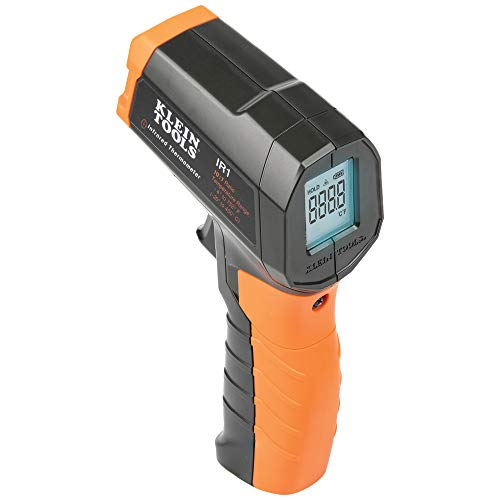
KLEIN TOOLS · Klein Tools IR1 Infrared Thermometer with Targeting Laser, Auto-Hold, More | Digital Laser Gun is Non-Contact Thermometer with a Temperature Range -4 to 752-Degree Fahrenheit, Optical Resolution 10:1
View on AmazonPrice and availability are shown on Amazon and can change at any time.
Verdict
The Klein IR1 is a compact infrared thermometer for spot temperature checks. The listing states a 10 to 1 distance-to-spot ratio, a range of -4 to 752 F, a targeting laser, a backlit display, auto power off, auto-hold and fixed emissivity. It is a good tool for what it is: a fast, non-contact reading of a surface. It is not a thermal camera, and the fixed emissivity is the specification that defines where it will mislead you.
Documented Specifications
| Item | Manufacturer listing |
|---|---|
| Distance to spot | 10 to 1 |
| Temperature range | -4 to 752 F (-20 to 400 C) |
| Targeting | Laser pointer |
| Display | Backlit |
| Emissivity | Fixed |
| Other | Auto-hold, auto power off |
The listing does not publish an accuracy figure or a response time. Check the datasheet if the reading has to go in a report.
The Distance-to-Spot Ratio Is the Number People Ignore
An infrared thermometer averages the temperature of everything inside its measurement circle. A 10 to 1 ratio means that circle is a tenth of your distance from the target: about 25 mm across at 250 mm, about 300 mm across at 3 metres.
This is the source of most wrong readings. Somebody stands across a plant room and points at a bearing, and the instrument dutifully reports the average of the bearing, the housing, the frame and some of the wall. The bearing was hot; the reading was not. The rule is simple: get close enough that the object fills the spot, and if you cannot, use a thermal camera instead, which is exactly the argument in thermal camera versus infrared thermometer.
Note also that the laser shows the centre of the spot, not its edges. It is an aiming aid, not a measurement of area.
Fixed Emissivity and What It Costs You
Every surface radiates infrared according to its temperature and its emissivity. Matt paint, wood, plastic, brick, skin and oxidised metal all sit close to 0.95, and an instrument with fixed emissivity assumes that value. For all of those, it is right.
Shiny metal is a different matter. Polished copper, clean aluminium, stainless steel and bright busbar can have an emissivity as low as 0.05, which means most of what the thermometer sees is reflected from elsewhere in the room, including you. Readings on such surfaces are wildly low and confidently displayed. The standard fixes are to apply a piece of matt tape or a dab of matt paint and measure that, or to measure an adjacent painted surface instead. Knowing this one fact prevents most of the errors people make with these instruments.
Where It Is the Right Tool
- HVAC supply and return temperatures at a register, close up.
- Checking a run of similar components for the odd one out, provided all have similar surfaces.
- Surface temperature for a dew point comparison during a damp survey.
- Quick checks on appliances, pipework and ducts during other work.
Where It Is Not
It cannot find a fault you have not already located, because it reads one spot at a time. A thermal camera scans a scene and shows anomalies you were not looking for; a spot thermometer confirms a temperature at a place you chose. That difference is why the two tools coexist rather than competing, and why many technicians carry both.
Strengths
- Fast, non-contact readings with a clear aiming laser.
- Range covers building, electrical and HVAC work.
- Backlit display and auto-hold for awkward positions.
- Small enough to carry alongside everything else.
Limitations
- Fixed emissivity, so shiny metal reads far too low.
- 10 to 1 ratio limits how far back you can stand.
- No accuracy figure published.
- Single spot only, so it cannot survey a scene.
How It Compares
The Klein IR5 offers a tighter 12 to 1 ratio with dual lasers, which helps at distance. For finding faults rather than confirming them, a thermal camera such as the FLIR C5 or the TOPDON TC004 Mini is the right tool. Our ranking is in the infrared thermometer roundup.
How We Research
All figures come from the manufacturer listing and Klein’s published documentation. We did not run laboratory tests and publish no measurements of our own.
Recommended Tools
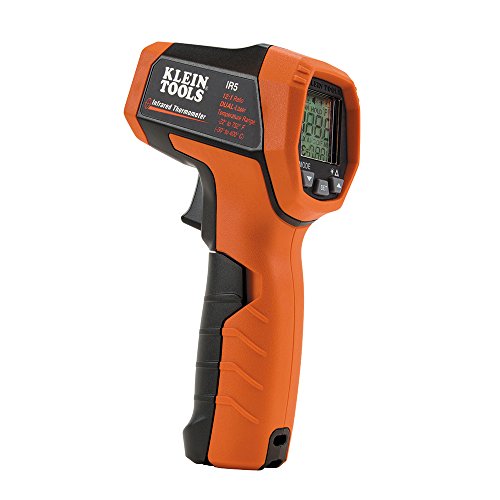

Products shown because their documented specifications fit this guide. Price and availability are on Amazon and can change.
Frequently Asked Questions
What does a 10 to 1 ratio mean?
At ten units of distance the measured spot is one unit across. At 10 inches it measures a 1 inch circle; at 10 feet it measures a 1 foot circle. Standing further back means averaging a larger area, which is the most common source of wrong readings.
What is fixed emissivity?
The instrument assumes a single surface emissivity, typically around 0.95, rather than letting you adjust it. That is correct for most painted, plastic and oxidised surfaces and wrong for shiny metal, which will read far too low.
What temperature range does it cover?
The listing states -4 to 752 F, or -20 to 400 C, which covers electrical, HVAC and building work.
Does the laser affect the measurement?
No. The laser only shows you where you are pointing. It marks the centre of the measured area, not its size, which is why understanding the distance-to-spot ratio still matters.
Affiliate disclosure: Akermin earns a commission from qualifying Amazon purchases made through links on this page. Our editorial picks are based on documented specifications and owner feedback, not commissions.