Best Infrared Thermometers: Spot Temperature Guns for Trades, Kitchens and Home Checks
An infrared thermometer reads the average surface temperature of a spot whose size grows with distance, which is why the distance-to-spot ratio and the emissivity setting matter more than the range printed on the box. This guide sorts current listings on those two figures plus laser type, readouts and durability, and says where a listing stays silent.
As an Amazon Associate, Akermin earns from qualifying purchases. Product links on this page are affiliate links.
Our Top Picks
These thermometers were compared on manufacturer listing figures: distance-to-spot ratio, laser targeting, emissivity control, temperature range, stated accuracy, readouts such as min, max and average, and ingress or drop ratings. We did not run laboratory tests; every figure is the manufacturer's own and gaps are marked Not stated.
Best Overall
Fluke 62 MAX+ Infrared Thermometer
Dual rotating lasers, 1202 F upper limit and IP54 for daily trade use.
Upper limit stated at 650 C (1202 F); accuracy plus or minus 1 C or 1.0% of reading from 0 to 650 C
Dual lasers rotate to mark the edges of the measurement area
Displays minimum, maximum, difference and average; backlit display
IP54 against dust and splashing; small enough to clip to a tool belt
All figures are the manufacturers' listing statements at the time of research. Not stated means the listing gives no value, not that the feature is absent. None of these instruments is intended for human or animal body temperature.
How to Choose an Infrared Thermometer
Four figures decide it:
Distance-to-Spot Ratio
At 12:1 the spot is 1 in across from 12 in away; at 10:1 it is 1.2 in. Stand closer than the ratio allows or the reading averages in the surroundings.
Emissivity Control
Adjustable 0.1 to 1.0 on the IR5, Etekcity dual laser and TempPro; fixed 0.95 on the IR1; not stated on the 774 and both Flukes. Shiny metal needs it.
Range You Will Actually Use
Every unit here covers ovens and coils. Only the Fluke 62 MAX+ and ennoLogic state 1202 F for flue pipes and forge work.
Durability and Readouts
IP54 and drop ratings are stated by Fluke and Klein. Min, max, average and alarms turn a scan into a number you can log.
What does a 12:1 distance-to-spot ratio mean in practice?
The sensor reads a circle whose diameter is one twelfth of the distance to the target. At 12 in the spot is 1 in across; at 36 in it is 3 in across. If the spot is bigger than the object, the reading blends in whatever surrounds it. A 10:1 unit has to be held closer for the same spot size, and a 16:1 or 50:1 unit can stand farther back.
Can I use one of these thermometers on a person?
No. Every listing here states industrial or surface use only, and Fluke, Klein, ennoLogic and Etekcity say explicitly that readings on people or animals will not be correct. These instruments read surface temperature with an emissivity setting for materials, not for skin, and are not medical devices.
Why does the reading change when I move closer to the same surface?
Because the spot shrinks as you approach and stops averaging in the cooler or warmer surroundings. Etekcity states a best distance of about 14.17 in for its 12:1 units; at that range the spot is a little over an inch across. If the number keeps climbing as you close in, the target was smaller than the spot at the previous distance.
When do I need adjustable emissivity on an infrared thermometer?
Whenever the surface is shiny: bare copper, aluminum, stainless steel, galvanized duct or a glossy finish. Those surfaces emit less infrared for their temperature and reflect their surroundings, so a thermometer set to 0.95 reads them low. Adjustable units let you set a lower value; on a fixed unit, a piece of tape or matte paint on the surface gives a true reading where it is safe to apply one.
Is a NIST calibration certificate worth paying for?
Only if someone will ask for it. Food safety audits, quality programs and some maintenance contracts require traceable calibration on record. The ennoLogic eT650D listing includes a NIST traceable certificate; for a home cook or a general contractor the certificate changes nothing about daily use, and periodic checks against a known reference are the practical substitute.
Reviews
Fluke 62 MAX+ Infrared Thermometer Best Overall
The 62 MAX+ is the thermometer for a technician who uses one every day. Fluke states an upper limit of 650 C (1202 F) with an accuracy of plus or minus 1 C or 1.0% of the reading across the 0 to 650 C span, which is the tightest accuracy statement in this group, and dual lasers that rotate to pinpoint the edges of the measurement area rather than its center. The display shows minimum, maximum, the difference between the two and the average, which is what a service call needs when scanning a coil or a set of breakers.
The body is certified IP54 against dust and splashing liquid, backlit for dark mechanical rooms and small enough to clip to a belt loop. Fluke describes it as an industrial instrument, not for human temperature.
Two gaps on the listing: it does not state the distance-to-spot ratio or an emissivity adjustment, and the lower end of the range is printed inconsistently, so we quote only the upper limit. The single-laser Fluke 62 MAX in the table states 10:1 and a 3 m drop rating where the MAX+ listing is silent.
Strengths
Accuracy of plus or minus 1 C or 1.0% stated
Dual rotating lasers mark the spot edges
IP54 and belt-clip size
Min, max, difference and average readouts
Limitations
Distance-to-spot ratio not stated on the listing
Emissivity adjustment not stated
Lower range limit printed inconsistently on the listing
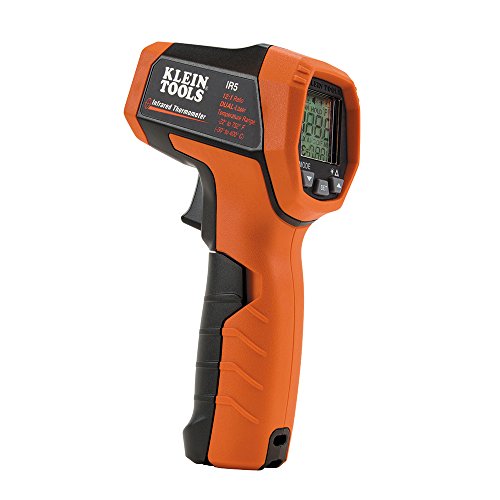
Klein Tools IR5 Dual Laser 12:1 Infrared Thermometer Best Dual Laser 12:1
The IR5 is the listing that states every figure a buyer wants to compare. Klein gives a 12:1 distance-to-spot ratio, a -22 to 752 F range, dual laser targeting, auto scan, max, min, average and difference readouts, a high and low alarm, a backlit display and auto power off. Emissivity is adjustable from 0.1 to 1.0, which is what separates a trade tool from a kitchen gadget when the surface is bare metal, a foil-faced duct or a glossy paint.
Durability is stated as 6.6 ft (2 m) drop protection, and the package includes a custom pouch and batteries. Klein labels it a non-medical device not intended for people or animals.
Against the Fluke 62 MAX+ the IR5 gives up the 1202 F upper limit and the tighter accuracy statement, and its listing gives no accuracy figure at all and no ingress rating. For an electrician or HVAC technician who works below 750 F and wants the emissivity and alarm functions spelled out, it is the more complete listing.
Strengths
12:1 ratio, dual lasers and adjustable emissivity all stated
Etekcity Lasergrip 774 Infrared Thermometer Best Value
The 774 is the thermometer for a kitchen drawer or a garage shelf. Etekcity states a 12:1 distance-to-spot ratio, a -58 to 842 F range, a reading in under half a second and a backlit LCD, with two AAA batteries in the box. The listing is unusually clear about what the number means: it is the average temperature within the circular area the sensor sees, not a single point, and a maximum readout is shown alongside it.
Etekcity recommends holding it about 14.17 in (36 cm) from the target, which at 12:1 means a spot a little over an inch across, about right for a skillet, a griddle zone or an air conditioner register.
What the listing does not state is as important as what it does: there is no emissivity adjustment mentioned, no accuracy figure, no dual laser and no drop or ingress rating. On a polished stainless pan or a bare copper pipe the reading will be low with no way to correct it. For painted, seasoned or dark surfaces it does the job; for trade work the IR5 is the step up.
Short answer: the Fluke 62 MAX+ is the infrared thermometer for daily trade use, with a stated upper limit of 1202 F, dual rotating lasers that mark the spot edges, an accuracy of plus or minus 1 C or 1.0% and an IP54 body; the Klein IR5 is the dual laser 12:1 pick whose listing states adjustable emissivity, alarms and a 2 m drop rating; and the Etekcity 774 is the value unit for kitchens and home checks, a 12:1 thermometer with a -58 to 842 F range that reads in under half a second.
What an infrared thermometer actually measures
An infrared thermometer reads the infrared energy leaving a surface and converts it to a temperature. Three consequences follow, and they explain most disappointed owners. It reads surfaces only, so it cannot tell you the air temperature in a room or a duct, the internal temperature of a roast or the temperature of water below its surface film. It reads a spot, not a point: the number is the average of the circular area the sensor sees, and that circle grows with distance. And it assumes an emissivity, usually 0.95, which is right for paint, wood, brick and food and wrong for bare metal. Every listing in this group also states that the instrument is not for human or animal body temperature. The infrared thermometer buying guide covers the physics in more depth; this page applies it to current listings.
Distance-to-spot ratio decides how close you stand
The ratio is the single most useful figure on a listing. The Klein IR5, Etekcity 774, Etekcity dual laser and TempPro TempScan all state 12:1, which means a 1 in spot at 12 in and a 3 in spot at 36 in. The Fluke 62 MAX and Klein IR1 state 10:1, so they have to be held a little closer for the same spot. The Fluke 62 MAX+ and ennoLogic eT650D listings do not state a ratio at all, a real omission on the Fluke, since the ratio decides whether a breaker lug or a 3/4 in line can be read from a safe distance. In practice, hold the tool closer than the ratio allows rather than farther: if the spot is bigger than the target, the reading averages in the wall behind it. Etekcity recommends about 14.17 in for its 12:1 units, which works as a default for most of the group.
Single laser, dual laser and no laser
The laser does not measure anything; it shows where the sensor is pointed. A single laser marks roughly the center of the spot, which is enough when the target is large. Dual lasers mark the edges of the spot at the distance for which they are set, so the user can see whether the whole circle sits on the target: the Klein IR5, ennoLogic eT650D and Etekcity dual laser state dual lasers, and Fluke describes the 62 MAX+ lasers as rotating to pinpoint the edges of the measurement area. The Fluke 62 MAX and Klein IR1 state a single laser, the Etekcity 774 states laser targeting without a count, and the TempPro listing does not describe the laser at all. Our dual laser guide goes deeper on what two beams do and do not tell you.
Emissivity: fixed, adjustable or not stated
This is where the group divides between trade tools and household tools. The Klein IR5, Etekcity dual laser and TempPro TempScan state adjustable emissivity from 0.1 to 1.0, and the ennoLogic states adjustable emissivity without a range. The Klein IR1 states a fixed 0.95, which Klein presents as consistent readings across surfaces. The Etekcity 774 and both Fluke listings do not mention emissivity at all. For painted enclosures, drywall, wood, food and cast iron the setting barely matters. For a copper bus bar, an aluminum heat sink, a stainless pan or a galvanized duct it decides whether the reading is close or badly low, and a fixed or unstated unit needs the tape trick: a strip of electrical tape or a patch of matte paint applied to the surface, read after it has reached the same temperature.
Range, accuracy and readouts on the listings
Every thermometer here covers the everyday span from a freezer to an oven. The upper limits separate them: the Fluke 62 MAX+ and ennoLogic state 1202 F, the Etekcity Lasergrip units 842 F and 1022 F, the TempPro 1022 F, the Fluke 62 MAX 932 F and the two Klein units 752 F. Only three listings state an accuracy: plus or minus 1 C or 1.0% on the 62 MAX+, 1.5 C or 1.5% on the 62 MAX and 1.5% on the TempPro. Readouts matter more than they look on a service call: both Flukes and the Klein IR5 show minimum, maximum, difference and average, the IR5 and ennoLogic add high and low alarms, the ennoLogic adds a hands-free scan mode, and the Klein IR1 offers auto-hold. Durability is stated only by Fluke and Klein: IP54 on both Flukes, a 3 m drop on the 62 MAX and 6.6 ft (2 m) drop protection on the two Kleins.
Where the number goes wrong
Three situations produce confident, wrong readings. Shiny metal, covered above, reads low and reflects: a bare copper line can show the temperature of the ceiling it reflects rather than its own. Steam, smoke and a dirty lens attenuate the infrared signal, so a pot boiling under a cloud of vapor or a smoker with the lid just opened reads unreliably until the air clears. And glass and clear plastic are largely opaque to the thermometer, so pointing through a window or an oven door reads the glass, not what is behind it. None of this is a defect in the instrument; it is what surface infrared measurement is. When the question is a pattern across a whole panel or wall rather than one spot, a thermal camera answers it; the thermal camera versus infrared thermometer comparison sets out when each tool earns its place.
Related guides
For service-call specifics such as registers, coils and flue pipes, see the HVAC infrared thermometer guide; for griddles, pizza stones and probe combinations, the cooking and grill guide covers the kitchen side.
How We Research
Thermometers were compared on manufacturer listing text: distance-to-spot ratio, laser targeting, emissivity control, temperature range, stated accuracy, readouts, response time, ingress and drop ratings and warranty. Owner feedback was reviewed for recurring reports of drift on shiny surfaces and battery problems. We did not run laboratory tests and publish no temperature measurements of our own. Amazon data supplies images, availability and links only.
A handheld thermal camera with a 160 by 120 infrared detector, a 320 by 240 enhanced image, 40 mK sensitivity, a focus free 40 by 30 degree field of view, a 25 Hz refresh rate and still JPG image capture.
A non contact infrared thermometer for electrical, mechanical, HVAC and automotive surfaces, with dual rotating lasers that mark the edges of the measurement area, minimum, maximum, difference and average readings, and an IP54 rating.
A pinless non invasive moisture meter that reads up to three quarters of an inch into a surface, with scales of 0 to 53 percent for softwood, 0 to 35 percent for hardwood and relative readings on wallboard, drywall and masonry.