Skip to content
AkerminMeasure. Monitor. Improve. Compare Products

Best Dual Laser Infrared Thermometers: Picks That Show the Real Measurement Spot

A second laser does not make an infrared thermometer more accurate; it shows where the edges of the measurement spot fall so you can tell whether the whole circle is on the target. This guide compares the dual laser listings on that, on distance-to-spot ratio from 12:1 to 50:1, and on emissivity and readouts, without inventing figures the manufacturers did not publish.

  • Independent Research
  • Verified Specifications
  • Honest Recommendations

Two Beams
Mark the Edges
Sensor Unchanged

As an Amazon Associate, Akermin earns from qualifying purchases. Product links on this page are affiliate links.

Our Top Picks

These thermometers were compared on manufacturer listing text: how the dual lasers are described, distance-to-spot ratio, emissivity control, range, stated accuracy, readouts and alarms, and certification or warranty. We did not run laboratory tests; every figure is the manufacturer's own and gaps are marked Not stated.

Best Overall
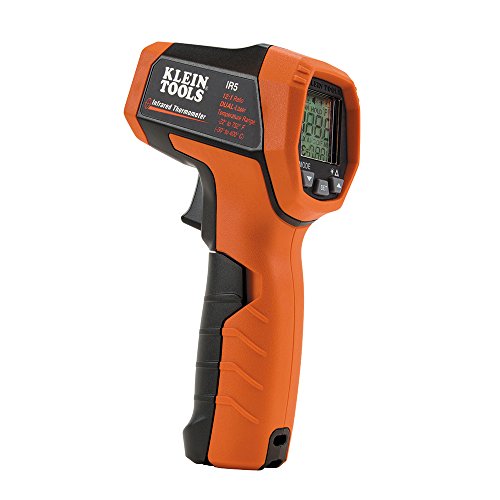
Klein Tools IR5 Dual Laser 12:1 Infrared Thermometer

Klein Tools IR5 Dual Laser 12:1 Infrared Thermometer

Dual lasers, 12:1 optics, adjustable emissivity and alarms in a 2 m drop-rated body.

  • Dual laser targeting with a stated 12:1 distance-to-spot ratio
  • Measures -22 to 752 F (-30 to 400 C)
  • Auto scan, max/min/avg/diff, high and low alarm, backlit display, auto power off
  • Adjustable emissivity 0.1 to 1.0; 6.6 ft (2 m) drop protection; pouch and batteries included
View on Amazon Read Full Review
Best With NIST Certificate
ennoLogic eT650D Dual Laser Infrared Thermometer

ennoLogic eT650D Dual Laser Infrared Thermometer

Dual lasers, -58 to 1202 F, NIST traceable certificate and a 10-year warranty.

  • Dual lasers with adjustable emissivity; -58 to 1202 F range
  • NIST traceable calibration certificate included
  • Scan and hold, high and low alarm, min/max/avg, hands-free mode, bright backlight
  • 10-year warranty; tested and packed in the USA per the manufacturer
View on Amazon Read Full Review
Best Value
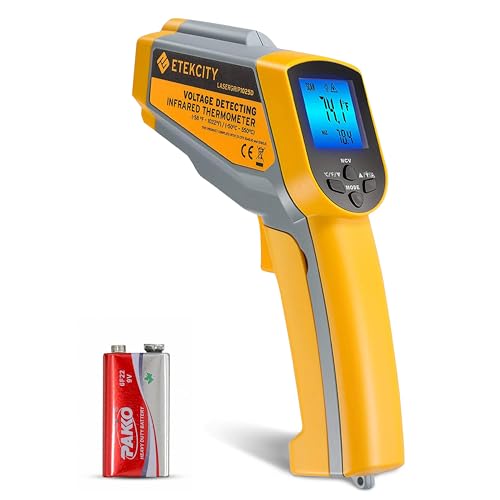
Etekcity Dual Laser Infrared Thermometer

Etekcity Dual Laser Infrared Thermometer

Dual Class 2 lasers, 12:1 and adjustable emissivity with a -58 to 1022 F range.

  • Dual laser targeting; Class 2 laser, 0.3 to 0.49 mW
  • 12:1 distance-to-spot ratio; best accuracy at about 14.17 in (36 cm)
  • Measures -58 to 1022 F (-50 to 550 C) with a response under 500 ms
  • Adjustable emissivity 0.1 to 1.0; max hold, auto data hold, low battery indicator, auto-off; 9 V battery included
View on Amazon Read Full Review

Comparison Table

View Full Comparison
ProductLasers as describedDistance-to-spotRangeEmissivityAlarms and readoutsCertificate or rating
Klein IR5Dual laser targeting12:1-22 to 752 FAdjustable 0.1 to 1.0Hi/lo alarm, auto scan, max/min/avg/diff2 m dropView
ennoLogic eT650DDual lasersNot stated-58 to 1202 FAdjustableHi/lo alarm, scan and hold, min/max/avg, hands-freeNIST certificate, 10-year warrantyView
Etekcity dual laserDual, Class 212:1-58 to 1022 FAdjustable 0.1 to 1.0Max hold, auto data holdNot statedView
TempPro 2-laser2 laser targeting16:1Not statedAdjustable 0.1 to 1.0Max/min/avg; plus or minus 1.5% accuracyNot statedView
Fluke 62 MAX+Dual lasers that rotate to mark the spot edgesNot statedUp to 650 C (1202 F)Not statedMin/max/diff/avg; plus or minus 1 C or 1.0% accuracyIP54View
DEASOMIYE 50:1Dual laser pointers50:1-58 to 2732 FNot statedHi/lo alarm, max/min/avgNot statedView

Laser descriptions are quoted from each manufacturer's Amazon listing at the time of research. Not stated means the listing gives no value. The Fluke 62 MAX+ is included because its listing describes rotating dual lasers, which behave differently from fixed parallel beams.

How to Choose a Dual Laser Infrared Thermometer

Four points decide it:

The Ratio Sets the Spot

Two lasers show the edges; the ratio sets how far apart they are. 12:1 on the Klein and Etekcity, 16:1 on the TempPro, 50:1 on the DEASOMIYE; not stated on the ennoLogic and Fluke.

Emissivity Still Matters

Seeing the spot does not fix a shiny surface. The Klein, ennoLogic, Etekcity and TempPro state adjustable emissivity; the Fluke and DEASOMIYE listings do not.

Certificate or Accuracy

The ennoLogic ships a NIST traceable certificate. Only the Fluke and TempPro state an accuracy figure. Decide which one your paperwork needs.

Range for the Hottest Job

From 752 F on the Klein to 2732 F on the DEASOMIYE. A gun at its ceiling shows a limit indicator, not a number.

Frequently Asked Questions

View All FAQs
Does a second laser make the temperature reading more accurate?

Not directly. The infrared sensor and its optics decide accuracy, and they are the same whether one or two beams are fitted. What the second laser adds is a visual check that the whole measurement spot sits on the target, which prevents the most common error: averaging in the wall behind a pipe. Etekcity's claim that dual lasers are more accurate should be read in that sense.

What is the difference between parallel dual lasers and rotating ones?

Fixed parallel beams show the spot width at the one distance where the beam spacing equals the spot diameter; closer in they overstate the spot, farther out they understate it. Fluke describes the 62 MAX+ lasers as rotating to pinpoint the edges of the measurement area, which the manufacturer presents as tracking the spot with distance. The other listings here describe fixed dual beams or do not specify.

What does a 50:1 ratio give me over 12:1?

Distance. At 50:1 the spot is 1 in across from 50 in away, so the DEASOMIYE can read a small target from four times the distance of a 12:1 unit, which is the point for kiln doors, forge work and molten metal where heat radiation keeps you back. It also means the spot is tiny up close, so the reading is a small patch rather than an area average. The DEASOMIYE listing does not state emissivity control, which matters on hot metal.

Are the lasers on these thermometers safe?

They are aiming pointers, and the one listing that states a class gives Class 2 at 0.3 to 0.49 mW on the Etekcity dual laser, the same class as a presentation pointer. The others do not state a class. Treat all of them the same way: never point them at anyone's eyes, and switch the laser off where a reflection off glass or polished metal could reach someone.

Reviews

Klein Tools IR5 Dual Laser 12:1 Infrared Thermometer

Klein Tools IR5 Dual Laser 12:1 Infrared Thermometer Best Overall

The IR5 is the dual laser thermometer whose listing states the most, which is why it leads a page about what the lasers actually tell you. Klein gives dual laser targeting alongside a 12:1 distance-to-spot ratio, so the two dots mark the spot edges at a known geometry: 1 in apart at 12 in. The range is -22 to 752 F, emissivity is adjustable from 0.1 to 1.0, and the readouts cover auto scan, maximum, minimum, average and difference, plus a high and low alarm on a backlit display.

Durability is stated as 6.6 ft (2 m) drop protection, and the package includes a custom pouch and batteries. Klein labels it a non-medical device.

The listing gives no accuracy figure and no ingress rating, and the 752 F ceiling is the lowest in this group, below the ennoLogic and Etekcity dual laser and far below the DEASOMIYE 50:1. For an electrician or HVAC technician working under that limit, it is the most complete set of stated features on a dual laser gun.

Strengths

  • Dual lasers and 12:1 ratio both stated
  • Adjustable emissivity
  • Alarms and difference readout
  • 2 m drop protection

Limitations

  • Accuracy not stated
  • 752 F upper limit is the lowest here
  • No ingress rating stated
View on Amazon
ennoLogic eT650D Dual Laser Infrared Thermometer

ennoLogic eT650D Dual Laser Infrared Thermometer Best With NIST Certificate

The eT650D is the dual laser gun for anyone who has to show a calibration record. ennoLogic states that a NIST traceable calibration certificate ships with the unit, which is what a food safety audit, a quality program or a maintenance contract may ask for, and backs it with a 10-year warranty. The range is -58 to 1202 F, wide enough for a freezer at one end and a flue pipe or forge surface at the other, and emissivity is adjustable.

The feature list is long: scan and hold, high and low alarms, minimum, maximum and average, a hands-free mode and a bright backlit display. The manufacturer names food safety inspection, HVAC, grilling, pizza ovens, insulation checks and automotive cooling among the uses.

What the listing does not state is the distance-to-spot ratio, an accuracy figure or the emissivity range, and there is no drop or ingress rating. The certificate documents the calibration at shipment; it does not tell you how big the spot is, so hold it close until the ratio is confirmed from the manual.

Strengths

  • NIST traceable certificate included
  • Wide -58 to 1202 F range
  • Alarms, scan and hold and hands-free mode
  • 10-year warranty stated

Limitations

  • Distance-to-spot ratio not stated
  • Accuracy not stated on the listing
  • No drop or ingress rating
View on Amazon
Etekcity Dual Laser Infrared Thermometer

Etekcity Dual Laser Infrared Thermometer Best Value

The Etekcity dual laser is the lowest-tier unit here that still states the three figures that matter: dual lasers, a 12:1 ratio and adjustable emissivity from 0.1 to 1.0. The range is -58 to 1022 F, the response is under 500 ms, and Etekcity gives a best working distance of about 14.17 in, where at 12:1 the spot is a little over an inch across. The listing is also the only one in the group to state the laser class: Class 2, 0.3 to 0.49 mW.

Readouts are simpler than on the Klein or ennoLogic: max hold, automatic data hold, a low battery indicator and auto-off, with F and C on a large backlit LCD. A 9 V battery is included.

There is no accuracy figure, no alarm, no difference readout and no drop or ingress rating on the listing. Etekcity's own copy says dual lasers make the reading more accurate than a single laser, which is only true in the sense that you can see where the spot falls; the sensor is the same. For grills, skillets and general home checks it is the sensible entry to two-beam targeting.

Strengths

  • Dual lasers, 12:1 and adjustable emissivity all stated
  • Laser class stated
  • -58 to 1022 F range
  • 9 V battery included

Limitations

  • Accuracy not stated
  • No alarm or difference readout
  • No drop or ingress rating
View on Amazon

Buying Guide

Short answer: the Klein IR5 is the dual laser thermometer whose listing states the full set, two beams at 12:1 with adjustable emissivity, alarms, a difference readout and a 2 m drop rating; the ennoLogic eT650D is the pick when a NIST traceable calibration certificate has to be on file, with dual lasers, a -58 to 1202 F range and a 10-year warranty; and the Etekcity dual laser is the value entry that still states dual Class 2 lasers, 12:1 and adjustable emissivity.

What two lasers actually show

An infrared thermometer reads a circular spot whose diameter grows with distance, and the reading is the average temperature inside that circle. A single laser marks roughly its center, which tells you where you are pointing but not how big the circle is. Two lasers mark points on its edge, so at a glance you can see whether the spot sits inside a breaker lug, a griddle zone or a 3/4 in copper line, or whether it has grown past the target and is averaging in the wall behind. That is the entire benefit. The sensor, the lens and the electronics are unchanged, and Etekcity’s line that dual lasers make the reading more accurate than a single laser is true only in the sense that you are less likely to measure the wrong thing. The infrared thermometer buying guide covers the general selection; this page is about the beam arrangement and the optics behind it.

Fixed beams, rotating beams and the ratio behind them

Fixed parallel beams are spaced a set distance apart, so they show the true spot width only at the distance where the spot diameter equals the beam spacing; closer in they overstate it and farther out they understate it, because the spot keeps growing while the dots do not. The Klein IR5, ennoLogic eT650D, Etekcity dual laser, TempPro 2-laser and DEASOMIYE all describe dual or two-laser targeting without saying more. Fluke describes the 62 MAX+ lasers as rotating to pinpoint the edges of the measurement area, which is a different mechanism intended to track the spot across distance. Either way the ratio sets the geometry: the Klein and Etekcity state 12:1 (a 1 in spot at 12 in), the TempPro 16:1, the DEASOMIYE 50:1 (a 1 in spot at 50 in), and the ennoLogic and Fluke listings do not state a ratio at all, so the spot size has to come from the manual.

Range and accuracy on the listings

The stated ranges run from -22 to 752 F on the Klein IR5, the narrowest here, through -58 to 1022 F on the Etekcity dual laser and -58 to 1202 F on the ennoLogic, to 650 C (1202 F) at the top of the Fluke 62 MAX+ and -58 to 2732 F on the DEASOMIYE. The TempPro 2-laser listing does not state a range. Only two listings state an accuracy: the Fluke at plus or minus 1 C or 1.0% of reading from 0 to 650 C and the TempPro at plus or minus 1.5%. The Klein, ennoLogic, Etekcity and DEASOMIYE give none, and the ennoLogic’s NIST traceable certificate documents the calibration at shipment rather than substituting for a published tolerance. A gun that reaches its ceiling shows a limit indicator, not a number, so buy headroom above the hottest surface you will scan.

Emissivity: the setting the lasers cannot fix

Two beams tell you where the spot is; they say nothing about whether the surface inside it is emitting honestly. Bare copper, aluminum, stainless steel, galvanized duct, chrome and polished cookware emit less infrared for their temperature than the 0.95 default assumes and reflect their surroundings, so a thermometer reads them low, dual lasers or not. The Klein, Etekcity dual laser and TempPro state adjustable emissivity from 0.1 to 1.0 and the ennoLogic states an adjustment without a range; the Fluke 62 MAX+ and DEASOMIYE listings do not mention emissivity, which is a notable gap on a 50:1 gun aimed at hot metal. On a unit without the adjustment, a strip of electrical tape or a patch of matte paint on the surface, read once it has reached the metal temperature, gives a reading you can trust.

Readouts, alarms and paperwork

Past the lasers, the listings separate on what they do with the reading. The Klein IR5 states auto scan, maximum, minimum, average and difference, plus a high and low alarm; the ennoLogic states scan and hold, high and low alarms, minimum, maximum and average and a hands-free mode; the DEASOMIYE states high and low alarms with max, min and average; the Fluke states minimum, maximum, difference and average; the TempPro states max, min and average; and the Etekcity dual laser states max hold and automatic data hold. For paperwork, the ennoLogic is the only listing that includes a NIST traceable certificate and the only one to state a 10-year warranty; Klein states 6.6 ft (2 m) drop protection and Fluke states IP54, while the Etekcity, TempPro and DEASOMIYE listings state no durability rating. The Etekcity is the only one to state its laser class, Class 2.

Which dual laser gun for which job

For electrical and HVAC work under 750 F where emissivity control and alarms matter, the Klein IR5 states everything needed. For a food safety program, a quality department or a contract that asks for traceable calibration, the ennoLogic is the one with the certificate in the box, and its 1202 F range also covers flue and oven work. For grills, skillets and general home checks, the Etekcity dual laser gives two beams, 12:1 and adjustable emissivity at the lowest tier here, and the TempPro 2-laser adds 16:1 optics for reading a griddle zone from farther back. For kilns, forges and anything else that keeps you at a distance, the DEASOMIYE’s 50:1 ratio and 2732 F limit are the point, with the caveat that its listing states no emissivity control on surfaces that need it most. The cooking and grill guide covers the kitchen side in detail.

Related guides

The main infrared thermometer guide compares single and dual laser units together for trades, kitchens and home checks.
How We Research

Thermometers were compared on manufacturer listing text: how the laser targeting is described, distance-to-spot ratio, temperature range, emissivity control, stated accuracy, readouts and alarms, laser class, certification, warranty and durability ratings. Owner feedback was reviewed for recurring comments on laser alignment and battery life. We did not run laboratory tests and publish no measurements of our own. Amazon data supplies images, availability and links only.

Read our full review methodology