Best Infrared Thermometers for HVAC: Picks for Registers, Coils and Flue Checks
On an HVAC call an infrared thermometer reads the face of a register, the surface of a coil or the skin of a flue pipe in a second, without touching anything. What it cannot read is the air moving through the duct, which is the number a delta T check actually needs. This guide sorts the listings for the surface jobs and says where a probe takes over.
As an Amazon Associate, Akermin earns from qualifying purchases. Product links on this page are affiliate links.
Our Top Picks
These thermometers were compared for HVAC work on upper temperature limit, distance-to-spot ratio, emissivity control for ducts and copper, readouts such as difference and average, and durability ratings, all from manufacturer listings. We did not run laboratory tests; figures are the manufacturers' own and gaps are marked Not stated.
Best Overall
Fluke 62 MAX+ Infrared Thermometer
1202 F upper limit, difference readout and IP54 for the service truck.
Upper limit stated at 650 C (1202 F) for flue and heat exchanger surfaces
Accuracy plus or minus 1 C or 1.0% of reading from 0 to 650 C
Minimum, maximum, difference and average readouts on a backlit display
Dual rotating lasers mark the spot edges; IP54; clips to a belt
Figures are from the manufacturers' Amazon listings at the time of research. Not stated means the listing gives no value. Infrared thermometers read surface temperature only; supply and return air temperatures for a delta T check need a probe thermometer.
How to Choose an Infrared Thermometer for HVAC
Four checks settle it:
Upper Limit for Flue Work
Vent pipe and heat exchanger surfaces on a firing appliance can exceed 752 F. The Fluke 62 MAX+ and ennoLogic state 1202 F; the Kleins stop at 752 F.
Emissivity for Galvanized and Copper
Duct and line sets are shiny metal. Adjustable emissivity on the IR5, TempPro and Etekcity dual laser handles them; a fixed unit needs tape on the surface.
Spot Size at the Register
A 12:1 unit reads a 1 in spot from 12 in. On a 3/4 in copper line, get closer or the reading averages in the wall behind it.
Difference and Alarms
A difference readout compares two surfaces in one sweep; a low alarm finds a leaking duct joint. Both Flukes and the IR5 state difference; the IR5 and ennoLogic state alarms.
Can an infrared thermometer measure the supply air temperature at a register?
No. It reads the surface of the register grille, which sits somewhere between the air temperature and the room temperature depending on airflow and material. A delta T check across the coil needs the air itself, measured with a probe thermometer or a thermohygrometer inserted into the supply and return streams. Use the infrared gun to compare registers quickly and to find the one that is not warming or cooling at all.
How do I get a true reading on a galvanized duct or a bare copper line?
Lower the emissivity setting if the unit has one, or apply a strip of electrical tape or a patch of matte paint to the surface and read that once it has reached the metal temperature. Galvanized steel and copper emit much less infrared than paint for the same temperature and reflect the surroundings, so a thermometer at 0.95 reads them low. The Klein IR5, TempPro and Etekcity dual laser state adjustable emissivity; the Fluke listings and Klein IR1 do not.
What upper range do I need for flue pipe and heat exchanger checks?
Enough headroom above the hottest surface you will scan. Single-wall vent pipe near the appliance collar on a firing furnace can run well above the 752 F limit of the Klein units. The Fluke 62 MAX+ and ennoLogic eT650D state 1202 F, the Etekcity dual laser and TempPro 1022 F and the Fluke 62 MAX 932 F. Choose the higher limit if flue work is routine.
Is an infrared thermometer enough for a coil delta T or superheat check?
No. Delta T compares supply and return air temperatures, which are air measurements. Superheat and subcooling compare a line temperature with the saturation temperature from the gauge pressure, and a clamp probe on the line gives a far more repeatable reading than a surface gun on a shiny copper tube. The infrared thermometer is the quick screen that tells you which coil, register or line to measure properly.
Why do the min, max and difference readouts matter on a service call?
Because a sweep tells you more than a point. Sweeping a condenser coil with minimum and maximum active shows whether one section is running warmer, which can point at a restriction or dirt; the difference readout on the Flukes and Klein IR5 gives that spread in one number. A low alarm, stated on the IR5 and ennoLogic, beeps at the coldest spot along a duct run, which is usually the leaking joint.
Reviews
Fluke 62 MAX+ Infrared Thermometer Best Overall
The 62 MAX+ earns the top spot on an HVAC page for two stated figures: an upper limit of 650 C (1202 F) that covers single-wall vent pipe and heat exchanger surfaces on a firing furnace, and an accuracy of plus or minus 1 C or 1.0% of reading, the tightest in the group. Fluke names electrical, mechanical, HVAC and automotive monitoring as the intended uses.
The readouts are the ones a service call uses. The display shows minimum, maximum, the difference between them and the average, so a sweep across a condenser coil or along a supply plenum gives a spread rather than a single number. Dual lasers rotate to mark the edges of the measurement area, and the IP54 body tolerates the dust and drips of a mechanical room.
The listing does not state a distance-to-spot ratio or an emissivity adjustment, both of which matter on galvanized duct and bare copper, and the lower range limit is printed inconsistently, so we quote only the upper. The tape trick covers the emissivity gap; the ratio has to come from the Fluke datasheet.
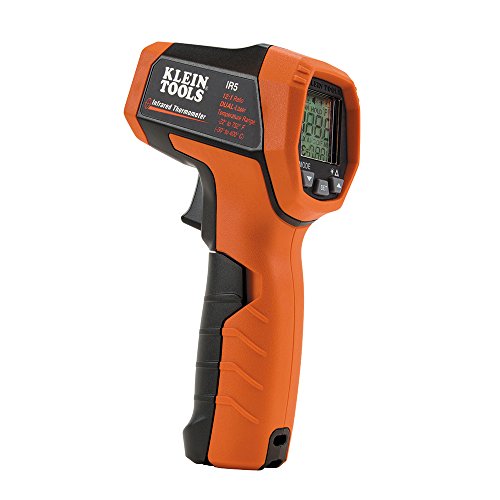
Klein Tools IR5 Dual Laser 12:1 Infrared Thermometer Best for Ducts and Copper
The IR5 is the HVAC pick for the surfaces that trip up a fixed-emissivity gun. Klein states adjustable emissivity from 0.1 to 1.0, so a galvanized trunk, a bare copper suction line and a painted condenser cabinet can each be read at a setting that suits them instead of at a single 0.95 default. The 12:1 ratio is stated, the range is -22 to 752 F, and the feature list covers dual laser targeting, auto scan, maximum, minimum, average and difference, and a high and low alarm that beeps when a swept surface crosses a threshold.
The alarm is more useful on a service call than it sounds: set the low limit and sweep a return duct for the cold spot where a joint is leaking conditioned air, or set the high limit and scan a compressor terminal cover.
The upper limit of 752 F is below the Fluke 62 MAX+ and rules out the hottest flue surfaces. The listing states no accuracy figure and no ingress rating, though it does state 6.6 ft (2 m) drop protection and includes a pouch and batteries.
The TempScan is the thermometer to keep in the truck door for register and vent checks when the primary tool is elsewhere. TempPro states a 12:1 ratio, a response under 500 ms, a -58 to 1022 F range and, unusually at this tier, both adjustable emissivity from 0.1 to 1.0 and an accuracy of plus or minus 1.5%. The manufacturer names AC vents and car engines among the intended targets, and the display shows the maximum, minimum and average of the last scan.
The backlit LCD reads in a dark attic or basement, and a 90-second auto-off saves the battery between rooms.
What the listing leaves out is the laser: it does not say whether the unit has one laser, two or none, and there is no drop or ingress rating and no alarm. For a helper checking supply registers room by room, or a homeowner comparing register surfaces before calling a technician, the stated figures are enough; for flue work or a daily tool, step up to the Fluke.
Strengths
Adjustable emissivity and a stated accuracy at this tier
Short answer: the Fluke 62 MAX+ is the HVAC infrared thermometer for a technician who also checks flue pipes and heat exchangers, with a stated 1202 F limit, a difference readout and IP54; the Klein IR5 is the pick for galvanized duct and copper lines, with adjustable emissivity, 12:1 optics and a high and low alarm; and the TempPro TempScan is the value spare for register and vent checks, with 12:1, adjustable emissivity and a stated 1.5% accuracy.
What an infrared thermometer does on an HVAC call
The tool answers surface questions fast. Is this register delivering anything? Is one section of the condenser coil warmer than the rest? Is the compressor shell hotter than it was last visit? Is the vent connector on this furnace running at a sane temperature? Each of those is a comparison between surfaces, and a spot thermometer answers it in a second from a few feet away. What it does not do is read air. The temperature of the supply stream at a register, the return air at the filter and the difference between them are the numbers a delta T check needs, and a surface reading of a grille is not that number. The HVAC thermal camera guide covers the imaging tool that shows a whole coil at once; this page is about the spot gun and where it stops.
Upper limit: the flue decides
For registers, coils and line sets any thermometer in the table has range to spare. The flue is different. Single-wall vent pipe near the collar of a firing furnace or water heater, and the surface of a heat exchanger cell viewed through an inspection port, can run past the 752 F that the Klein IR5 and IR1 state as their upper limit. The Fluke 62 MAX+ and ennoLogic eT650D state 1202 F, the TempPro and Etekcity dual laser 1022 F and the Fluke 62 MAX 932 F. A gun that hits its ceiling shows a limit indicator rather than a number, which tells you nothing about how hot the pipe actually is. If combustion appliances are a routine part of the work, the higher limit is the one to buy, and remember that a shiny galvanized or stainless flue reads low without an emissivity correction.
Emissivity: galvanized, copper and painted cabinets
HVAC surfaces are mostly metal, and much of it is shiny. Galvanized trunk and branch duct, bare copper suction and liquid lines, aluminum coil fins and stainless flue all emit less infrared for their temperature than the 0.95 default assumes, and they reflect the ceiling, the lights and the technician. The Klein IR5, TempPro TempScan and Etekcity dual laser state adjustable emissivity from 0.1 to 1.0; the ennoLogic states an adjustment without a range; the Klein IR1 is fixed at 0.95; the Fluke 62 MAX+ and 62 MAX listings do not mention emissivity at all. On a fixed or unstated unit, the practical fix is a strip of electrical tape or a patch of matte paint on the duct or pipe, read after it has had a minute to reach the metal temperature. Painted condenser cabinets, insulated duct wrap and flex duct jacket read close to true without any of this.
Spot size at the register and on a line set
A 12:1 unit reads a 1 in spot from 12 in away and a 3 in spot from 36 in; a 10:1 unit reads a 1.2 in spot from 12 in. A supply register is large enough that distance barely matters. A 3/4 in copper line is not: from 12 in a 12:1 gun already averages in whatever is behind the pipe, so get close or use a clamp probe. The Klein IR5, TempPro, Etekcity dual laser and Etekcity 774 state 12:1, the Fluke 62 MAX and Klein IR1 state 10:1, and the Fluke 62 MAX+ and ennoLogic listings do not state a ratio. Etekcity gives a best working distance of about 14.17 in for its 12:1 units, which is a sensible default for the whole group when the target is a register face or a coil section.
Readouts and alarms that earn their place
A single number is rarely the finding on an HVAC call; the spread is. Both Flukes and the Klein IR5 display minimum, maximum, the difference between them and the average across a sweep, so one pass along a condenser coil or a supply plenum gives the hot and cold ends in one reading. The IR5 and the ennoLogic add a high and low alarm: set the low threshold and sweep a return trunk for the coldest spot, which is usually a leaking joint pulling in unconditioned air, or set the high threshold and scan compressor terminals. The TempPro and Etekcity units show max, min and average or a max hold, and the Klein IR1 offers auto-hold. Fluke and Klein also state the durability figures that a truck tool needs: IP54 on both Flukes, a 3 m drop on the 62 MAX and 6.6 ft (2 m) drop protection on the Kleins.
Where the surface gun stops and the probe takes over
Three HVAC measurements are not surface measurements and should not be attempted with any of these tools. Delta T across the coil is an air temperature difference between supply and return; a thermohygrometer or probe thermometer placed in the airstream reads it, and a register grille does not. Superheat and subcooling compare a refrigerant line temperature with the saturation temperature from the gauge pressure, and a pipe clamp probe gives a repeatable line temperature where a surface gun on bare copper gives a reflection-contaminated guess. And any reading through a window or a plastic inspection cover is a reading of the glass or plastic, not what is behind it. The testo 605i review covers an in-duct thermohygrometer for the air side. For a whole-coil or whole-duct picture rather than a spot, the HVAC thermal camera guide lists the imaging options.
Related guides
The main infrared thermometer guide compares the same instruments for general use, and the dual laser guide explains what two beams add on a large duct face.
How We Research
Thermometers were compared on manufacturer listing text: upper temperature limit, distance-to-spot ratio, emissivity control, readouts including difference and average, alarm functions, stated accuracy, ingress and drop ratings. Owner feedback was reviewed for recurring comments on readings from galvanized duct and copper. We did not run laboratory tests and publish no temperature measurements of our own. Amazon data supplies images, availability and links only.
Cameras for confirming what the thermal camera flagged: the Teslong NTS500 through a small hole, the wireless Klein ET30 on a fish rod and the DEPSTECH DS300.
Inspection cameras sorted by probe diameter, cable length and display: the Teslong NTS500 dual lens, the Klein ET21 Wi-Fi scope and the 16.5 ft DEPSTECH DS300.
Two-beam thermometers compared on what the lasers mark: the Klein IR5 at 12:1, the ennoLogic eT650D with a NIST certificate and the Etekcity dual laser.