Best Thermal Cameras for HVAC: Picks for Ducts, Coils, Compressors and Comfort Calls
HVAC diagnostics use a thermal camera two ways: to read the temperature pattern across a coil, compressor or refrigerant line, and to walk a duct run or a room looking for the leak behind a comfort complaint. Those jobs favor different cameras. These picks were sorted on manufacturer listing figures for range, resolution, spot tools and runtime.
As an Amazon Associate, Akermin earns from qualifying purchases. Product links on this page are affiliate links.
Our Top Picks
Cameras were compared for HVAC service on native resolution, upper temperature limit, spot measurement tools, visible-light overlay, refresh rate, runtime and reporting, all from manufacturer listings. We did not run laboratory tests or field comparisons; figures are the manufacturers' own and Not stated marks the gaps.
Best Overall
FLIR E6 Pro Commercial Thermal Imaging Camera
Native 240x180 with a 550 C limit, MSX and Ignite cloud for service records.
240 x 180 native detector, 43,200 pixels
Measures -20 to 550 C (-4 to 1022 F)
MSX embosses visible edges so a warm line or a cold coil section is identifiable
Wi-Fi to FLIR Ignite cloud with over-the-air updates; 2-year camera, 10-year detector warranty
All values are taken from the manufacturers' Amazon listings at the time of research and shown in the unit each listing used. Upscaled figures are software output and are not comparable with native counts. Not stated means the listing gives no value; FLIR publishes spot tools, NETD and range in its datasheets.
How to Choose a Thermal Camera for HVAC Work
Four points settle it:
Upper Temperature Limit
Flue collars, burner compartments and discharge lines run hot. The FLIR E-series states 550 C; the TC004 Mini stops at 842 F; the TG268 listing states no range.
Spot Tools You Can See
A laser that marks the measurement area, or on-screen hot, cold and center readings, turn the image into a number for the ticket.
Resolution at Coil Distance
A 240 x 180 or 320 x 240 detector resolves line sets and coil sections from a normal working distance. A 128 x 128 detector is for close range.
Runtime for a Full Day
Only the TC004 Mini states a figure here, 15 hours. Phone modules share the phone battery. The FLIR listings do not state runtime.
Can a thermal camera tell me whether a system is low on refrigerant?
It shows the temperature pattern: a partly frosted evaporator, a suction line warmer than expected or a liquid line cooler than expected. That pattern points toward a charge or restriction problem, but the diagnosis is made with gauges, superheat and subcooling. The camera tells you where to look, not the charge.
Is the FLIR TG268 a thermal camera or an infrared thermometer?
Both, in one body. It measures a spot temperature and shows a thermal image with MSX around that spot, and its laser indicates the size of the measurement area. The detector is 160 x 120 native, upscaled to 320 x 240, so it is a spot tool with an image rather than a survey camera.
Can I find duct leaks in an attic with a thermal camera?
Often, with the system running. A supply leak shows as a plume of conditioned air warming or cooling the insulation or framing near the joint, and a disconnected boot shows as a cold or warm area where the duct ends. The image needs a temperature difference between the supply air and the attic, so run the system long enough for the ducts to reach temperature first.
Why does a galvanized duct or a copper line look colder than it is?
Bare metal has low emissivity: it emits little infrared and reflects the surroundings, so the camera reads it low. Set the emissivity for the surface, or read a piece of tape or the painted or insulated section next to it. Comparisons along a copper line are still valid if the surface is the same the whole way.
Do I still need an infrared thermometer if I own a thermal camera?
A spot thermometer is faster for a quick register or coil reading and easier to hold at a burner. A camera shows the whole pattern. Many technicians carry both; the TG268 is the compromise that puts a marked spot reading and an image in one tool. Our thermal camera versus infrared thermometer guide covers the trade-offs.
Reviews
FLIR E6 Pro Commercial Thermal Imaging Camera Best Overall
The E6 Pro sits between the 160 x 120 E5 Pro and the 320 x 240 E8 Pro in the FLIR handheld line, and for HVAC it is the sensible middle. FLIR states a native 240 x 180 detector, 43,200 pixels, which resolves the individual refrigerant lines at a condenser and the return-air pattern across an evaporator coil from where a technician normally stands. The stated range of -20 to 550 C covers compressor discharge lines, flue collars and burner compartments with headroom.
MSX puts the visible outline of the coil, the line set or the register onto the thermal image, which is what makes the picture usable in a service record, and Wi-Fi upload to Ignite stores and shares it. FLIR covers the detector for 10 years.
The listing does not state NETD, refresh rate, field of view, spot measurement tools or battery life; those are in the FLIR datasheet. A technician who wants on-screen spot readings itemized on the listing will find them on the TC004 Mini and TR20 instead.
Strengths
Native 240 x 180 detector with no upscale in the figure
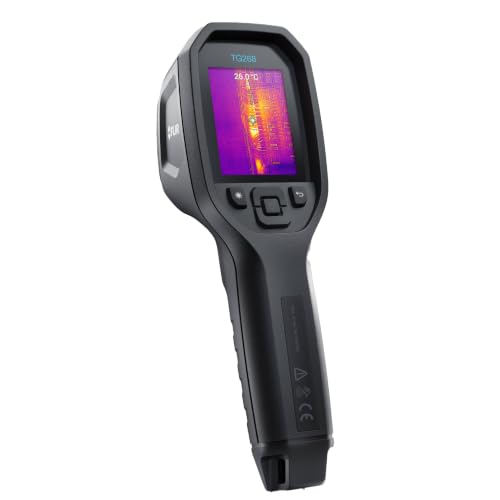
FLIR TG268 Thermal Imaging Camera with Bullseye Laser Best Spot Thermal Camera
The TG268 is the camera for a technician who reaches for an infrared thermometer several times per call and wants to see what the spot is reading. FLIR states a laser pointer that indicates the size of the measurement area, which solves the oldest problem with a spot thermometer: not knowing whether the reading came from the compressor shell or the insulation next to it. The thermal image with MSX shows the context around the spot.
The detector is 160 x 120 native, and the listing describes 320 x 240 as Vivid IR upscaling, so compare it with the E5 Pro and C5 rather than with the E8 Pro. The 640 x 480 visual camera is what feeds MSX. The IP54 enclosure against dust and oil and the drop-tested design suit a rooftop unit, and the 2-10 warranty matches the handhelds.
The listing states no temperature range, no NETD, no refresh rate and no battery figure, which is a large gap for a spot-measurement tool; FLIR publishes the range in its datasheet, and a buyer working on flues should check it there first.
TOPDON TC004 Mini Thermal Imaging Camera Best Value
The TC004 Mini is the pick for a technician who wants a camera in the shirt pocket for every call and does not need to resolve fine detail. TOPDON states a 128 x 128 native detector enhanced to 240 x 240 by TISR, a 40 by 30 degree field of view and 25 Hz refresh, which keeps the image smooth while walking a duct run in an attic. The listing itemizes what the FLIR listings do not: automatic highest, lowest and center spot readings, a preset alarm that flags the reading on screen and captures a photo, and five palettes.
The range of -4 to 842 F with a stated accuracy of 3.6 F or 2 percent covers most residential HVAC surfaces, though it stops short of the 550 C the FLIR E-series states. The 15-hour stated runtime is the longest on this page.
The detector is small: 128 x 128 is fewer elements than the 160 x 120 in the E5 Pro, so the TC004 Mini is for close-range checks of registers, line sets and cabinet panels rather than a coil from across a mechanical room. NETD is not stated.
Strengths
Spot readings and photo-capturing alarm itemized on the listing
Short answer: the FLIR E6 Pro is the HVAC camera for a service company that documents its calls, with a native 240 x 180 detector, a 550 C limit for flue and compressor work, MSX and Ignite cloud; the FLIR TG268 is the spot thermal camera for a technician who wants a laser-marked spot reading with a thermal picture around it; and the TOPDON TC004 Mini is the value pick for register, duct and cabinet checks, with hot, cold and center readings, a photo-capturing alarm and a stated 15-hour runtime in a pocket body.
What HVAC work asks of a thermal camera
An HVAC technician uses a thermal camera for two quite different jobs. The first is reading a pattern on equipment: the temperature spread across an evaporator coil, a frost line on a suction line, a compressor running hotter than the one beside it, a contactor or capacitor warm under load, a burner compartment and flue collar on a furnace. The second is walking a building: the duct run in the attic that is leaking supply air, the register that is barely moving air, the room the customer says is always cold and the wall or ceiling that is losing the conditioned air. The first job favors temperature range, spot tools and enough resolution to separate lines and coil sections; the second favors field of view, refresh rate and runtime. The HVAC thermal camera selection guide lays out the method; this page applies it to current listings.
Coils, compressors and refrigerant lines
Equipment work wants resolution and range. The FLIR E6 Pro states a native 240 x 180 detector and the E8 Pro 320 x 240, and both state a range to 550 C, which is enough headroom for a discharge line, a flue collar or a burner compartment on a furnace. The E5 Pro and C5 state 160 x 120 and stop at 400 C, which still covers most residential surfaces. The MiLESEEY TR20 states 320 x 240, 25 Hz, NETD under 40 mK and a range to 1022 F, plus automatic hot and cold spot tracking, and it is the only listing on this page that quotes a sensitivity figure. A thermal image of a coil is a pattern, not a diagnosis: a frosted or starved section points toward airflow, charge or a restriction, and the confirmation still comes from gauges, superheat and subcooling. For refrigerant leaks the camera does not help at all; that is a sniffer job, covered in the infrared refrigerant leak detector guide.
Ducts, registers and comfort calls
Building work is where the pocket cameras earn their place. A comfort complaint usually ends in an attic or a crawl space, and a camera that is already in the shirt pocket gets used there. The TC004 Mini states a 40 by 30 degree field of view, 25 Hz refresh so the image follows the camera along a duct run, and a 15-hour runtime, the only runtime figure on this page. Its 128 x 128 detector is small, so it is a close-range tool: fine for a register, a boot connection or a cabinet panel, not for reading a coil from across a mechanical room. The C5 gives a 160 x 120 detector and MSX in a similar pocket form, and the FLIR ONE Pro turns an iPhone 15 or newer into a survey tool with in-app inspection guides for air leaks and moisture. Run the system for long enough that the ducts reach temperature before scanning; a duct at attic temperature shows nothing.
Spot camera or full imager
The TG268 is a different kind of tool. FLIR describes it as a thermal imaging camera with a bullseye laser that indicates the size of the measurement area, which is the piece of information a plain infrared thermometer never gives you: whether the reading came from the compressor shell or the pipe insulation beside it. The thermal image with MSX around the spot adds the context. It is built on a 160 x 120 detector that the listing upscales to 320 x 240 by Vivid IR, so it is not a survey camera, and the listing does not state a temperature range, which a buyer working on flues should check in the FLIR datasheet before relying on it. For a technician who reaches for a spot thermometer several times a call, it replaces that tool with a better one; for a technician who scans coils and duct runs, the E6 Pro or TR20 is the right shape.
Emissivity: copper, aluminum fins and galvanized duct
HVAC equipment is mostly metal, and bare metal is where thermal cameras mislead. Copper line sets, aluminum coil fins, galvanized duct and stainless cabinet panels have low emissivity: they emit little infrared and reflect whatever is around them, so the camera reads them low and can show a reflection of the technician or a nearby lamp as a warm patch. Set the emissivity for the surface where the camera allows it, read the insulated or painted section beside the bare metal, or put a strip of tape on the surface and read the tape. Comparisons along the same surface are still valid, which is why a frost line on a suction line or one compressor warmer than its twin shows correctly even when the absolute number is off. Reflections move when you step sideways; real temperature patterns stay where they are. Why shiny metal misleads a thermal camera covers the values to use.
Related guides
Electrical faults at the contactor, disconnect and panel are covered with the same cameras in the electrical maintenance thermal camera guide, where upper temperature limit and spot tools are weighed the same way. For a spot thermometer without an image, our infrared thermometer guides cover distance-to-spot ratio and emissivity for register and coil readings.
How We Research
Cameras were compared on manufacturer listing figures for HVAC diagnostics: native detector resolution, upscaled output where quoted, temperature range, spot measurement tools and alarms, visible-light overlay, refresh rate, ingress and drop ratings, runtime and reporting features. Owner feedback was reviewed for recurring comments on rooftop screen readability and app stability. We did not run laboratory tests or field comparisons and publish no measurements of our own. Amazon data supplies images, availability and links only.
A detailed review of the FLIR One USB-C thermal camera for Android, explaining its Vivid IR upscaling, MSX image blending, stated accuracy and the practical limits of a phone-attachment design.
A review of the Wagner Meters Orion 950 pinless wood moisture meter, explaining its dual depth measurement, Bluetooth reporting, and where it stops being the right instrument next to a thermal camera.