As an Amazon Associate, Akermin earns from qualifying purchases. Product links on this page are affiliate links.
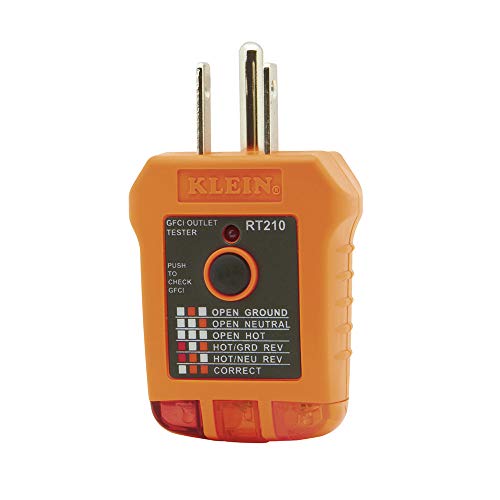
KLEIN TOOLS · Klein Tools RT210 Outlet Tester, Receptacle Tester for GFCI / Standard North American AC Electrical Outlets, Detects Common Wiring Problems
View on AmazonPrice and availability are shown on Amazon and can change at any time.
A three wire receptacle tester for standard and ground fault protected North American outlets, specified for 110 to 125 volts AC at 50 or 60 Hz, built to survive a 6.6 foot drop and rated to operate between 32 and 140 degrees Fahrenheit. Two of those figures are more concrete than this category usually offers. The weakness is that a tool whose entire output is a pattern of lights never publishes the list of faults those lights represent, and the lower end of the operating range rules out the cold spaces it gets carried into.
Common wiring problems, with no list of them
A receptacle tester has one output. Some combination of indicators illuminates, and you compare that pattern against a legend to learn what is wrong behind the faceplate. The legend is the product.
The first bullet promises detection of common wiring problems in standard and GFCI receptacles. The second promises verification of the ground fault protective device. Neither names a single fault condition, and no legend appears anywhere in the five bullets.
That is a strange omission, because the fault set is the only thing that distinguishes one tester of this kind from another. Instruments in this class generally resolve a handful of states: correctly wired, open ground, open neutral, open hot, hot and neutral reversed, and hot and ground reversed. Some reach further and separate a hot on the ground conductor with the neutral open, which is the most dangerous configuration on the list. Others collapse two conditions into one indication and leave you guessing.
Without the list you cannot tell which this is. You also cannot tell whether the legend is moulded onto the body, which is the difference between a tool you can read in a crawl space and a tool that needs the instruction sheet you left in the van.
Freezing point is where the operating range stops
The fourth bullet publishes an operating range: 32 to 140 degrees Fahrenheit, which it also gives as 0 to 40 degrees Celsius.
Start with the credit, because it is deserved. Very few receptacle testers publish an operating range at all. A specific pair of limits is a checkable statement, unlike the word rugged, and it tells you the manufacturer has characterised the thing.
Then take it seriously, because the lower limit lands in an awkward place. Think about where this tool gets used. Crawl spaces and unheated basements. Garages and workshops with no heating on a winter morning. New construction tested before commissioning, when the building is at outside temperature. Outdoor and weather resistant receptacles. Barns, sheds, boat houses and site huts. In a cold climate a meaningful proportion of that work happens below freezing, and the rated range says the instrument is not characterised there.
What actually happens below the limit is not catastrophe, it is uncertainty, and uncertainty is worse on a tester than failure. A dead tester tells you to stop. A tester operating outside its rated range gives you an indication of unknown reliability, and you have no way to tell the two apart. The sensible practice is to keep it inside a coat on a cold job and let it come up to temperature before trusting a pattern.
The top limit of 40 degrees Celsius is worth a thought too, for attics in summer, plant rooms and sun facing outdoor outlets.
What three indicator lights cannot see
This is the part of the category that deserves stating plainly on any page about it, because the tool is often treated as a verdict when it is a screen.
- A bootleg ground. If the neutral has been jumpered to the ground terminal at the outlet, the tester finds a voltage between hot and the ground pin just as it would with a genuine ground, and reports correct wiring. The appliance chassis is then bonded to a current carrying conductor. No tester of this architecture can see it.
- The quality of the ground. A ground connection can be present and still have far too much impedance to carry a fault current and operate a breaker. The tester establishes continuity in the loosest sense and says nothing about impedance.
- Anything that only fails under load. The tester draws very little current, so a loose terminal, a backstabbed connection on the edge of failure or an undersized conductor on a long run all look perfect. Those faults announce themselves as heat and volt drop when a real load is connected, and this does not connect one.
- The actual voltage. The bullets state the tester is designed for 110 to 125 volts AC. They do not say it displays a voltage, and a pattern of lights cannot. A supply sagging under load is invisible.
- Faults upstream. A reversal or an open conductor at a junction box feeding several outlets shows at the outlets, not at its location, so the tester tells you there is a problem and never where.
None of that makes it a poor tool. It makes it a first pass tool, which is a valuable thing to own: it checks every outlet in a property in a few minutes and flags the ones worth opening. The error is treating a row of correct indications as a clean bill of health. Our roundup of receptacle testers covers which units push past the basic fault set, and our list of electrical fault finders covers the instruments that pick up where this stops.
Verifying a protective device operates is not testing it
The second bullet claims the tester works on GFCI outlets and verifies the proper operation of the ground fault protective device.
The mechanism is simple and worth knowing. The device compares current going out on the line conductor with current returning on the neutral, and opens if the two differ, because a difference means current is leaving by some other route. The tester deliberately creates that difference by passing a small current into the ground conductor. If the contacts open, the sensing circuit and the mechanism both work.
The word verifies is doing a lot of work, though. Nothing here measures the residual current at which the device opened, and nothing times the interruption. A device that needs well above its rated current, or takes much longer than it should, still opens, and this tester will call that a pass. Both quantities require an instrument that ramps current and measures the break, which is a separate class of tool entirely.
One practical note the bullets do not make: find out what the circuit feeds before you trip it. Tripping a protective device that happens to supply a freezer, a sump pump or a desktop in use creates a problem you did not have.
The figures it publishes, and the ones it does not
| Detail | Listing content |
|---|---|
| Outlet types | Standard and GFCI, three wire |
| Supply specified | 110 to 125 V AC, 50 or 60 Hz |
| Protective device check | Verifies the device operates |
| Drop rating | 6.6 feet, 2 m |
| Operating range | 32 to 140 F, 0 to 40 C |
| List of fault conditions indicated | Not stated in the listing bullets |
| Whether a legend is printed on the body | Not stated in the listing bullets |
| Residual current at which the device should trip | Not stated in the listing bullets |
| Trip time measurement | Not stated in the listing bullets |
| Voltage display | Not stated in the listing bullets |
| Indicator type | Not stated in the listing bullets |
| Ingress protection | Not stated in the listing bullets |
| Product safety listing | Not stated in the listing bullets |
| Dimensions and weight | Not stated in the listing bullets |
| Warranty | Not stated in the listing bullets |
Two published rows deserve the credit they are due. The drop figure of 6.6 feet is a repeatable test rather than an adjective, and the height is well chosen, because a tester lives in a pouch and the realistic accident is dropping it from waist height or off a step ladder. Two metres covers both. And the supply specification is refreshingly unambiguous about region: 110 to 125 volts AC at 50 or 60 Hz in three wire outlets describes North American receptacles and excludes everything else, where a great many listings in this category stay deliberately vague and absorb the returns.
A first pass instrument, and it should be treated as one
Buy this if you want to walk a property and find out quickly which outlets deserve attention. For a homeowner moving into an older house, a landlord checking a let between tenancies, or a technician confirming an outlet before plugging equipment into it, a few minutes per circuit for a pattern of indications and a protective device check returns a great deal for the effort. The drop rating suits the way the tool actually lives, and the stated supply range means you know immediately whether it applies to you.
Do not treat it as a sign off. The architecture cannot see a bootleg ground, cannot judge a ground connection, cannot see a fault that only appears under load, and does not show a voltage, so a row of correct indications narrows the possibilities rather than closing the question. And respect the published operating range: if your work takes you into unheated spaces in winter, the instrument is outside its characterised conditions and the reading is not evidence. Warm it up, or use something rated for the cold. The practical comparison against other formats sits in our list of outlet testers.
Recommended Tools


Products shown because their documented specifications fit this guide. Price and availability are on Amazon and can change.
Frequently Asked Questions
Which wiring faults does it detect?
The bullets do not say. They promise detection of common wiring problems in standard and GFCI receptacles and leave the list to the imagination. Testers of this type work by lighting a pattern of indicators which you read against a legend, and the usual distinguishable states are correct wiring, open ground, open neutral, open hot, hot and neutral reversed, and hot and ground reversed. Whether this unit reports all of those, and whether the legend is printed on the body where you need it, is not published.
Why does the operating range matter?
Because it stops at 32 degrees Fahrenheit, which is freezing point. Receptacle testers get used in crawl spaces, unheated garages, new builds before the heating is commissioned and at outdoor receptacles, and in a cold climate those are below the rated range for a good part of the year. Outside the stated range the behaviour of the indicators is simply unspecified, which means a result is not a result. Crediting the manufacturer for publishing the figure and then ignoring it would be the wrong response.
What is a bootleg ground and will this find it?
It is a neutral conductor jumpered to the ground terminal at the outlet, usually to make a two wire circuit accept a three pin plug. A three light tester sees a voltage between hot and the ground pin, exactly as it would with a real ground, and reports correct wiring. No tester of this architecture can distinguish the two, which is the single most important limitation of the class. Finding it needs a different method, such as checking the ground path separately back to the panel.
Does pressing the GFCI test button prove the device is compliant?
No. It proves the device responds. The tester routes a deliberate leakage current to the ground conductor so that the residual sensing circuit sees an imbalance and opens the contacts. Neither the current at which it opened nor the time it took is measured, and a device that trips slowly or above its rating still trips. It is also worth knowing what is on the circuit before you trip it, because freezers, servers and aquarium pumps do not appreciate the exercise.
Will it work outside North America?
No. The fifth bullet specifies 110 to 125 volts AC at 50 or 60 Hz in three wire outlets, which describes North American receptacles and nothing else. That is a clearer statement of region than most listings in this category manage, and it is worth reading as a hard boundary rather than a recommendation. A 230 volt supply is outside the stated design voltage entirely.
Affiliate disclosure: Akermin earns a commission from qualifying Amazon purchases made through links on this page. Our editorial picks are based on documented specifications and owner feedback, not commissions.
Related Guides

Fluke 1AC II VoltAlert Review: Two Detection Thresholds in One Listing
A pocket sized non contact voltage tester whose tip glows red and beeper sounds when voltage is detected, with a continuous self test and a choice of audible or silent operation.
Read More→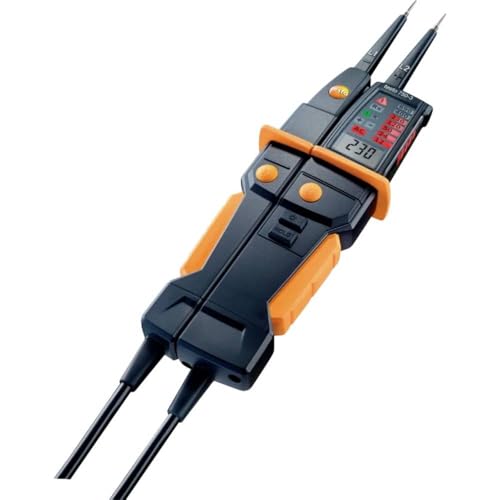
Testo 750-3 Review: Four Bullets, and No Published Category Rating
A two pole voltage tester with a three digit LCD showing measured voltage, a patented LED voltage bar viewable from any angle, polarity detection on DC and a GFCI test function for AC outlets.
Read More→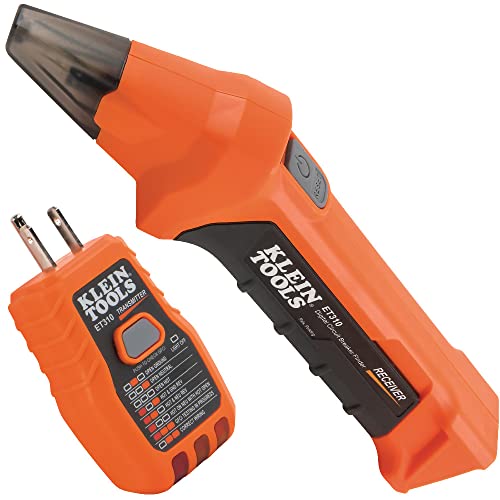
Klein Tools ET310 Review: Wide Compatibility Means 90 to 120 Volts
A two part circuit breaker finder with a transmitter that connects at the outlet or fixture and a receiver that scans the panel, stated to work on 90 to 120 V AC circuits and carrying a built in GFCI test function.
Read More→