Best Receptacle Testers: 8 Smart Picks for Quick Wiring Diagnostics
A receptacle tester is the fastest instrument in the bag: plug it in, read the lights, move on. This page compares eight tools whose listings state a plug-in outlet testing function, from a three light indicator to a circuit analyzer that measures voltage drop and device trip time, and it explains why three breaker finders were left out of the table.
As an Amazon Associate, Akermin earns from qualifying purchases. Product links on this page are affiliate links.
Our Top Picks
Only products whose own listing states a plug-in receptacle or outlet testing function are included. Where a listing publishes no figure the entry reads Not stated. We ran no tests, we publish no measurements of our own, and no prices appear on this page.
Best Overall
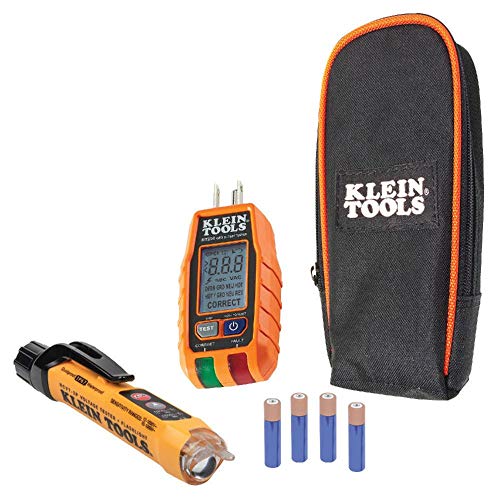
Klein Tools RT250KIT Receptacle Tester and Voltage Pen
A backlit numeric readout instead of a light pattern you have to translate.
Large backlit LCD readout stated on the listing
Voltage reading plus wiring condition indication stated
GFCI receptacle testing stated
Supplied with a non-contact voltage test pen and a flashlight function
Functions are quoted from the manufacturer listing for each product at the time of research. Where a listing states nothing the cell reads Not stated rather than an assumption. Nothing on this page is a measurement of ours and no prices are published here.
How to Choose a Receptacle Tester
Four questions settle which of the eight belongs in your bag:
Lights or Numbers
A light pattern answers whether the wiring order is right. A readout answers how far the voltage has sagged and how long a device took to trip. Reports need numbers, quick sweeps do not.
Does It Test the Device
Five of the eight listings state a GFCI test function and only the RT390 states AFCI as well. A tester that checks wiring but never trips the protective device leaves the most important question unanswered.
Voltage Drop Under Load
Only the RT390 states voltage drop. It is the measurement that exposes a loose connection or an undersized run, because both look perfect until current flows.
Single Tool or Kit
Three entries are kits that pair the tester with a non-contact pen, and one adds a multimeter. For property walkthroughs that pairing covers most of the day in one pouch.
What is a bootleg ground and why does a three light tester miss it?
A bootleg ground is a jumper strapping the ground terminal to the neutral at the outlet, usually to make a two wire circuit accept a three prong plug. To a three light tester the ground now carries voltage reference from the neutral, so the pattern reads correct. It is a real hazard, and finding it needs an analyzer that loads the circuit or a proper impedance measurement rather than a light legend.
Does pressing the test button on a GFCI outlet prove it works?
It proves the mechanism trips. It does not prove the device responds at the correct leakage current or within the correct time, because the button injects a fixed internal fault rather than a measured one. A tester that states a GFCI test function trips it from the outside through the ground path, which is closer to a real fault, and only an analyzer that states trip time tells you how fast it opened.
Can a receptacle tester be used on a GFCI protected circuit?
Yes, and it will trip the protection, which is the point. Be aware that tripping a GFCI at one outlet can cut power to several downstream of it, so know what else is on the circuit before testing in an occupied property. The same caution applies to AFCI testing with the RT390.
Why were three products left out of the table?
All three are circuit breaker finders or wire tracer kits that happen to include an outlet tester as an accessory. Their listings lead on locating breakers and tracing conductors, which is a different job from diagnosing a receptacle. They belong on a cable tracer comparison rather than here, and including them would have filled the table without adding a receptacle tester.
Is an expensive analyzer worth it for a homeowner?
Usually not. A homeowner checking a house needs to know that the wiring order is right and that the GFCI still trips, which the light based tools answer for a fraction of the outlay. The analyzer earns its place for someone producing reports, chasing intermittent faults or testing AFCI devices repeatedly.
Reviews
Klein Tools RT250KIT Receptacle Tester and Voltage Pen Best Overall
The weakness of a three light tester is that it hands you a pattern and expects you to remember a legend printed on the body in four point type. The RT250KIT replaces that with a number. Klein states a large backlit LCD that shows the actual voltage alongside a clear indication of the wiring condition, which turns an ambiguous amber into a reading you can write on a report.
Voltage is more useful at a socket than it first appears. A reading well below nominal at one outlet and correct at the next points straight at a high resistance joint upstream of the low one. A light pattern cannot make that distinction because it only cares whether voltage is present at all. Klein also states GFCI receptacle testing, so the protective device gets checked in the same visit.
The kit pairs the tester with a non-contact voltage pen and a flashlight, which is a sensible bundle for anyone walking a property. The listing does not state a trip time measurement, an AFCI function, a safety category or a voltage tolerance, so the numeric readout should be treated as a guide rather than a certified measurement.
Strengths
Numeric backlit readout rather than a light legend
Voltage and wiring condition in one view
GFCI testing stated
Non-contact pen and flashlight included in the kit
Klein Tools RT390 Circuit Analyzer Best for Deep Diagnostics
This is the step beyond a tester. Klein states that the RT390 reports wiring faults, AFCI and GFCI behaviour, voltage drops and device trip time on a large colour LCD, and each of those last two is a measurement that no light based tester can make.
Voltage drop is the measurement that finds the faults a light pattern misses entirely. A backstabbed receptacle, a loose lug or an undersized run reads perfect with no load on it and collapses the moment current flows, so an instrument that loads the circuit and watches the voltage is the only one that will see it. Trip time matters for the same reason: a protective device that eventually opens is not the same as one that opens fast enough, and only a timed test separates them.
AFCI testing is the rarer capability. Arc fault devices are now required on many circuits, they are the ones most often reported as nuisance tripping or as quietly failing, and testing one properly needs an instrument designed for it. The listing does not state a trip time resolution, a voltage drop tolerance or a safety category, so the figures it produces are diagnostic rather than certification grade.
Strengths
Voltage drop under load, not just wiring order
AFCI as well as GFCI testing stated
Device trip time stated
Colour LCD rather than a light legend
Limitations
Trip time resolution not stated
Safety category not stated
More instrument than a quick sweep of a house needs
There is a reason this format has outlived every attempt to replace it. Klein states a clear light sequence that indicates correct or incorrect wiring on standard North American outlets, and that is the whole instrument. Nothing charges, nothing boots, nothing needs a firmware update, and it takes about two seconds per socket.
For the job it does, it is unbeatable on speed. Walking a house before a purchase, checking a room after a rewire, or working out why one circuit behaves oddly all start with plugging this into every outlet in sequence. Open ground, open neutral, open hot and reversed hot and neutral each produce a distinct pattern, and reversed polarity in particular is a genuine hazard that this finds instantly.
The limits are the format limits and they are worth stating plainly, because this is the tool most often trusted too far. A three light tester cannot see a bootleg ground, where the ground is strapped to the neutral at the outlet, because that looks correct to it. It cannot see a high resistance connection, it cannot measure voltage drop and it says nothing about whether a GFCI still trips. It is the first test, not the only one.
Short answer: the Klein Tools RT250KIT is the best general buy, because its backlit LCD gives a voltage reading and a wiring condition instead of a light pattern to translate, and the kit includes a non-contact pen; the Klein Tools RT390 is the one for diagnostics, the only listing here that states voltage drop, AFCI testing and device trip time; and the Klein Tools RT110 is the value pick, a three light tester with no battery, nothing to fail and about two seconds of work per socket.
Eight of eleven listings are receptacle testers
The research list for this page held eleven products and three were removed. Each of those three is a circuit breaker finder or a wire tracer kit that includes an outlet tester as a bundled accessory: one states accurate circuit breaker identification as its headline, one is a breaker finder kit with a GFCI tester attached, and one is an advanced breaker finder and wire tracer kit bundled with a circuit analyzer. Their purpose is locating a breaker or following a conductor, not diagnosing a socket, so they are compared properly on circuit breaker finders and circuit tracers instead. Eight genuine receptacle testers remained, which is the number in the heading.
What the lights actually tell you
Five of the eight report through indicator lights, and the patterns are standardised enough to be worth knowing. Correct wiring lights one combination. Open ground, open neutral and open hot each light a different one. Reversed hot and neutral lights another, and that fault matters more than it sounds because it leaves the shell of a lamp holder or the casing of an appliance energised whenever it is plugged in even with the switch off. Klein states a clear light sequence on the RT110 and common wiring problem detection on the RT210. Triplett states detection of faulty wiring in three wire receptacles on the ET102. What none of them can show is a bootleg ground, a high resistance joint or a circuit that sags under load, which is the boundary between a tester and an analyzer.
Testing the protective device, not just the wiring
Five listings state a GFCI function. Southwire states seven test modes with a push button design. Klein states GFCI detection on the RT210 and GFCI testing on the RT250KIT, and includes a GFCI tester in the 80025 two piece kit. KAIWEETS includes a GFCI outlet tester in the KIT01 alongside a multimeter and a non-contact pen. The distinction worth understanding is that the button on the device itself injects an internal fault, while an external tester drives the imbalance through the ground path, which is closer to what a real fault does. Only the RT390 goes further and states how long the device took to open, and it is also the only listing in the group that states AFCI testing, which matters because arc fault devices are the ones most often reported as either nuisance tripping or quietly failing.
Where voltage drop changes the diagnosis
A socket measured with nothing plugged in is measured in the one condition where a bad connection looks perfect. The RT390 listing states voltage drops and device trip time alongside wiring faults, which means it loads the circuit and watches what the voltage does. That is the measurement that exposes a backstabbed receptacle whose spring has relaxed, a loose lug in a panel, or a long run on undersized conductors feeding a garage. All three read nominal voltage at rest and all three are found the moment current flows. If a reading will not settle when you start probing, how to test continuity with a multimeter covers the technique side of chasing a high resistance joint.
Kits and the case for carrying two tools
Three of the eight are kits. The Klein 80025 is described as a two piece kit pairing an outlet tester with a non-contact voltage test pen. The RT250KIT adds an LCD tester to a pen with a flashlight. The KAIWEETS KIT01 goes furthest, stating a digital multimeter, a non-contact voltage pen and a GFCI outlet tester in one case, with the listing framing the benefit as not having to walk back to the van. For anyone assessing a property rather than working on one circuit, that pairing is the realistic daily kit: the tester answers the socket, the pen answers whether anything nearby is live, and the meter answers the number.
Listings were compared on the fault types each one states it detects, whether GFCI and AFCI function testing is stated, whether a numeric readout or a light pattern is used, whether voltage drop and trip time are measured, and what a kit actually contains. Owner feedback was reviewed for recurring reports of false indications. Nothing here was tested by us and no figure appears that the manufacturer did not publish.
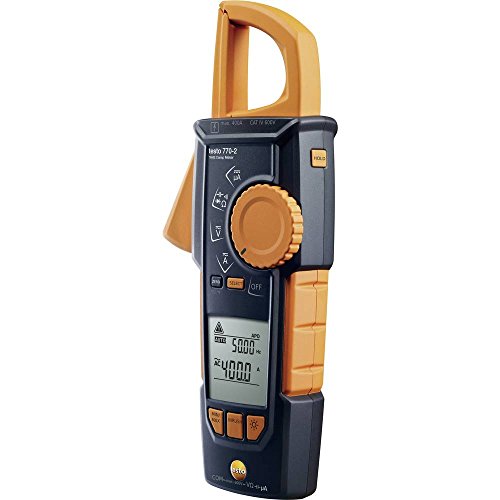
A mechanism-first review of the Testo 770-2 hook-clamp meter, including what the listing states, what it omits, and where the hook design stops being the right answer.
A first-hour review of the HiLetgo LCR-T4 kit, covering what it measures, what the listing leaves out, and when a different instrument is the better answer.