Best Non-Contact Voltage Testers: 10 Trusted Picks for Safer Electrical Work
A non-contact voltage tester is the cheapest instrument in the bag and the one used most often, because it answers the first question on every job: is this live. This hub compares the stated detection ranges, dual-range models and the clamp meters that build the same sensor in, and it explains where the technology stops being reliable.
As an Amazon Associate, Akermin earns from qualifying purchases. Product links on this page are affiliate links.
Our Top Picks
Every product here states non-contact AC voltage detection on its listing. They were compared on the stated voltage range, whether the range can be switched for low-voltage circuits, the alert method, extra features such as a flashlight and whether the sensor is built into a larger instrument. Figures are the manufacturers' own.
Best Overall
Klein Tools NCVT3P Dual Range Voltage Tester
Switches between line voltage and 12 volt circuits, with a flashlight.
Stated range 12 to 1000 V AC across two selectable ranges
Low range covers security, entertainment, communications, environmental control and irrigation wiring
Integrated flashlight and an audible alert, stated
Ranges are the manufacturers' stated figures. Where a clamp meter lists non-contact detection as a feature without publishing a detection range, the range cells read Not stated. Detection range is not an accuracy claim; a pen reports presence, never a value.
How to Choose a Non-Contact Voltage Tester
Four things separate these tools:
Where the Range Starts
A pen that starts at 90 V or 50 V cannot see a 24 V thermostat circuit. One that starts at 12 V sees everything, including induced voltage you did not want to know about.
Switched or Fixed
Dual-range pens such as the NCVT3P let you choose sensitivity. A single wide-range pen is simpler but noisier around bundled cable.
How It Tells You
A glowing tip is readable overhead and at distance. A small body LED is not. An audible alert matters when the pen is out of your line of sight.
Standalone or Built In
Four of the ten here are clamp meters with the sensor built in. Convenient on a service call, but a clamp meter is not something you clip to a shirt pocket.
Yes, and this is the single most important thing to know about the category. A pen senses the electric field around a conductor, so metal conduit, shielded cable, a conductor buried behind others, thick insulation, a flat battery or simply not gripping the pen properly can all produce a quiet pen on a live circuit. Treat a silent pen as unconfirmed, never as proof of a dead circuit.
Why does my pen alert on a wire I know is dead?
Induced voltage. A dead conductor running alongside a live one picks up a small voltage through capacitive coupling, and a sensitive pen reports it. The same effect produces the ghost voltage readings people see on high-impedance multimeters. A low-impedance or LoZ meter setting collapses it, which is why several clamp meters in the table state LoZ.
What does dual range actually change?
Sensitivity. The high range responds only to line-voltage conductors, so the pen stays quiet around control wiring and induced fields. The low range drops the threshold so 12 V and 24 V circuits register. One pen then covers both a lighting circuit and a thermostat run without giving constant false alerts on the first.
Should I buy a pen or a clamp meter with NCV built in?
Both, eventually. The pen is what you carry in a pocket and reach for fifty times a day. The clamp with built-in detection saves a tool change while you are already holding it. If the budget allows one purchase, buy the pen first; it is the tool that keeps you safe, and the clamp answers a different question.
Do these testers work on DC?
No. Non-contact detection relies on the alternating field around an AC conductor. A DC circuit, including a solar string, a battery bank or a vehicle system, produces no such field and the pen stays silent whatever the voltage. DC work needs a contact meter rated for the voltage involved.
Reviews
Klein Tools NCVT3P Dual Range Voltage Tester Best Overall
A single-range pen that starts at 50 volts is blind to the wiring that causes half the call-backs: thermostat runs, doorbell transformers, irrigation valves, alarm loops and low-voltage lighting. The NCVT3P exists to fix that. Klein states a dual-range design covering 12 to 1000 V AC, and the listing spells out the low-range applications by name, which is unusually specific for this class of tool.
The practical value of two ranges is not just reach, it is discrimination. On the high range the pen ignores the low-voltage clutter around a panel and responds to the line conductor you care about. Switch to the low range and the same pen picks up a 24 volt control circuit that the high range would never see. Buying one pen instead of two is the point.
The listing states an audible alert and an integrated flashlight, which is a small feature that earns its keep in a crawlspace or behind a furnace. It does not state a battery type, a battery life, a category rating or an ingress rating, so those remain unverified from the listing alone.
Strengths
Dual range covers 12 V control wiring and 1000 V line work
Low-range applications named explicitly on the listing
The 1AC II is the reference point for this category, and the reason is the alert. Instead of a small indicator on the body, the whole tip glows red while the beeper sounds, so the tool is readable at arm's length, above your head and in a dark ceiling void where the wire and the pen are not both in view at once.
The stated range starts at 90 V AC, which tells you what it is for. This is a line-voltage pen. It is designed to be unambiguous on a 120 V or 240 V conductor and to stay quiet around the low-voltage noise that makes a sensitive pen chatter. A technician who also works on 24 V controls needs a second tool or a dual-range pen.
Fluke publishes no battery life, no category rating and no ingress figure on this listing, and there is no self-test beyond the sequence every pen needs anyway: check it on a known live source before and after every dead check. The five-pack listing exists because crews lose them, which is its own kind of endorsement.
Strengths
Glowing tip is readable from a distance and overhead
Audible beeper as well as the visual alert
Widely recognised and widely stocked
Five-pack available for crews
Limitations
Starts at 90 V AC, so 24 V control circuits are out of range
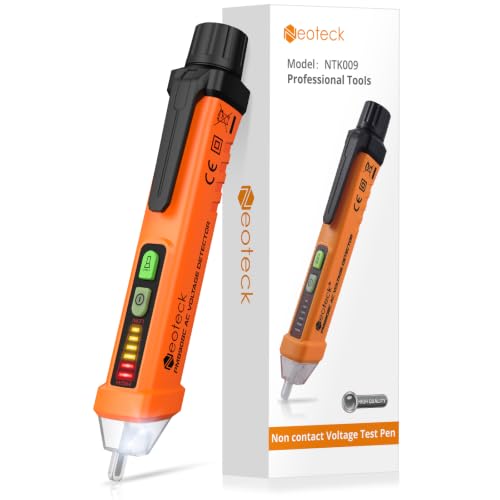
Neoteck covers the same nominal 12 to 1000 V AC span as the Klein dual-range pen at a fraction of the price, and adds a graded response: the listing states that different levels of alarm sound and LED indication let you tell the live conductor from the neutral. On a cable where both conductors are present, the pen that gets progressively louder as it nears the hot is more useful than one that simply says yes.
The trade-off is that this is a single wide-range pen rather than a switched one. A tool that responds from 12 V upward is sensitive by design, and a sensitive pen picks up induced voltage on nearby conductors, which produces alerts on wires that are not actually energised. That is a real limitation around a crowded panel or a bundled cable run.
The listing does not state a category rating, a battery type or a self-test function. At this price it belongs in the bag as a screening tool and a backup to a better pen, not as the instrument on which a dead check is proven.
Strengths
12 to 1000 V AC stated in a single pen
Graded alarm helps separate live from neutral
Very low price, easy to keep a spare
LED indicator as well as audible alert
Limitations
High sensitivity invites false alerts from induced voltage
Short answer: the Klein NCVT3P is the pen to buy if you touch both line voltage and control wiring, because its stated 12 to 1000 V AC range is switchable and it carries a flashlight; the Fluke 1AC II is the classic pocket pen, with a whole tip that glows red and a stated 90 to 1000 V AC range for line work only; and the Neoteck detector covers 12 to 1000 V AC with tiered alarm levels at the lowest price, which makes it a good spare rather than the tool you prove a dead circuit with.
What a non-contact tester actually senses
There is no connection to the circuit and no current path through the instrument. The pen contains a high-impedance amplifier that responds to the alternating electric field radiating from an energised AC conductor, coupled through the insulation, the air and your body to ground. That is the whole mechanism, and everything useful and everything dangerous about the tool follows from it. It is why a pen works through insulation and drywall, why it works without touching bare metal, and equally why it can be defeated by grounded metal conduit, by a shielded cable, by a conductor sitting behind two others in a bundle, and by holding the pen in a way that breaks the return path. What non-contact voltage detection senses covers the physics; the practical consequence is the rule in the next section.
A silent pen is not proof
Because the failure mode is silence, and silence is exactly what you expect on a dead circuit, a non-contact pen can never by itself prove a conductor safe to touch. The discipline that covers this is the live, dead, live sequence: verify the pen on a known energised source, test the conductor you intend to work on, then verify the pen on the known source again. If it alerted before and after, the quiet reading in the middle means something. If it did not alert on the second check, the battery died at some point during the test and everything since the first check is void. For proving dead on a circuit you are about to work on, follow the pen with a two-pole or contact tester; the voltage tester hub compares those.
Where the range starts, and why 12 V matters
The single specification that separates these products is the bottom of the stated range. The Fluke 1AC II starts at 90 V AC and the Klein NCVT1P at 50 V AC, which makes both of them line-voltage instruments: clear on a 120 V or 240 V conductor, deliberately deaf to everything smaller. The Klein NCVT3P, the NCVT3PKIT and the Neoteck all state 12 V at the bottom, which brings thermostat wiring, doorbell transformers, irrigation valves, alarm loops and landscape lighting into scope. The cost of that reach is noise: a pen sensitive enough to see 12 V will also see induced voltage on dead conductors lying next to live ones, which is the same phenomenon described in why ghost voltage appears on a multimeter. The dual-range design on the NCVT3P is the compromise, letting you pick the sensitivity to suit the circuit.
The alert is part of the specification
How the tool tells you is not a cosmetic detail. The Fluke 1AC II illuminates its entire tip red, which stays readable when the pen is above your head in a ceiling void, at the far end of your reach inside a panel, or in bright daylight where a small body LED washes out. Klein pairs an audible alert with a flashlight on the NCVT3P, which matters because the places you most need a voltage check are the places with no light. The Neoteck listing states graded alarm levels, so the tone changes as the field strengthens, which is how you distinguish a hot conductor from the neutral beside it in the same cable. When comparing two pens with identical ranges, the alert is usually the thing that decides which one you actually reach for.
Detection built into a clamp meter
Four entries in the table are not pens at all. The Klein CL900, CL710, CL445 and the 80197 kit are clamp meters whose listings name non-contact detection as one function among many, alongside true RMS current and voltage, LoZ, continuity and, on the CL445, temperature, capacitance and DC microamps for flame sensors. None of them publishes a detection range for the NCV function, so those cells read Not stated. The convenience is real: you are already holding the clamp, and a quick sweep costs no tool change. The limitation is equally real, because a clamp meter does not live in a shirt pocket and will not be the thing in your hand when you open an unfamiliar junction box. The clamp meters are compared on their measuring functions in how to choose a clamp meter and multimeter versus clamp meter.
What these tools cannot do
Three limits are worth stating plainly. They do not read a value: a pen reports presence, never 118 volts versus 240 volts, so a voltage measurement still needs a meter. They do not work on DC at all, because a steady field does not couple into the sensor, which rules them out for solar strings, battery banks and vehicle systems. And they do not distinguish a genuinely energised conductor from one carrying induced voltage, which is why an alert on a supposedly dead wire is a prompt to check with a low-impedance meter rather than evidence the circuit is live. Used inside those limits, this is the most useful tool for its size and cost in electrical work.
Guides in This Category
What is non-contact voltage detection for anyone who wants to understand how the sensor works before trusting it, including the conditions that make a pen stay silent on a live wire.
Products were compared on the stated detection range, single or dual range operation, alert method, additional stated features such as flashlights and receptacle testers, and form factor. Owner feedback was reviewed for recurring reports of false alerts and missed detections. We ran no laboratory tests and publish no detection measurements of our own. Amazon data supplies images, availability and links only.
A voltage range describes what an instrument will read, a measurement category describes where it may be connected, and a listing that gives one without the other leaves the safety question unanswered.
A meter fuse protects the current input path and its interrupting capacity has to match the fault energy the category implies, but the category itself comes from clearances and input protection rather than from the fuse.
Exceeding a measurement category usually ends in a flashover across internal clearances rather than a blown display, and the most common outcome is an instrument that still reads correctly with its safety margin gone.