Best Voltage Testers: 11 Reliable Picks for Quick Electrical Checks
A voltage tester has one job that matters more than all the others: proving a conductor dead before you touch it. The instruments that do that well load the circuit slightly, so induced voltage collapses instead of reading as live. This hub compares eleven listings across two-pole testers, non-contact pens, clamp meters and battery testers.
As an Amazon Associate, Akermin earns from qualifying purchases. Product links on this page are affiliate links.
Our Top Picks
Testers were sorted by the way they establish voltage: a two-pole instrument that loads the circuit, a non-contact pen that senses the field, a clamp meter with voltage leads, or a dedicated battery tester. Comparison uses stated ranges, stated functions and stated resolution only; no figure appears that the manufacturer did not publish.
Best Overall
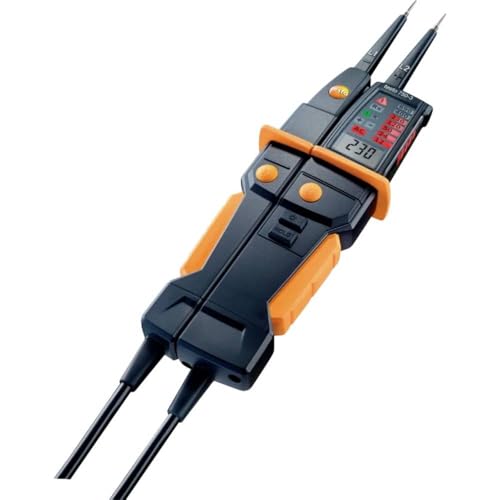
Testo 750-3 Voltage Tester
A two-pole tester with a digital readout and an outlet GFCI test.
Three-digit LCD, so the tester shows a value rather than a lamp
Performs GFCI tests on AC outlets, stated on the listing
Two-pole design contacts both conductors
Built by a test-equipment manufacturer rather than a general brand
Stated voltage capability is quoted from the manufacturer listing. Several listings publish no range at all, and those cells read Not stated. The proves dead column reflects the instrument design, not a claim tested by us.
How to Choose a Voltage Tester
Start with what you need the tester to settle:
Proving Dead
Only a contact tester that loads the circuit does this reliably. A two-pole instrument such as the Testo 750-3 or a meter with a low-impedance setting collapses induced voltage instead of displaying it.
Presence or Value
A pen tells you a conductor is live. It never tells you 118 volts or 240 volts. If the answer has to be a number, you need leads.
AC or DC
Non-contact detection is AC only. Battery banks, vehicles and solar strings need a contact meter or a dedicated battery tester such as the BR502.
Rated for the Location
Only the ZMIWNIED kit states a category rating in this group, at CAT III 1000 V and CAT IV 600 V. For panel work, confirm the rating in the manual before the tester goes near a busbar.
What is the difference between a voltage tester and a multimeter?
A voltage tester answers one question, usually with a lamp, a tone or a coarse digital readout, and many are built to load the circuit so the answer is trustworthy. A multimeter measures many quantities precisely but usually has very high input impedance, which makes it display voltage that is not really there. For proving dead, the tester is the better instrument; for diagnosis, the multimeter is.
Why does my multimeter show voltage on a wire I switched off?
That is ghost or phantom voltage. A disconnected conductor running beside an energised one picks up a small charge through capacitive coupling, and a meter with ten megohms of input impedance draws so little current that the charge is never bled away. Switch to a low-impedance or LoZ setting, or use a two-pole tester, and the reading drops to nothing.
Is a two-pole tester better than a multimeter for safety checks?
For proving a circuit dead, yes, for the reason above. It also has no range switch to set wrongly and no leads to plug into the wrong jacks, which removes two common sources of error when the consequence of an error is contact with a live conductor.
Can I test a car battery with an AC voltage tester?
Not with a non-contact pen, which senses AC fields only. A multimeter on DC volts will read the resting voltage. A dedicated battery tester such as the BR502 goes further: its listing states 6 V, 12 V and 24 V coverage, 100 to 2000 CCA and an internal resistance measurement, which is what actually identifies a battery that reads fine at rest but collapses under cranking load.
How often should I check that my tester still works?
Before and after every dead check, on a known live source. Batteries fail, leads break internally and sensors drift, and every one of those failures produces a reading that looks exactly like a safe circuit. The check costs five seconds.
Reviews
Testo 750-3 Voltage Tester Best Overall
A two-pole tester is the instrument electricians in most of the world reach for when the question is whether a conductor is safe to touch, and the reason is the load. Because the tool bridges both conductors through a defined impedance, any capacitively coupled voltage sitting on a disconnected wire collapses the moment the probes land. A high-impedance multimeter does the opposite, happily displaying 60 volts of nothing.
The 750-3 adds a three-digit LCD to that design, so instead of interpreting a ladder of neon lamps you read the number. Testo also states GFCI testing on AC outlets, which turns the same tool into a quick check that the protective device on a circuit still opens, without carrying a separate plug-in unit.
The listing is sparse on figures. It does not publish a voltage range, a category rating, an ingress rating or a trip current for the GFCI function, so all of those have to come from the manual. What it does state is enough to place the tool: this is a two-pole prover with a numeric display and a GFCI button, which is exactly the combination most service work needs.
Strengths
Two-pole design collapses ghost voltage instead of displaying it
Klein Tools NCVT3P Dual Range Voltage Tester Best for Fast Screening
Before you put probes on anything you want to know roughly what you are dealing with, and that is what a non-contact pen is for. The NCVT3P states a 12 to 1000 V AC span split across two switchable ranges, so the same pen screens a 240 volt feeder on the high setting and a 24 volt control run on the low one.
Used in front of a two-pole tester it saves time and reduces risk. Sweep the pen over the cable, find which conductors respond, and only then open the enclosure and make contact. Klein states an audible alert and a flashlight on the tool, both of which matter in the confined and unlit places where this kind of check happens.
The limitation is inherent, not a fault of this model. A pen reports presence, never a value, and it can miss a live conductor inside grounded conduit or behind other wires. It screens; it does not prove. Pair it with a contact tester, and never skip the check on a known live source before and after.
Strengths
Dual range covers both control wiring and line voltage
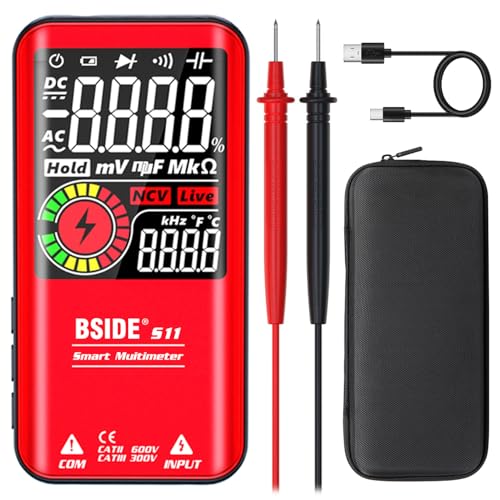
If what you need is a number rather than a yes or no, the cheapest honest route is a small auto-ranging multimeter, and BSIDE has built one that removes the last piece of expertise required. The listing states a Smart Mode that decides for itself between AC voltage, DC voltage, resistance and continuity, at the best available resolution, so a user who does not know which position the dial should be in still gets a correct reading.
The display is better than the price suggests: 9999 counts gives a digit more resolution than the common 6000 count meters, three results appear at once, and the colour LCD reads well in poor light. For checking a battery, confirming a socket is at nominal voltage or testing a fuse, it does everything asked.
The gap is safety documentation. There is no stated category rating, no stated maximum voltage and no stated accuracy, and the listing does not claim true RMS. Keep it for outlets, appliances, batteries and low-energy circuits, and use a rated instrument at a distribution panel.
Strengths
Automatic function selection, no dial expertise needed
9999 counts and a three-result colour display
Reads both AC and DC voltage
Rechargeable and inexpensive
Limitations
No category rating or maximum voltage stated
True RMS not stated
High input impedance will show ghost voltage on disconnected wiring
Short answer: the Testo 750-3 is the tester to buy for proving circuits dead, because its two-pole design loads the circuit so induced voltage collapses, and its listing adds a GFCI test on AC outlets; the Klein NCVT3P is the fast screening tool, stated at 12 to 1000 V AC across two ranges with a flashlight; and the BSIDE colour LCD multimeter is the value choice when you need an actual number, with automatic AC and DC voltage selection, though no category rating is stated so it belongs on outlets rather than panels.
Three kinds of voltage tester, three different answers
The eleven products here are not eleven versions of the same tool. A two-pole tester bridges two conductors through a defined load, so it answers is this circuit really energised in a way that cannot be fooled by a stray charge. A non-contact pen senses the field around a conductor and answers is something in here live, quickly and without opening anything. A multimeter or clamp meter with leads answers how many volts, to three or four digits. A battery tester answers a different question again: how much capacity is left in this cell. The first job of buying in this category is deciding which of those four questions you are paying to answer, because a tool that is excellent at one of them is mediocre at the others.
Why loading the circuit is the whole point
Take a cable that has been isolated at the breaker and run a high-impedance multimeter across it. It is common to read anything from a few volts to most of line voltage. Nothing is wrong with the meter. A dead conductor running parallel to a live one for any distance forms a small capacitor with it, and a tiny displacement current flows into a meter drawing almost no current of its own. The result looks like a live circuit and is not. The fix is to give that charge somewhere to go. A two-pole tester such as the Testo 750-3 includes a load by design, and a meter with a LoZ setting, which the Klein CL900 and CL710 listings both state, does the same electronically. Why ghost voltage appears covers the mechanism, and low impedance multimeters lists the meters that handle it.
What the pens add, and where they stop
Three of the eleven are non-contact pens: the Klein NCVT3P at a stated 12 to 1000 V AC, the Klein NCVT1P at 50 to 1000 V AC and the Fluke 1AC II at 90 to 1000 V AC. Their value is speed and the fact that nothing has to be opened or touched. Sweep a pen along a cable and you know where to be careful before a screwdriver comes out. Their limit is absolute: they report presence, never a value, they see AC only, and they can be silenced by grounded conduit, shielding or a conductor buried in a bundle. The rule that follows is worth repeating even though it appears on every page in this cluster. A quiet pen is a reason to continue testing, not a reason to touch. The non-contact voltage tester hub compares the pens in detail.
Clamp meters as voltage testers
Four entries are clamp meters, and it is worth being clear about why they appear on a voltage page. Every one of them has voltage leads and measures volts as a normal function; the clamp is for current. The KAIWEETS inrush model states 1000 V AC and DC, 1000 amps and 6000 count true RMS along with frequency, duty cycle, resistance, capacitance, diode and continuity, which makes it a multimeter with a clamp attached rather than a current-only tool. The INSTRUKART listing states ten functions with a built-in non-contact detector, a backlit display and a flashlight. The Klein 80197 and the Testo 770-2 both state true RMS. If your work involves load measurement as well as voltage checks, buying one of these instead of a separate meter and tester is sensible, and multimeter versus clamp meter works through the trade.
DC and the battery tester exception
The OBDResource BR502 is in the table because battery voltage is voltage, but it works in a different world. Its listing states coverage of 6 V, 12 V and 24 V batteries from 100 to 2000 CCA, across flooded, AGM flat plate, AGM spiral and gel chemistries, plus an internal resistance measurement. That last figure is the one that matters, because resting voltage is a poor indicator of a battery near failure. A cell can sit at 12.6 volts and still collapse the moment a starter draws current, and internal resistance is what reveals it. For the wider subject see how to choose a battery capacity tester, testing a 12 V battery with a multimeter and internal resistance testers for maintenance.
Ratings, and the one listing that publishes them
Of the eleven, only the ZMIWNIED FS899L kit states a safety category on its listing, at CAT III 1000 V and CAT IV 600 V, together with a twenty-piece silicone test lead set and USB-C charging. That is not proof that the others are unrated, but it does mean the rating has to be found in the manual before any of them goes near a service entrance or a distribution panel. The rating is about surviving a transient, not about the steady voltage on the screen, and a tester used above its category can fail violently at a voltage it displays happily. What a CAT rating means explains the four levels and where each applies.
Listings were compared on the stated measurement type, stated voltage capability, instrument design and the additional functions each manufacturer publishes. Owner feedback was read for repeated reports of misreadings and premature failure. We ran no laboratory tests and publish no measurements of our own; every figure on this page is the manufacturer's. Amazon data supplies images, availability and links only.
A voltage range describes what an instrument will read, a measurement category describes where it may be connected, and a listing that gives one without the other leaves the safety question unanswered.
A meter fuse protects the current input path and its interrupting capacity has to match the fault energy the category implies, but the category itself comes from clearances and input protection rather than from the fuse.
Exceeding a measurement category usually ends in a flashover across internal clearances rather than a blown display, and the most common outcome is an instrument that still reads correctly with its safety margin gone.