As an Amazon Associate, Akermin earns from qualifying purchases. Product links on this page are affiliate links.
For bench work where two related readings must be visible together and resolution matters, P1 is the pick: its listing states a 5.5 digit dual display and 0.015 percent basic DC voltage accuracy, which is a different class of instrument from the handhelds here. For field work, P2 is the pick because its dual-display behaviour comes from logging and trend review, not from a split screen, and the listing states selectable AC filtering and a low pass filter for drive measurements. P5 is the bench alternative with a stated 30,000 count dual display and USB data management. P3 and P4 are not general-purpose multimeters with two displays; P3 is a fixed battery monitor and P4 is a handheld whose listing does not state a dual display at all, so both are treated as context rather than picks.
What a dual display is actually for
A dual display shows two measured values at once. The point is not screen space; it is that some measurements only make sense as a pair. When you adjust a power supply and watch the load, you want source voltage and load current visible together, because the moment you look away to change a range you lose the interaction you were studying. When you check a DC rail for ripple, you want the DC level and the AC component on screen at the same time so you can see whether the ripple grows as the load changes.
On a bench meter, the second display is usually a genuine second measurement channel, often at lower resolution than the main reading. On a handheld, the second value is more often a secondary function such as frequency alongside voltage, or a min/max/avg register that updates while the main reading continues. Both are useful, but they answer different questions. A bench dual display answers what are these two values right now. A handheld secondary display answers what has this value been doing while I watched the main one.
That distinction is the reason this page separates bench instruments from handhelds rather than ranking all four listings on one scale. If your work is on a bench with mains power available, the bench class gives you resolution and a stable second reading. If your work is on a live panel or a vehicle, the handheld class gives you portability and the registers that catch intermittent faults.
The bench meters: resolution, and what 5.5 digits buys you
P1 states a 5.5 digit dual display and a basic DC voltage accuracy of 0.015 percent. Those two figures belong together. A 5.5 digit display resolves roughly one part in 200,000 of full scale, which is finer than the accuracy specification, so the last digit is a trend indicator rather than a truth claim. That is normal and useful: you watch the last digit move to see drift, while the stated accuracy tells you how far the whole reading might be from the real value.
The listing also states dedicated DC leakage current measurement and a 2×4 ohm 4-wire measurement technique. The 4-wire method matters for low resistance because it removes the test lead resistance from the measurement. In a 2-wire ohm reading, the leads and their contact resistance add to the value you see; at a few ohms or less, that error can exceed the resistance you are trying to measure. The 4-wire technique drives current through one pair of leads and senses voltage through another, so the lead drop is excluded. If you test motor windings, contactors or shunts, that is the difference between a number and a guess.
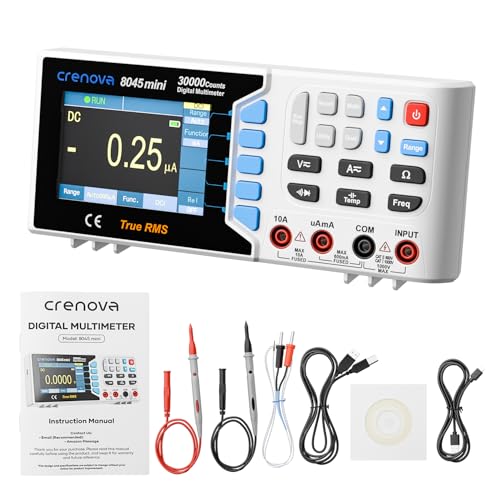
P5 states a 30,000 count LCD with dual display, 11 measurement functions, auto and manual ranging, data hold, and USB connectivity for remote control and data management. The listing states up to 10 hours from a 5000mAh rechargeable battery and a 3.5 inch screen with adjustable backlight. The USB port is the practical separator: it lets you log and review readings on a computer instead of writing them down. Neither bench listing states a safety category, a CAT rating, or a maximum input voltage for the measurement terminals, so treat both as bench instruments connected to low-energy sources unless the manufacturer publishes otherwise.
| Specification | P1 | P5 |
|---|---|---|
| Display stated | 5.5 digit dual display | 30,000 count dual display, 3.5 inch LCD |
| Basic DC accuracy | 0.015 percent | Not stated in the listing bullets |
| Low resistance method | 2×4 ohm 4-wire stated | Not stated in the listing bullets |
| Functions stated | DC leakage current, setup buttons | 11 functions including capacitance, temperature, frequency, duty cycle |
| Data output | Not stated in the listing bullets | USB, remote control, firmware updates |
| Power | 120V bench supply stated in title | 5000mAh rechargeable, up to 10 hours stated |
Read that table as a division of labour. P1 is the metrology instrument: fewer stated functions, better stated accuracy, and a measurement technique aimed at low values. P5 is the data instrument: more functions, a computer link, and a battery so it can be moved. If you need both, they are complements, not substitutes.
The four listings, and the two that are not dual-display multimeters
Fluke 8808A bench multimeter
The only listing here that states a 5.5 digit dual display on a bench instrument, with 0.015 percent basic DC accuracy.
Fluke 289 handheld multimeter
A handheld whose listing states logging, TrendCapture and a low pass filter, so two values are compared over time rather than on a split screen.
CGELE battery monitor meter
A fixed monitor, not a handheld multimeter. Its listing states nine parameters on one screen, which is a multi-parameter display rather than a dual measurement display.
Crenova 30000 count bench multimeter
The listing states a 30,000 count LCD with dual display and USB data management, making it the second bench option.
The handheld: two values over time, not two values at once
P2 does not state a split-screen dual display. Its listing states TrendCapture, which graphically displays a logged session so you can see whether an anomaly occurred, with zoom stated up to 14 times. It also states a selectable AC filter, sometimes called a smoothing mode, which steadies the reading when the input signal is changing rapidly or noisy, and a low pass filter for voltage and frequency measurements on adjustable speed motor drives. A LoZ voltage function is stated for eliminating ghost voltages when checking for the presence or absence of live power.
The mechanism behind the low pass filter is worth understanding. A variable frequency drive switches its output rapidly, so a true-RMS meter can read the switching carrier as if it were part of the fundamental voltage. The low pass filter removes the high-frequency component so the displayed voltage reflects the drive output the motor actually sees. Without it, you can log a voltage that is technically present but not the quantity you meant to measure. The AC filter does something related on the display side: it averages the reading over a longer window so a jumping number becomes readable, at the cost of responding more slowly to real changes.
The listing states ShareLive video calling through a wireless connector that is sold separately, and a mobile app. That is a workflow feature for teams, not a measurement feature. If you work alone, it does not change the reading. The listing does not state a safety category, an IP rating, a battery type or a battery life, so those are open questions to resolve before buying. If your work is on drives rather than bench circuits, the VFD troubleshooting meter comparison covers that ground directly, and the low impedance multimeter comparison explains the LoZ function in more depth.
Two listings that are not dual-display multimeters
P3 is a battery monitor with a shunt. Its listing states nine parameters on one interface: voltage from 0 to 200V, current from 0 to 100A, power to 60000W, impedance, internal resistance, capacity to 1000AH, state of charge, energy to 9999kWh and running time. It also states a full-view LCD with backlight, screwless pressing terminals, and measurement accuracy of 1 percent. This is a multi-parameter display, and the nine values are computed from the same shunt and voltage inputs rather than being independent measurements. It is permanently installed in a vehicle or battery bank. It is not a handheld multimeter, it does not have test leads in the usual sense, and it should not be bought as a general-purpose meter. It is included here only because its listing describes a display that shows several electrical quantities at once, which is the question this page started from.
P4 is a handheld multimeter whose listing states a 6000 count colour screen, true RMS, auto ranging, non-contact voltage detection, temperature measurement, USB recharging from a 200mA battery, and a backlight with flashlight. It does not state a dual display or a secondary display. The listing’s mention of a large screen is about readability, not about showing two measurements simultaneously. On the evidence given, P4 is a single-display handheld and does not belong in a dual-display comparison. It is noted here so the reader does not assume otherwise, and it is not counted among the picks.
One claim in P4 deserves a flag. A 6000 count handheld is a normal consumer specification, but listings in this class sometimes quote display resolution as accuracy. The listing does not state an accuracy figure at all, so there is nothing to check against. If accuracy matters to your work, ask for the stated accuracy before buying, because a count figure alone tells you how finely the display divides its range, not how close the reading is to the truth.
Maintenance, safety and where a dual display stops helping
Bench meters live on a mains supply and rarely move, so their maintenance is mostly about the input terminals and the leads. Dirty or oxidised terminals add resistance exactly where a 4-wire measurement is trying to avoid it. Keep the terminals clean, keep the leads short where you can, and check the leads themselves before trusting a low-ohm reading. A bench meter left powered continuously will accumulate dust internally; the listing does not state a service interval, so follow the manufacturer’s documentation.
Handheld meters take the opposite kind of punishment. Battery contacts, range switch detents and lead sockets are the usual failure points. P2’s listing does not state a battery type or life, so a spare set of cells is a reasonable precaution on a long job. P4 states a rechargeable internal battery, which removes the disposable cell problem but introduces charging downtime and eventual cell ageing.
On safety, the listings here are largely silent. P1, P2 and P5 do not state a safety category or a maximum input voltage in the supplied bullets. P3 is a permanently installed monitor, not a test instrument you probe live circuits with. A dual display does not change any of this. It shows you two numbers; it does not tell you whether the circuit can hurt you, and it does not alarm. If you need a meter that sounds an alert rather than displaying a value, a dual display is the wrong feature to shop for.
The honest limit of the category is this: a dual display helps when two values are related and you need both in view. It does not help when the second value is one you will look at later, where logging is the better tool, and it does not help when the two quantities need different instruments entirely. For readers whose second value is temperature, the temperature measurement meter comparison is the more direct route.
Recommended Tools


Products shown because their documented specifications fit this guide. Price and availability are on Amazon and can change.
Frequently Asked Questions
Does a dual display mean I can measure two circuits at once?
Not on any listing here. On a bench meter the second display is normally a second function of the same input, such as AC ripple alongside DC level, or frequency alongside voltage. It is not an isolated second channel. If you need to measure two independent circuits simultaneously, you need two meters or a data logger with multiple channels.
Why is P3 in the comparison if it is not a multimeter?
Because its listing states nine electrical parameters on one screen, which is the closest thing in this batch to a multi-value display, and readers searching for dual displays often land on battery monitors. It is a permanently installed monitor for a battery bank, not a handheld test meter, and it is not counted as a dual-display multimeter pick.
Is a 5.5 digit display more accurate than a 6000 count display?
They are different things. Digits and counts describe how finely the display divides its range. Accuracy is a separate stated figure, and P1 states 0.015 percent basic DC accuracy while P4 states no accuracy figure at all. A high-resolution display with poor accuracy shows you a precise-looking number that may still be wrong.
Do any of these meters log data without a computer?
P2 states TrendCapture, which displays a logged session on the meter itself, with zoom stated up to 14 times. P5 states USB connectivity for logging and reviewing on a PC, which implies a computer is part of the workflow. P1's listing does not state a logging function.
What does the low pass filter on P2 actually do?
It removes high-frequency content from the measured signal so the displayed voltage reflects the fundamental rather than the switching carrier. On a variable frequency drive, that means the voltage you see is closer to what the motor experiences. The listing states it for voltage and frequency measurements on adjustable speed drives.
Are these meters safe for live panel work?
The listings do not state safety categories or maximum input voltages for P1, P2 or P5, so that cannot be answered from the supplied data. Before any live work, check the manufacturer's published safety rating for the specific model. A meter is not an alarm, and a display of any kind does not warn you of a hazard.
Affiliate disclosure: Akermin earns a commission from qualifying Amazon purchases made through links on this page. Our editorial picks are based on documented specifications and owner feedback, not commissions.