As an Amazon Associate, Akermin earns from qualifying purchases. Product links on this page are affiliate links.

sainlogic · Sainlogic Air Quality Monitor Indoor, 16 in 1 VOC Meter, CO2, HCHO, TVOC, PM2.5, PM1.0, PM10, Humidity, Temperature, 7.2" Large Display 3-Color AQI Alerts Air Quality Tester for Home Air Monitor
View on AmazonPrice and availability are shown on Amazon and can change at any time.
A portable indoor air quality monitor with a 7.2 inch display, a tri colour status LED, seven thresholds you set yourself and nine readings covering CO2, PM1.0, PM2.5, PM10, formaldehyde, TVOC, temperature, humidity and an AQI index, running up to eight hours on a 2500 mAh cell charged over USB-C. Unusually for this category it publishes accuracy figures. It publishes them for temperature and humidity and for nothing else, so the three channels you are buying it for arrive with no tolerance at all.
Accuracy is published for the two channels that need it least
The second bullet gives real numbers. Temperature covers 14 F to 122 F with an accuracy of plus or minus 1 F to plus or minus 3 F. Humidity covers 0 to 99 percent relative humidity with an accuracy of plus or minus 2 to plus or minus 3 percent RH. Both are proper specifications, a range with a tolerance, which is exactly the format that lets a buyer compare one instrument against another.
Then notice which channels received them. Temperature and humidity are the two cheapest sensing elements inside the case and the two that a plain hygrometer already specifies. Nobody buys a nine reading air monitor for its thermometer.
Carbon dioxide has no stated range and no stated tolerance. Neither does formaldehyde. Neither do the three particulate bands. Those are the readings the product name leads with, and they are the ones that arrive unspecified.
The tolerances that are published also need reading carefully, because each is written as a bracket rather than a figure. Plus or minus 1 F to plus or minus 3 F does not describe an error that lands somewhere in that interval at random. It summarises two or more tolerances that apply over different portions of the span, and the bullet does not say where one gives way to the other. With no breakpoint stated, the only safe reading is the worse figure across the whole range, which is plus or minus 3 F and plus or minus 3 percent RH. Three percent RH is a wide margin in the one investigation people most often buy a hygrometer channel for, because it straddles the line between a wall that is drying out and a wall that is not.
A 1.5 second sample is not a 1.5 second response
The same bullet states that the unit samples at 1.5 second intervals and refreshes its readings every one to two seconds. That is a genuine figure and it is good to see published, but it describes the electronics rather than the chemistry.
Sampling interval is how often the processor asks the sensor for a value. Response time is how long the sensor needs to settle after the air around it changes, and the two are independent. An optical carbon dioxide sensor has to exchange the air inside its measurement cell before it can see a new concentration, and a particulate sensor averages over a flow period by design in order to produce a figure that does not jump about. A display updating every second can quite happily show you a one second old copy of a reading that is thirty seconds behind the room.
No response time appears in the bullets. The figure normally quoted is the time to reach 63 percent or 90 percent of a step change, and it is the one that tells you whether the instrument can show a door opening or a window being closed. Our note on how fast a CO2 monitor should respond describes how to establish it yourself with nothing more than your own breath and a watch.
The reset button is a zero, not a calibration
The fourth bullet describes a one touch reset button that allows for quick sensor recalibration whenever needed. That wording deserves a second look, because a reset and a calibration are not the same operation.
Calibrating an instrument means comparing it against a reference of known value and correcting the difference. It requires a reference. A single button on a monitor has no reference available to it, so whatever the button does, it is not that.
What a button like this can do is set a baseline. It takes the air present at the moment you press it and treats that as the clean condition. On a carbon dioxide channel the clean condition is normally taken to be outdoor air, and that assumption is the whole trick: press it outdoors or at an open window and the result can be sensible, press it in an occupied bedroom and you have just instructed the instrument that the stale air it is sitting in is fresh. Every reading afterwards is shifted down by however wrong you were.
The listing never says what reference condition the reset assumes, so treat the button as something used deliberately and rarely rather than whenever a figure looks odd. Why automatic CO2 calibration can be wrong covers the same failure in the version that happens without anybody pressing anything.
Eight hours of battery and nowhere to store a trend
A 2500 mAh cell, up to eight hours of running without a cable and USB-C charging is a coherent set of figures, and the fourth bullet presents the absence of an app and a wireless connection as a simplification. For a walk around instrument it genuinely is one. Nothing to pair, nothing to update, and you can carry it from a bedroom to a kitchen to a car and read it immediately.
The consequence is that there is no record. No logging interval, no memory capacity, no export and no app appears anywhere, which means every reading exists only while somebody is looking at it. Eight hours is a working day of readings you cannot keep.
That matters for the job this category is most useful for. Judging ventilation is a question about shape over time: how fast carbon dioxide climbs with the door shut, how long it takes to fall once a window is open, whether the overnight peak in a bedroom reaches 900 or 2000 parts per million. A live figure answers none of those, and using CO2 data to evaluate ventilation depends on having the curve rather than the instant.
In place of a graph the instrument gives an instruction. The first bullet states that once any reading reaches Level 4 or higher, the display flashes a prompt to open windows for ventilation. For a household that will never look at a chart, that is a sensible substitute and arguably more useful than a logged file nobody opens. What is missing is any definition of the levels. There are apparently at least four of them, there are seven thresholds you can set, and no table says what any level corresponds to.
What the five bullets commit to
| Specification | Published in the listing |
|---|---|
| Readings | Nine: CO2, PM1.0, PM2.5, PM10, AQI, HCHO, TVOC, temperature, humidity |
| Temperature range and accuracy | 14 F to 122 F, plus or minus 1 F to plus or minus 3 F |
| Humidity range and accuracy | 0 to 99 percent RH, plus or minus 2 to plus or minus 3 percent RH |
| Sampling | 1.5 second interval, display refresh every 1 to 2 seconds |
| Display | 7.2 inch, three brightness levels, jumps to brightest on an alert |
| Status indication | Tri colour LED with icons, flashing ventilation prompt at Level 4 or above |
| Alerts | Seven user defined thresholds, audible alarm can be silenced |
| Battery | 2500 mAh, up to 8 hours, USB-C charging |
| Connectivity | None, by design: no app and no wireless |
| CO2 range and accuracy | Not stated in the listing bullets |
| Formaldehyde range and accuracy | Not stated in the listing bullets |
| Particulate range and accuracy | Not stated in the listing bullets |
| Sensing technology, any channel | Not stated in the listing bullets |
| Sensor response time | Not stated in the listing bullets |
| Logging, memory or export | Not stated in the listing bullets |
| Reference the reset button assumes | Not stated in the listing bullets |
| Definition of the alert levels | Not stated in the listing bullets |
The published half of that table is a description of an interface and a battery, and all of it is checkable. The blank half is where the measurement would be.
Right for a room you are standing in
This is a readable, portable, cable free panel for somebody who wants to know whether the air in the room they are in is good or bad right now, and who will respond to a colour and a prompt rather than to a figure. The 7.2 inch screen, the automatic jump to full brightness on an alert and the silenceable alarm are all sensible decisions for that person, and the two published tolerances are more than most of this category offers.
It is the wrong instrument for proving something. With no tolerance for the three readings that matter, no sensing technology, no response time and no record, a formaldehyde figure from it cannot support a complaint and a carbon dioxide figure from it cannot support a ventilation assessment. Buy it as an indicator, use the reset button almost never, and do not read a three digit display as a three digit truth.
Recommended Tools


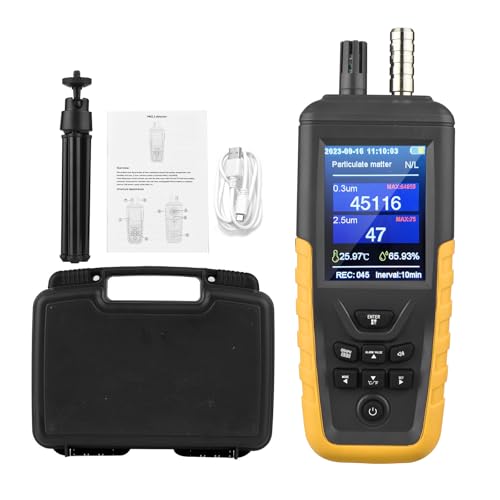
Products shown because their documented specifications fit this guide. Price and availability are on Amazon and can change.
Frequently Asked Questions
Which readings come with a published accuracy figure?
Temperature and humidity only. The second bullet gives 14 F to 122 F at plus or minus 1 F to plus or minus 3 F, and 0 to 99 percent relative humidity at plus or minus 2 to plus or minus 3 percent RH. Carbon dioxide, formaldehyde and the three particulate bands get no range and no tolerance at all, and those are the readings the product name leads with.
What does a tolerance written as plus or minus 1 F to plus or minus 3 F mean?
It means the instrument is better over part of its span and worse elsewhere, and the bullet does not say where the boundary falls. A tolerance written as a bracket is not a random spread, it is a summary of two or more figures that apply to different portions of the range. With no breakpoint published, the only safe assumption is the worse figure everywhere, so treat it as plus or minus 3 F and plus or minus 3 percent RH. On a damp investigation, 3 percent RH is the difference between a wall that is drying and one that is not.
Does the one touch reset really calibrate the sensors?
Calibration means comparing an instrument against a reference of known value and correcting the difference, and a button on the case has no reference available to it. What a single button can do is set a baseline, treating the air present when you press it as the clean condition. That makes where you press it the whole question, and the listing never states what reference condition the reset assumes. Use it deliberately and rarely rather than whenever a number looks wrong.
Can it log readings or send them to a phone?
No, and the fourth bullet presents that as a simplification: no app to install and no wireless to configure, so it works the moment it is switched on. The consequence is that no logging interval, memory capacity, export route or app is mentioned anywhere, so every reading exists only while you are looking at it. The flashing prompt to open windows, which the first bullet says appears at Level 4 or higher, is the substitute for a graph.
Is a 1.5 second sampling interval fast for a CO2 monitor?
It is a fast sampling interval, and it is not the same thing as a fast sensor. Sampling interval is how often the processor interrogates the sensor. Response time is how long the sensor itself takes to settle after the air around it changes, and an optical carbon dioxide sensor has to exchange the air in its measurement cell first. A display refreshing every second can show a one second old copy of a reading that is half a minute behind the room, and no response time is published here.
Affiliate disclosure: Akermin earns a commission from qualifying Amazon purchases made through links on this page. Our editorial picks are based on documented specifications and owner feedback, not commissions.
Related Guides

Temtop Handheld Particle Counter Review: Three Channels and No Published Flow Rate
A pump suction handheld particle counter reading 0.3, 0.5 and 1.0 micron channels alongside PM2.5, PM10 and TSP, with temperature and humidity sensors, 32 GB of internal storage and a 3500 mAh battery.
Read More→
VETOUCH Plug In CO2 Monitor Review: An Alarm the Bullets Never Define
A mains powered three in one monitor showing carbon dioxide, temperature and humidity on a 1.83 inch colour screen, with three brightness settings and a display that flips 180 degrees.
Read More→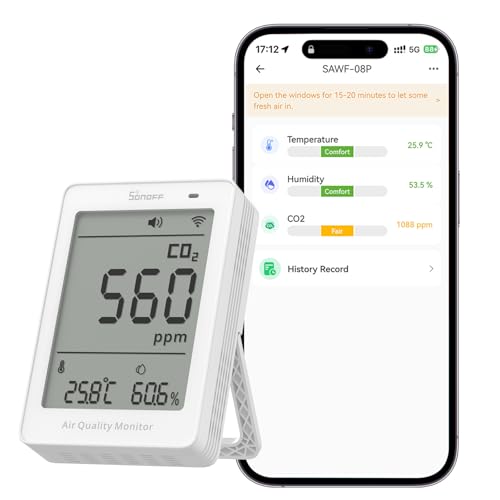
SONOFF AirGuard SAWF-08P Review: NDIR Accuracy Written as a Formula
A mains powered Matter compatible monitor showing CO2, temperature and humidity on one screen, with an NDIR sensor, 5 second updates and 12 months of history in the eWeLink app.
Read More→