As an Amazon Associate, Akermin earns from qualifying purchases. Product links on this page are affiliate links.
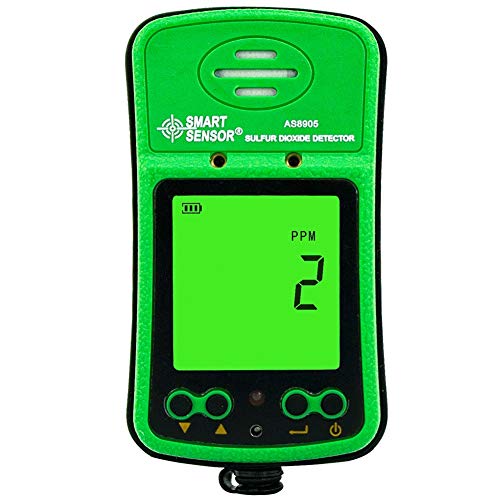
SMART SENSOR · Portable SO2 Gas Monitor Tester 0~20ppm Digital LCD Display Rechargeable Li-Battery Powered Alarm Handheld Sulfur Dioxide Gas Detector Analyzer Sensor
View on AmazonPrice and availability are shown on Amazon and can change at any time.
A clip on personal monitor for sulfur dioxide, built on an electrochemical sensor, reading 0 to 20 ppm in 0.1 ppm steps, with adjustable high and low alarm thresholds signalled three ways at once and a rechargeable cell quoted at 8 to 9 hours. The alarm design is the right design for a worn instrument. The problem is that no accuracy figure appears anywhere in the five bullets, and on a 20 ppm scale the readings that matter all sit in the bottom tenth of it.
Resolution without accuracy, on a scale where the bottom matters
The first bullet gives a range of 0 to 20 ppm and a resolution of 0.1 ppm, and calls the sensor highly sensitive and accurate. Those are the only numbers about the measurement on the whole page.
Resolution and accuracy are different properties and only one of them is here. Resolution is the smallest change the display can show. Accuracy is how far that display may sit from the concentration in the air. A reading can step in tenths while being whole parts per million out, and a resolution figure places no constraint on that at all. Our explainer on what ppm means on a gas detector goes through the distinction.
Now put that against where sulfur dioxide readings live. Occupational guidance for sulfur dioxide is set in the region of a part per million or below for short exposures, depending on which body publishes it, and the smell threshold is in similar territory. So the whole interesting part of a 0 to 20 ppm scale is the bottom tenth of it.
An instrument with no published accuracy is one whose readings in that bottom tenth cannot be defended. It will still tell you useful things: that the number went up, that it is higher near one place than another, that a threshold you set was crossed. What it cannot support is a statement that a concentration was below a limit, because nothing on the page bounds the error.
Three alarm channels is the right answer for a clip on meter
The second bullet is the strongest part of the listing. It describes a high and a low alarm threshold, both adjustable, and three simultaneous indications: sound, flash and vibration.
That is correct engineering for a device worn on clothing, because each channel covers a failure of the others. Sound is lost under ear defenders or beside running plant. A flashing indicator is lost when the instrument is under a coat or behind you. Vibration reaches you in both of those cases, which is why it matters more than it looks, as we set out in our piece on detectors with vibrating alerts.
Two adjustable thresholds rather than one fixed alarm is also the right choice. It lets you set a low threshold as a working warning and a high threshold as a leave now signal, which is how a personal monitor is meant to be used. What the bullets do not state is the value each threshold ships at, or whether your settings survive a flat battery.
Peak hold is a small feature that changes what you learn
Tucked into the same bullet is a peak value display mode, showing the highest concentration the instrument has seen.
It is easy to read past and it changes what the instrument is for. Without it, a monitor only answers one question: what is the concentration now. You look away, the level spikes, the level falls, and the display tells you nothing happened. With a peak record you can walk a space, come back and read the worst value it encountered.
That is how you find a source. Walk a line, read the peak, reset, walk another line, compare. It turns a present tense instrument into one that can survey, and on a device with no logging and no export it is the only memory you have.
Compiled with is not the word a certificate uses
The fifth bullet states that the product is compiled with the following standard and regulation: JJG 693, JJG 695, JJG 915 and the GB 3836 series anti explosion standard.
Naming documents is better than the adjectives most listings in this category manage, so take the intent seriously. Here is what they are.
JJG numbers are Chinese national metrological verification regulations. Each sets out how a class of measuring instrument is to be verified and what it has to achieve. They describe a procedure rather than a result, so citing them tells you a defined test exists without telling you the figure the instrument reached.
GB 3836 is the Chinese standard series for electrical equipment in explosive atmospheres, occupying the same role as the international IEC 60079 series. Conformity to it is a certification matter, evidenced by a marking on the instrument naming the protection concept, the equipment group, the gas group and the temperature class, and by a certificate number you can look up.
None of that is on the page. What is on the page is the phrase compiled with, which is a weaker statement than certified to and may be a rendering of complied with. If you need an instrument you can take into a classified area, the marking and the certificate are what to ask for, and a line in a bullet list is not a substitute for either.
The bullets in a table, and the gas detector essentials missing
| Item | Stated in the listing |
|---|---|
| Target gas | Sulfur dioxide |
| Sensing principle | Electrochemical |
| Range | 0 to 20 ppm |
| Resolution | 0.1 ppm |
| Accuracy | Not stated in the listing bullets |
| Response time | Not stated in the listing bullets |
| Alarms | Adjustable high and low, audible, visual and vibrating |
| Peak hold | Yes, peak value display mode |
| Display | Backlit LCD showing real time concentration |
| Power source | Internal 3.7 V rechargeable lithium cell |
| Runtime | 8 to 9 hours continuous from a full charge |
| Charging time | Not stated in the listing bullets |
| Documents cited | JJG 693, JJG 695, JJG 915, GB 3836 series |
| Explosion protection marking | Not stated in the listing bullets |
| Expected sensor life | Not stated in the listing bullets |
| Sensor replaceable | Not stated in the listing bullets |
| Ingress protection rating | Not stated in the listing bullets |
| Operating temperature and humidity | Not stated in the listing bullets |
| Logging or data export | Not stated in the listing bullets |
Two of those blanks are more serious than the rest. A response time tells you whether you can read while walking, and without it you do not know how long to stand still before believing the display. An expected sensor life tells you when the instrument stops being an instrument. Electrochemical cells for toxic gases are consumed by the reaction they depend on and degrade whether or not you use them, which is why the better ones publish a life and sell a replacement, as we explain in why gas detectors do not last forever.
Buy this to see a change, not to clear a space
There is a real use for this instrument. If you work somewhere sulfur dioxide is a known possibility, a pulp mill, a smelter, a winery, a refrigeration plant on older chemistry, and you want something clipped to your collar that will shake, flash and sound when a threshold you chose is crossed, it does that job and the alarm design does it well. The peak hold lets you survey. The runtime covers a shift.
It is the wrong instrument for anything that has to be written down and relied upon. Clearing a confined space, supporting an exposure assessment or demonstrating that a level is under a limit all need an accuracy figure, a response time, a certified explosion protection marking where the area demands one, and a calibration record. None of those are on this page. If your work needs them, buy from a listing that publishes them, and treat a missing accuracy figure on a toxic gas instrument as the significant omission it is.
Recommended Tools


Products shown because their documented specifications fit this guide. Price and availability are on Amazon and can change.
Frequently Asked Questions
Why does a missing accuracy figure matter when the resolution is 0.1 ppm?
Because resolution and accuracy answer different questions. Resolution is the smallest change the display is able to show. Accuracy is how far the displayed number may sit from the true concentration. A meter can step in tenths while being whole parts per million out, and nothing in a resolution figure constrains that. On a 0 to 20 ppm instrument the practical reading region for sulfur dioxide is the first few parts per million, so the unstated figure is the one that decides whether a number in that region means anything.
What are JJG 693, JJG 695 and JJG 915?
JJG numbers are Chinese national metrological verification regulations. Each one defines how a class of measuring instrument is to be checked and what it has to achieve to pass. Citing them is more than citing nothing, because it implies a defined verification procedure rather than a marketing adjective. What they do not give the reader is the resulting figure. A verification regulation sets the test; the certificate that comes out of the test carries the numbers, and the listing does not reproduce them.
What is the GB 3836 series?
It is the Chinese standard series for electrical equipment used in explosive atmospheres, filling the same role as the international IEC 60079 series. Conformity is a certification matter, evidenced by a marking on the instrument naming the protection concept, the equipment group, the gas group and the temperature class, plus a certificate number. The bullet says the product is compiled with the series, which is not the same statement as a certified protection level. If you need an instrument you can legitimately carry into a classified area, ask for the marking and the certificate rather than the sentence.
Is 8 to 9 hours of runtime enough?
It covers a working shift and not much more, and the listing is careful to add that the figure varies slightly with conditions, which is a reasonable thing to say about a lithium cell driving a backlight and a vibration motor. What the bullets do not state is the charging time, whether the instrument can run while on charge, or how the runtime behaves in the cold. An electrochemical sensor also draws current continuously, so switching the instrument off between uses is the normal way to make a day out of one charge.
Does the listing say how fast the sensor responds?
No. Response time, usually quoted as the seconds taken to reach 90 percent of the final reading after a step change, is absent from all five bullets. That is less damaging on a personal monitor than it would be on a leak sniffer, because a personal monitor is meant to sit on you and alarm rather than be swept across joints. It still matters when you walk into a space and want to know whether the number in front of you has caught up with the air you are standing in.
How long will the sensor last?
Not stated in the listing bullets. Electrochemical cells for toxic gases are consumable by design, because they work through an irreversible reaction and the electrolyte and electrodes change with exposure and with age whether the instrument is used or not. A published end of life expectation and a replaceable sensor are the two things that make a detector of this type ownable, and the bullets describe neither, so treat it as a sealed item of unknown service life.
Affiliate disclosure: Akermin earns a commission from qualifying Amazon purchases made through links on this page. Our editorial picks are based on documented specifications and owner feedback, not commissions.
Related Guides

WiFi Natural Gas Alarm Review: One Unit Reveals the Whole Design
A WiFi natural gas alarm with an LCD showing gas concentration status and temperature, a stated response within 30 seconds, an alarm of at least 85 decibels and notifications to a phone app.
Read More→
Forensics Detectors Cl2 Review: 5 Percent of Full Scale Is 2.5 ppm
A rechargeable chlorine detector with an electrochemical sensor reading 0 to 50 ppm at 0.1 ppm resolution, a response time under 30 seconds, adjustable audible, visual and vibrating alarms and a supplied calibration certificate.
Read More→
Robinair LD9-TGKIT Review: It Senses Hydrogen and Quotes Refrigerant
A tracer gas service kit built around a hydrogen leak detector for a 5 percent hydrogen and 95 percent nitrogen mixture, with a full colour screen, sweep mode, automatic reset to ambient air, a mechanical pump, three UV lights at 395 to 415 nm, couplers, hose and a regulator.
Read More→