As an Amazon Associate, Akermin earns from qualifying purchases. Product links on this page are affiliate links.
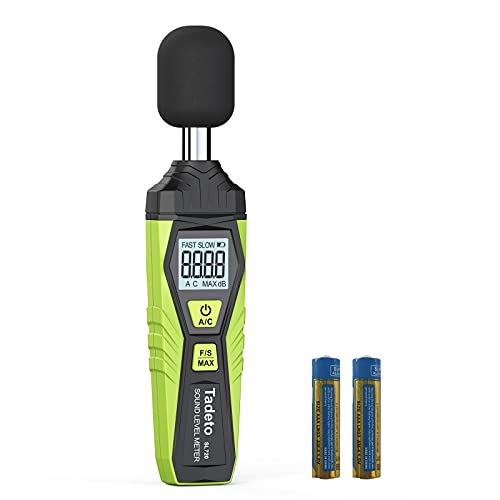
Tadeto · Decibel Meter, Tadeto Digital Sound Level Meter Portable SPL Meter 30dB to 130dB MAX Data Hold with LCD Display Backlight A/C Weighted for Home Factories
View on AmazonPrice and availability are shown on Amazon and can change at any time.
A pocket sound level meter reading 30 dB to 130 dB with a stated accuracy of plus or minus 2.0 dB, A and C weighting, selectable fast and slow response using 0.125 second and 1 second time constants, maximum and data hold, and a four digit backlit screen with 0.1 dB resolution and a low battery icon. The specification is coherent and honestly presented. What decides the purchase is that plus or minus 2.0 dB is a wide band in a quantity where three decibels is a doubling, so this is an instrument for finding and comparing loud places, not for producing numbers anyone else will act on.
A tenth of a decibel on a two decibel instrument
Two figures in the first and fourth bullets sit oddly together. The accuracy is plus or minus 2.0 dB. The resolution is 0.1 dB.
That means the display offers forty steps inside the uncertainty band. The last digit will move as you stand still, and every one of those movements is inside the margin the manufacturer has already told you about. Nothing is wrong with the meter. The mistake is the one the screen invites, which is believing that a figure shown to a tenth is known to a tenth.
In practice this sets a floor on the questions the instrument can answer. Asking whether the workshop is louder than the office is fine, because that difference is usually tens of decibels. Asking whether a new acoustic panel took two decibels off the far wall is not, because a two decibel change is the same size as the uncertainty on each reading. Our explainer on resolution in a digital meter works through why these two specifications keep getting confused.
Why two decibels is larger than it sounds
Decibels compress an enormous range of sound pressures into a short scale, and the compression is logarithmic. That has two consequences worth holding on to.
The first is that adding three decibels doubles the sound energy. A reading of 88 dB carries twice the acoustic energy of 85 dB, and the exposure limits used in occupational hygiene are built around that relationship, which is why an allowed exposure time halves for every few decibels of increase. An uncertainty of plus or minus 2.0 dB therefore spans most of a doubling. A true 84 dB and a true 88 dB can both be displayed as 86 dB by an instrument behaving exactly as specified.
The second is that the recognised instrument classes are tighter than this. The class system for sound level meters defines tolerances at a reference frequency and across the audible band, and the familiar classes allow roughly one decibel and roughly one and a half decibels respectively at that reference point. Plus or minus 2.0 dB is outside both, and no class is claimed anywhere in the listing. Credit where it is due: the figure is published rather than hidden behind the word professional, and a published wide tolerance is far more useful than an unpublished one.
A and C weighting answer different questions about one noise
The second bullet is the strongest part of the listing, because it explains its own feature correctly rather than simply naming it.
Weighting is a filter applied before the level is worked out, and it exists because hearing is not equally sensitive at all frequencies. A weighting discards much of the low frequency content, which makes the resulting figure track how loud a moderate sound seems. It is the weighting used for environmental noise, neighbour complaints and most published limits, which is why the unit is so often written as dBA. See our note on what dBA means for the detail.
C weighting keeps the low end. A compressor, a motor, a bass bin or an impact produces most of its energy below the region A weighting attenuates, so the same noise measures considerably higher on C than on A. The gap between the two readings is itself diagnostic: a large difference tells you the noise is dominated by low frequencies, which changes the remedy from absorption to mass and isolation. Having both on a meter this simple is worth more than the extra digit on the screen.
Fast and slow are time constants, not precision settings
The third bullet describes a fast response using a 0.125 second time constant and a slow response using one second. Neither changes how accurate the meter is. They change how much of the recent past each reading contains.
A short time constant lets the display follow a sound that changes quickly, which is what you want when you are hunting for the moment a machine makes its worst noise. A long one averages over more of the fluctuation and produces a figure steady enough to write down, which is what you want in a space where the level wanders constantly. Choosing the wrong one does not give a wrong answer so much as an unreadable one, either a screen that never settles or a screen too sluggish to catch the peak.
| Specification | Published in the listing |
|---|---|
| Measuring range | 30 dB to 130 dB |
| Accuracy | Plus or minus 2.0 dB |
| Resolution | 0.1 dB |
| Weighting | A and C |
| Response | Fast, 0.125 s time constant; slow, 1 s time constant |
| Display | Four digit LCD, backlit, low battery icon |
| Hold functions | Maximum and data hold |
| Instrument class | Not stated in the listing bullets |
| Frequency range | Not stated in the listing bullets |
| Reference conditions for the accuracy figure | Not stated in the listing bullets |
| Time averaged level function | Not stated in the listing bullets |
| Peak measurement | Not stated in the listing bullets |
| Microphone type and size | Not stated in the listing bullets |
| Calibration adjustment or calibrator | Not stated in the listing bullets |
| Battery type and life | Not stated in the listing bullets |
| Data output or logging | Not stated in the listing bullets |
Nothing here produces an average, and that rules out exposure work
The blank row that matters most is the time averaged level. Every rule written about noise exposure, whether it concerns a shift in a factory or an evening next to a venue, is built on the energy average of a fluctuating level over a defined period rather than on what the needle did at one moment.
This meter offers instantaneous readings, a maximum hold and two response speeds. That combination answers how loud is it now and how loud did it get. It cannot answer how much noise a person received over an hour, because nothing in it integrates. Nor does the listing mention peak measurement, which is the separate quantity used for impulsive noise such as hammering or gunfire where the damage happens faster than any average can register.
None of this is concealed. The listing never claims an average, and the honest reading of it is that this is an indicating meter. The problem only arises when a buyer assumes that a decibel meter and a noise assessment instrument are the same category of thing.
The job this meter is right for
Buy it to find out which machine is the problem, whether a room is tolerable, how much quieter a space becomes when a door is shut, and whether a complaint is about something measurable. For those questions a plus or minus 2.0 dB instrument with both weightings and two response speeds is entirely adequate, and the gap between the A and C readings tells you more about a noise than an instrument this simple has any business revealing.
Do not buy it to document exposure, to support a complaint formally, to verify a planning condition or to check compliance with a stated limit. Those jobs need a named instrument class, a time averaged level and a calibrator, and the listing offers none of the three. The options in our sound level meter guide include instruments that publish a class.
Recommended Tools


Products shown because their documented specifications fit this guide. Price and availability are on Amazon and can change.
Frequently Asked Questions
Can this meter be used for a workplace noise assessment?
No, and nothing in the listing claims it can. Occupational noise rules are built on a time averaged level measured over a shift, usually with a stated instrument class and a field check against an acoustic calibrator before and after the measurement. These bullets describe instantaneous readings with a maximum hold, an accuracy of plus or minus 2.0 dB, and no class, no averaging function and no calibrator. It can tell you that a room is loud and roughly how loud. It cannot produce a figure that will stand up in a dispute or in a compliance file.
What is the difference between A and C weighting?
They are different filters applied before the level is calculated. A weighting rolls off the low frequencies steeply, imitating the reduced sensitivity of hearing to bass at moderate volumes, which is why it is the standard for environmental and community noise. C weighting is close to flat across most of the audible range and keeps the low frequency energy in the figure, which is why it suits machinery, motors, peaks and anything where the rumble is the problem. The second bullet describes exactly this split, and it describes it accurately.
Why does 0.1 dB resolution not mean 0.1 dB accuracy?
Resolution is the smallest change the display is able to show. Accuracy is how far the displayed figure may sit from the real sound pressure level. This meter shows tenths while the stated accuracy is plus or minus 2.0 dB, so the last digit is moving within a band twenty times its own size. The practical consequence is that comparing 72.3 dB in one corner with 72.8 dB in another is reading noise in the instrument, not a difference in the room. Differences smaller than a couple of decibels are not measurable here.
Is 30 dB low enough for a bedroom or a nursery?
It is the very bottom of the range, and the fifth bullet does suggest baby rooms as an application. A quiet bedroom at night sits around the low thirties, which means the measurement happens at the limit of what the instrument can register and inside a plus or minus 2.0 dB band. The reading will tell you whether a room is quiet. It will not resolve the difference between quiet and very quiet, and it cannot show you how far below 30 dB the room actually is.
Does a sound level meter need calibrating?
Yes, because the microphone is the part that ages. Diaphragm sensitivity drifts with time, humidity and handling, and a drifted microphone produces readings that look perfectly stable while being consistently wrong. Instruments intended for assessment work are checked against an acoustic calibrator that produces a known level at a known frequency, and the meter is adjusted to match. These bullets state no calibration function, no calibrator and no recommended check interval, so the only practical option is to compare readings against a meter you trust.
Affiliate disclosure: Akermin earns a commission from qualifying Amazon purchases made through links on this page. Our editorial picks are based on documented specifications and owner feedback, not commissions.