As an Amazon Associate, Akermin earns from qualifying purchases. Product links on this page are affiliate links.

TempPro · TempPro TP50 Digital Hygrometer Indoor Thermometer Room Thermometer | Humidity Meter Humidity Gauge with Temperature Humidity Monitor for House Office Celler Kitchen Greenhouse RV
View on AmazonPrice and availability are shown on Amazon and can change at any time.
Verdict
The TempPro TP50 is a small room thermometer and hygrometer that does three things well: it publishes an accuracy figure, it retains high and low values, and it shows a comfort indicator that anyone can read without knowing what a percentage means. The listing states plus or minus 2 to 3 percent relative humidity and plus or minus 1 F, readings updated every 10 seconds, and a dry, comfort or wet icon. For a bedroom, a greenhouse, a store cupboard, an instrument case or a nursery, that is the right amount of instrument.
Documented Specifications
| Item | Manufacturer listing |
|---|---|
| Humidity accuracy | Plus or minus 2 to 3 percent RH |
| Temperature accuracy | Plus or minus 1 F |
| Refresh | Every 10 seconds |
| Records | High and low temperature and humidity |
| Indicator | Dry, comfort or wet icon |
The listing does not publish measurement ranges, operating limits or a calibration method. Treat it as a comfort instrument rather than a reference.
High and Low Is the Feature That Earns Its Keep
The current humidity in a room is rarely the interesting number. What matters is the range: a bedroom that sits at 50 percent while you are in it and climbs to 70 percent overnight with the door shut has a ventilation problem that a spot reading will never reveal. A cellar that is fine in summer and saturated in winter needs a different response from one that is always damp.
Recording the extremes turns a display into a small investigation. Put the instrument in place, leave it a week, and read the high and low. That single habit answers most household damp questions without any further equipment.
The Comfort Icon Is Not Just Decoration
Most people do not know what 55 percent relative humidity implies, and telling them will not help. A three-state indicator does, because it converts a measurement into an instruction: ventilate, do nothing, or add moisture. If the purpose of putting an instrument in a living space is to change behaviour, the readout everyone can interpret is the one that works.
The underlying guidance is straightforward. Persistently above about 60 percent favours mould growth and dust mites. Persistently below about 30 percent dries out throats, skin and timber. The comfortable band between them is where the icon should sit.
Two to Three Percent, Understood Properly
An uncertainty of 2 to 3 percent relative humidity means a reading of 60 could be anywhere from about 57 to 63. For deciding whether a room is too damp, that is irrelevant. For comparing two rooms, it matters slightly: a difference of 3 percent between two instruments could be entirely measurement error, so treat small differences with suspicion.
If you own several of these and want to compare rooms, put them side by side for an hour first and note how they differ. That offset is the number to subtract when you separate them, and it costs nothing to establish.
Placement Decides the Reading
- Keep it away from windows, radiators and exterior doors, all of which report the ventilation rather than the room.
- Do not put it on an exterior wall, which is colder than the room and reads higher humidity as a result.
- Give it a few hours after moving before trusting a reading, because humidity sensors take time to equilibrate.
- In a greenhouse, shade it. Direct sun produces a temperature reading of the instrument, not of the air.
Strengths
- Publishes accuracy figures, which most instruments at this level do not.
- High and low records turn it into a simple logger.
- Comfort indicator that needs no explanation.
- Ten second refresh, fast enough to watch a change.
Limitations
- No measurement ranges or operating limits published.
- No logging beyond the high and low values.
- No calibration facility, so drift over years cannot be corrected.
- Sensor is in the body, so it cannot measure in a duct or a void.
How It Compares
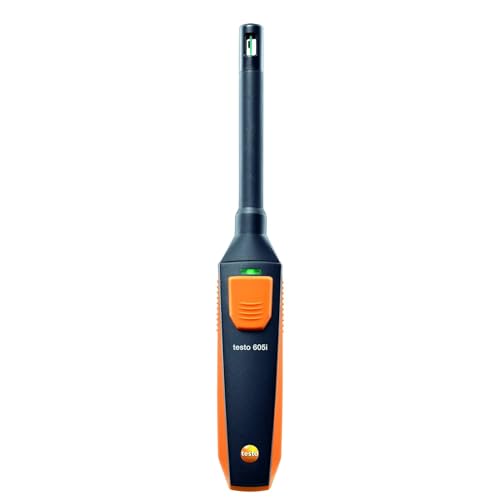
The Testo 405i and the Extech RH300 are professional instruments for taking measurements anywhere, which is a different job. For remote alerting from an unoccupied property, the Temp Stick reports rather than records. The full picture is in TP50 versus the Testo 605i and the hygrometer roundup.
How We Research
All figures come from the manufacturer listing. We did not run laboratory tests and publish no measurements of our own.
Recommended Tools

Products shown because their documented specifications fit this guide. Price and availability are on Amazon and can change.
Frequently Asked Questions
How accurate is it?
The listing states plus or minus 2 to 3 percent relative humidity and plus or minus 1 F. That is reasonable for a room instrument and is enough to distinguish a damp room from a comfortable one, though not enough for calibration or laboratory use.
How often does it update?
Every 10 seconds, per the listing. That is fast enough to see a bathroom rise after a shower and slow enough not to flicker constantly.
Does it record highs and lows?
Yes. The listing states it displays high and low temperature and humidity, which is the single most useful feature on a cheap hygrometer because it tells you what happened while you were not watching.
Can I use it in a greenhouse?
The listing names greenhouses as a use case for fluctuating conditions. Keep it out of direct sun and away from irrigation spray, since both distort readings and neither is good for the electronics.
Affiliate disclosure: Akermin earns a commission from qualifying Amazon purchases made through links on this page. Our editorial picks are based on documented specifications and owner feedback, not commissions.