As an Amazon Associate, Akermin earns from qualifying purchases. Product links on this page are affiliate links.

TOPTES · Natural Gas Detector, TopTes PT177 Gas Leak Detector with Audible & Visual Alarm, Portable Gas Sniffer to Locate Combustible Leak Sources Like Methane, Propane for Home (Includes Battery x2)-Orange
View on AmazonPrice and availability are shown on Amazon and can change at any time.
Verdict
The TopTes PT177 is a pocket combustible gas sniffer for homeowners and technicians who want something small and immediate. The listing states detection of LPG, methane, ethane, propane, butane, natural gas and coal gas, a 30 second warm-up and auto-calibration in a clean gas-free environment, alarm within 0.5 to 3 seconds, five red LEDs and a 75 decibel audible alarm that intensify as concentration increases, a pocket clip, a storage bag and two batteries included. It is a locating tool, not a monitor, and the listing is unusually clear about how to use it correctly.
Documented Specifications
| Item | Manufacturer listing |
|---|---|
| Gases | LPG, methane, ethane, propane, butane, natural gas, coal gas |
| Warm-up | 30 seconds in a clean, gas-free environment |
| Alarm response | 0.5 to 3 seconds |
| Indication | Five red LEDs and a 75 dB alarm, intensifying with concentration |
| Carry | Pocket clip, storage bag |
| Power | Two batteries included |
The listing does not publish a detection range in ppm or a sensitivity figure. For a stated range, the PT520A+ publishes 50 to 10,000 ppm.
The Warm-Up Instruction Deserves Its Own Section
This listing states the requirement twice, and it is the single most important thing to understand about any combustible gas sniffer. During warm-up the sensor establishes what it considers clean air. Everything it reports afterwards is relative to that baseline.
Switch the detector on inside a cabinet with a leaking fitting, and the detector concludes that the cabinet’s atmosphere is normal. It will then sit quietly next to the leak while you conclude there is not one. The correct procedure is to switch on outdoors or in a room you are confident about, wait the full 30 seconds, and only then approach the suspect area.
The same principle explains a confusing behaviour people report: the alarm sounds strongly when you first arrive at a fitting and then quietens. Some detectors re-baseline continuously, so a steady concentration becomes the new normal. Move away into clean air and return to confirm.
Pocket Format and Its Limits
A detector small enough to keep in a drawer is a detector that exists when you need it. The clip and bag make it easy to carry, and two included batteries mean it works on arrival. The limitation is reach: a rigid pocket unit only gets where your hand gets, which in a real house excludes the connector behind the range, the union above the water heater and the valve inside the furnace cabinet. If your fittings are in those places, a gooseneck model is the right purchase.
It Does Not Detect Carbon Monoxide
This is the most dangerous misunderstanding in the category and it is worth stating plainly. A combustible gas sniffer detects unburned fuel: the gas that escapes from a pipe or a fitting. Carbon monoxide is a product of incomplete combustion inside an appliance, it requires a different sensor, and a gas sniffer will not respond to it. A house needs both kinds of protection, and they are not substitutes at any price. See gas leak detector versus carbon monoxide detector.
Using It Properly
- Warm up in clean air, every time.
- Sweep slowly along joints, roughly an inch per second, with the tip close to the fitting.
- For natural gas work upward, since methane rises. For propane work downward, since it sinks.
- Confirm any alarm with soapy water before tightening or cutting anything.
- If you can smell gas strongly, leave and call the utility. Do not go hunting.
Strengths
- Clear warm-up instruction stated on the listing itself.
- Fast alarm with five stage LED indication.
- Pocket clip, bag and batteries supplied.
- Broad list of combustible gases named.
Limitations
- No ppm range or sensitivity figure published.
- Fixed probe, so awkward fittings are out of reach.
- No carbon monoxide detection.
- Not a continuous monitor for a property.
How It Compares
The PT520A+ adds a 17 inch gooseneck, a published 50 to 10,000 ppm range and rechargeable operation. The Klein ET120 offers two sensitivity modes for closing in on a leak. Our ranking is in the handheld gas leak detector roundup.
How We Research
All figures come from the manufacturer listing. We did not run laboratory tests and publish no measurements of our own.
Recommended Tools
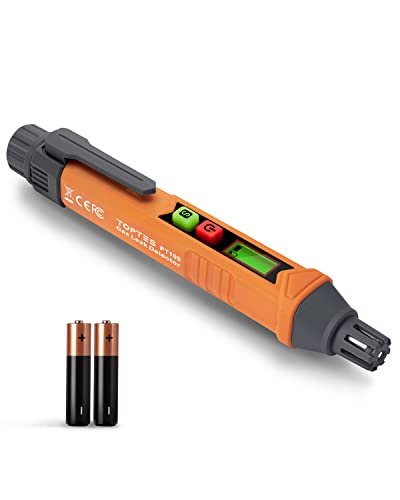

Products shown because their documented specifications fit this guide. Price and availability are on Amazon and can change.
Frequently Asked Questions
Why does it need warming up in clean air?
Because the detector sets its baseline during warm-up. The listing states it must be powered on and warmed up for 30 seconds in a clean, gas-free environment. Start it inside a cupboard that already smells of gas and it will treat that concentration as normal and stay silent.
Which gases does it detect?
The listing names LPG, methane, ethane, propane, butane, natural gas and coal gas among combustible gases. It does not detect carbon monoxide.
How fast does it alarm?
The listing states gas detection and alarm within 0.5 to 3 seconds after the 30 second auto-calibration on power up.
Is it a replacement for a fixed alarm?
No. It is a handheld locating tool that is switched off most of the time. A property with gas appliances still needs a fixed alarm watching the room continuously.
Affiliate disclosure: Akermin earns a commission from qualifying Amazon purchases made through links on this page. Our editorial picks are based on documented specifications and owner feedback, not commissions.