As an Amazon Associate, Akermin earns from qualifying purchases. Product links on this page are affiliate links.
Choose a wired probe when the measurement point is hostile, enclosed, or far from where a person can stand: inside a fridge, behind a duct, in a vial, under a lid. Choose an all-in-one housing when the air around the device is the thing you want to know about, and when you want the simplest possible install. The Elitech GSP-6 is the clearest example of the probe form in this set, with a separable probe and a magnet for mounting on a fridge. The SAF Aranet4, the GoveeLife 3-Pack and the Govee H5074 are all-in-one units where the sensor sits inside the same case as the radio and the battery. Neither form is more accurate by nature; the accuracy comes from the sensing element and its calibration, not from whether there is a cable.
Where the sensing element sits decides what you can measure
Every environmental instrument has a sensing element, the part that actually changes with the thing you are measuring. In an all-in-one housing, that element sits inside the same plastic case as the battery, the radio, and the display. In a wired probe, the element sits at the end of a cable, and only the cable enters the place you are measuring.
That single difference drives most of the practical consequences. An all-in-one unit measures the air around its own case. If you hang it on a wall in a room, it reports the conditions at that wall. If you put it inside a refrigerator, the radio has to work through a metal door, and the battery has to survive the cold. A wired probe lets you put the element inside the fridge and keep the electronics outside, where the radio and the battery are comfortable.
The Elitech GSP-6 is built around this idea. The listing describes a separable probe and a built-in magnet for mounting on a refrigerator, and it says the separable probe eliminates the need for precooling after each device movement. That last phrase is the mechanism in plain language: if the sensing element is on a cable, you can move the logger without waiting for the whole unit to come back to room temperature before it reads correctly.
The all-in-one units in this set are designed for the opposite case. The SAF Aranet4 pairs an Aranet4 CO2 monitor with an Aranet2 humidity and temperature sensor, both wireless and battery powered, with the listing stating up to five years of battery life for the Aranet4. The GoveeLife 3-Pack is a WiFi gateway with a three-pack of mini sensors, and the Govee H5074 is a single Bluetooth sensor with twenty days of on-board storage. In all three, the sensor lives in the case, and the case is meant to sit in the room you are monitoring.
The cable is a thermal path, and that cuts both ways
A cable is not electrically or thermally neutral. Metal conductors carry heat along their length, so a probe cable run from a warm room into a cold fridge will conduct some warmth to the sensing element. The thicker the conductors and the shorter the run, the smaller the effect, but it never goes to zero. This is why probe placement matters as much as probe choice: you want the sensing element far enough inside the measured space that the cable’s contribution is small compared with the condition you are measuring.
The same cable that conducts heat can also act as an antenna. Long probe leads pick up electrical noise, and that noise can couple into a high-impedance sensing element. Manufacturers handle this with shielding, twisted pairs, or by putting the signal conditioning close to the element. The listing for the Elitech GSP-6 does not publish cable length, conductor gauge, or shielding details, so if your installation has heavy electrical machinery nearby, that is a question for the manufacturer rather than something you can read off the page.
For an all-in-one housing, the case itself is the thermal path. A plastic case insulates the element from rapid air changes, which slows the response but also smooths out short fluctuations. That is often what you want in a room monitor: you care about the trend over minutes, not the gust from a door. It is usually not what you want when you are checking whether a fridge door was left open, because the case delays the reading and the alarm fires later than the condition began.
Response time is not stated in the listing bullets for any of SAF Aranet4 to the Elitech GSP-6. The GoveeLife 3-Pack and the Govee H5074 both state that data refreshes every two seconds, which is the reporting interval, not the sensor’s physical response time. Those are different numbers, and the listing does not publish the second one.
What each form can and cannot be asked to do
The table below sets out the practical differences. It is a comparison of form factors, not of the four products against each other, and every cell that depends on a published figure is marked where the listing is silent.
| Question | Wired probe (the Elitech GSP-6 form) | All-in-one housing (the SAF Aranet4, the GoveeLife 3-Pack, the Govee H5074 form) |
|---|---|---|
| Where is the sensing element? | At the end of a separable cable, per the Elitech GSP-6 listing | Inside the same case as the radio and battery |
| Can the element go inside a closed metal enclosure? | Yes, the cable passes through a door seal or port | Only if the radio can still reach its receiver; the listing does not publish range through metal |
| Radio and battery environment | Stays outside the measured space | Must survive the measured space |
| Response to a step change | Faster, because the element is directly exposed | Slower, because the case buffers the element; response time not stated in the listing bullets |
| Mounting | Magnet on the logger body, probe placed separately | Wall or shelf placement of the whole unit |
| Published accuracy | Not stated in the listing bullets | GoveeLife 3-Pack and the Govee H5074 state plus or minus 0.3 C and plus or minus 3 percent RH; the SAF Aranet4 does not publish figures in the supplied bullets |
| Published battery life | Not stated in the listing bullets | SAF Aranet4 states up to five years for the Aranet4; the GoveeLife 3-Pack states two years; the Govee H5074 does not state |
| Data export | Not stated in the listing bullets | Govee H5074 states twenty days on board and two years exportable as CSV |
The table makes the trade visible. The probe form buys placement freedom at the cost of a cable and a second thing to install. The all-in-one form buys simplicity at the cost of measuring the air around the case rather than the air at the point of interest.
The common mistake: treating the housing as a shelter
Buyers often assume an all-in-one housing protects the sensor, so it must be the rugged choice. Sometimes that is true, but a sealed case also traps the air the sensor is trying to measure. If the case is not ventilated, the sensor reads the air inside the case, which lags the room and can be warmed by the electronics. If the case is ventilated, it is no longer a shelter from dust or splashes.
The honest answer is that the housing is a compromise, and the listing rarely tells you which side of it the manufacturer chose. None of SAF Aranet4 to the Elitech GSP-6 publishes a ventilation or ingress rating in the supplied bullets. If your environment has dust, steam, or washdown, that is a question to settle before you buy, not after.
The second common mistake is reading the reporting interval as accuracy. The GoveeLife 3-Pack and the Govee H5074 both state a two second refresh, and the GoveeLife 3-Pack states plus or minus 0.3 C and plus or minus 3 percent RH. A fast refresh with a loose accuracy gives you a rapidly updated wrong number. The accuracy figure is the one that determines whether the instrument is fit for the job; the refresh rate only determines how often you see the error.
A third mistake is assuming a probe is automatically more accurate. It is not. Accuracy comes from the sensing element and its calibration. A well calibrated all-in-one unit will beat a poorly calibrated probe every time. The probe’s advantage is placement, not precision.
Where the probe form stops being the right answer
A wired probe is the wrong tool when the thing you want to know is the general condition of a room. If you are tracking CO2 in a classroom to decide when to open the windows, you want the sensor where people breathe, which is the room itself. The SAF Aranet4 is built for that job, with the listing stating NDIR technology for the CO2 measurement and a wireless design with up to five years of battery life. A probe on a cable adds nothing here, because there is no hostile space to reach into.
The probe form is also the wrong answer when you need many measurement points and few cables. The GoveeLife 3-Pack states that the gateway pairs up to ten humidity and temperature sensors over WiFi, and that it supports 2.4 GHz networks only. That is a room-scale architecture, not a probe architecture. If you want to know the conditions in ten rooms, ten all-in-one sensors on one gateway is simpler than ten probes run back to one logger.
Where the probe form earns its place is the enclosed or regulated space. The Elitech GSP-6’s listing states that it is designed to meet CDC and VFC requirements and FDA 21 CFR Part 11 compliance for pharmaceutical and vaccine storage monitoring. Those are documentation and access-control requirements as much as measurement requirements, and they belong to the logger, not to the probe. But the probe is what lets the same logger sit outside the refrigerator while its element sits inside, which is how the installation stays practical.
One more limit applies to both forms. A logger is not an alarm unless the listing says it alarms. The GoveeLife 3-Pack states a remote alarm function with app and email notification, and the Govee H5074 states app monitoring but does not state an alarm in the supplied bullets. If your job depends on being told when a fridge warms up, check that specific function rather than assuming it from the word logger.
The decision in one line
If the measurement point is somewhere a person cannot comfortably stand, or is enclosed, or is regulated and documented, use a wired probe and keep the electronics outside. If the room itself is the subject, use an all-in-one housing and spend your effort on placement and calibration instead of cable routing. The four products here show both forms: the Elitech GSP-6 dual probe logger for the enclosed case, and the Aranet4 bundle, the GoveeLife WiFi hygrometer kit and the Govee Bluetooth hygrometer for the room case.
Frequently Asked Questions
Is a wired probe more accurate than an all-in-one sensor?
No. Accuracy comes from the sensing element and its calibration. A probe's advantage is that you can put the element where the condition is, which removes placement error, but a well calibrated all-in-one unit can still be more accurate than a poorly calibrated probe. The Elitech GSP-6 does not publish an accuracy figure in the listing bullets, so you cannot compare it to the GoveeLife 3-Pack or the Govee H5074 on that basis from the page alone.
Can I put an all-in-one sensor inside a refrigerator?
You can, but the radio has to reach its receiver through the door, and the battery has to tolerate the cold. The listing does not publish range through metal or the operating temperature range for the SAF Aranet4, the GoveeLife 3-Pack or the Govee H5074. If the fridge is metal and the receiver is in another room, the probe form is the safer choice, which is exactly what the Elitech GSP-6 is built for.
Why does the refresh rate matter less than the accuracy?
The refresh rate tells you how often the display or app updates. The accuracy tells you how far each of those updates can be from the truth. A two second refresh with plus or minus 3 percent RH gives you a fast stream of numbers that can each be off by three percentage points. For most room monitoring the accuracy is the number that decides whether the instrument is fit for the job.
Does a data logger count as an alarm?
Only if the listing states an alarm function. The GoveeLife 3-Pack states a remote alarm with app and email notification when preset limits are crossed. The Govee H5074 states app monitoring and data storage but does not state an alarm in the supplied bullets. The SAF Aranet4 and the Elitech GSP-6 do not state an alarm in the supplied bullets either. If your procedure depends on being notified, confirm that function before you rely on the device.
What does the probe cable do to the reading?
It conducts heat along its length, so a cable run from a warm room into a cold space carries some warmth to the sensing element. It can also pick up electrical noise. Both effects are managed by placement and by the manufacturer's shielding, and the listing for the Elitech GSP-6 does not publish cable length or shielding details. Keep the element well inside the measured space and ask the manufacturer about shielding if the installation is electrically noisy.
Can I mix probe and all-in-one units in one monitoring plan?
Yes, and it is often the right answer. Use all-in-one units for the rooms people occupy, where the room itself is the subject, and use a probe logger for the enclosed or regulated spaces. The two forms answer different questions, and a plan that needs both questions answered needs both forms.
Related Guides
Handheld Meter vs Fixed Installed Monitor: Which Do You Actually Need?
This page explains the engineering difference between spot measurement and continuous monitoring, and how that difference decides which instrument fits the job.
Read More→Single point reading against a logged average: which number should you trust?
This page explains when a single point reading is the honest answer, when an average is, and how to tell which your instrument is actually giving you.
Read More→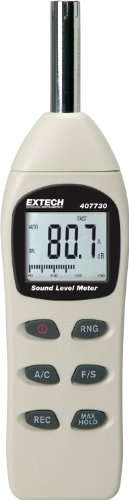
Extech 407730-NIST Sound Level Meter Review: Who It Is For, and Who Should Walk Away
This review explains what the Extech 407730-NIST measures, what its specifications mean in practice, and which buyers should choose a different instrument.
Read More→