As an Amazon Associate, Akermin earns from qualifying purchases. Product links on this page are affiliate links.
For most PV site work, P1 is the pick because it is the only listing here that pairs a 1400 W/m2 mono-crystalline sensor with a compass, an inclination sensor and a choice of built-in or external temperature probe, which is the combination you need to document orientation and panel temperature alongside irradiance. P3 is the value alternative if you want tilt and compass data with a faster 300 ms sample rate, and P2 is the one to consider if you need to store up to 99 readings on the instrument itself for a rooftop audit. P4 is the budget entry with the widest stated range, but its listing publishes no orientation or temperature function.
What the four listings actually publish, side by side
The table below draws only on what each manufacturer listing states. Where a listing is silent, the cell says so. This matters because a missing figure is not the same as a low figure; it means the buyer has to ask.
| Feature | P1 | P2 | P3 | P4 |
|---|---|---|---|---|
| Sensor type | Mono-crystalline solar sensor | Industrial-grade photodiode (made in Japan) | Cosine-corrected silicon photodiode | Not stated |
| Irradiance range | Up to 1400 W/m2 | Not stated | Not stated | 0 to 1999 W/m2 |
| Sample or refresh rate | Not stated | Not stated | 300 ms | 2.5 seconds |
| Temperature measurement | Built-in sensor or external suction probe | Not stated | Yes, shown with irradiance | Not stated |
| Tilt and compass | Integrated compass and inclination sensor | Not stated | Tilt -90 to 90 degrees, compass azimuth | Not stated |
| Data logging | Not stated | 99 points internal memory | Not stated | Not stated |
| Wireless | Model name implies Bluetooth, listing does not describe the app | Not stated | Not stated | Not stated |
P1 is the only listing that names a wireless capability in the model designation, and even there the listing bullets do not describe the companion app or the transfer range. That is a gap worth confirming before purchase. P2 is the only listing that states a logging capacity. P3 is the only listing that states a sample rate below one second.
Why the sensor type decides what your reading means
Every meter here measures light, but they do not all measure it the same way. P1 uses a mono-crystalline solar sensor, which is a small solar cell. A cell responds to the same spectrum a panel does, so the reading tracks what the array actually sees. P3 uses a cosine-corrected silicon photodiode, which means the sensor is shaped or filtered so that light arriving at a shallow angle is counted correctly. Without cosine correction, a reading taken at a low sun angle reads low, and you would wrongly blame the array.
P2 uses an industrial-grade photodiode made in Japan. The listing does not state whether it is cosine corrected, and it does not state the spectral response. For flat rooftop work near midday this may not matter much. For a tilted array in winter, it matters a great deal. If you plan to compare readings across seasons or across orientations, ask the supplier for the cosine response curve before you buy. The general principle is covered in what solar irradiance actually measures.
P4 states no sensor type at all. It publishes a range and an accuracy figure of plus or minus 10 W/m2 or plus or minus 5 percent, which is a useful number, but without knowing the sensor you cannot judge how that accuracy behaves off-axis. Treat the stated accuracy as valid for normal incidence unless told otherwise.
Range, resolution and the number that is not on the listing
P4 publishes the widest range, 0 to 1999 W/m2, with a manual choice between a 199.9 scale and a 1999 scale. The low scale gives finer resolution in shade or indoor light; the high scale covers full sun. That dual-scale approach is genuinely useful for shade mapping, where you are looking at small differences.
P1 publishes a ceiling of 1400 W/m2. That is above the clear-sky maximum at sea level, so it will not clip in normal use. P2 and P3 publish no range at all. For P2 that is a significant omission, because the listing leans on the phrase high precision without saying over what span. For P3 the omission is less serious because the sensor type is stated, but you still cannot tell whether the instrument will saturate in desert conditions.
None of the four listings publishes a resolution figure in W/m2. Resolution is the smallest change the display can show, and it is not the same as accuracy. A meter can be accurate to 5 percent and still have a coarse display. If you are mapping partial shading, resolution is the specification that decides whether you can see the difference between one string and the next. Ask for it. The trade-off between accuracy and resolution is discussed in more depth in how to choose a solar irradiance meter.
The four irradiance meters compared
Fluke IRR2-BT
The only listing here that combines irradiance, orientation, inclination and a choice of temperature measurement in one handheld.
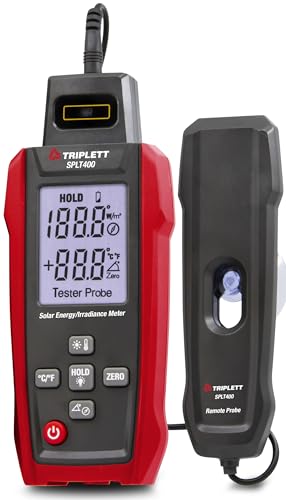
Triplett SPLT400
Tilt and compass readings shown simultaneously with irradiance and temperature, with a 300 ms sample rate.
AquaHorti AH-SOL
Internal memory for 99 measurement points, which suits spatial audits across a large array.
TENMARS Solar Power Meter
The widest stated range at 0 to 1999 W/m2, with dual units and MAX/MIN tracking.
Temperature, tilt and compass: the site data that travels with the light reading
Irradiance alone tells you how much energy is arriving. It does not tell you whether the array is hot, which way it faces, or how far it is tilted. Those three facts determine how much of that energy the panel can convert.
P1 addresses all three. It offers a built-in temperature sensor or an external suction-mount probe, so you can measure ambient air and panel back-of-module temperature separately. It also carries an integrated compass and inclination sensor, so orientation and tilt are recorded with the same instrument. For a commissioning report, that is the difference between a number and a defensible measurement.
P3 covers tilt and compass with a stated range of minus 90 to plus 90 degrees and a compass azimuth function, and it shows irradiance and temperature or tilt and compass simultaneously. The simultaneous display is a small thing that saves a lot of button pressing on a roof. The listing does not say whether the temperature reading is ambient or contact, so confirm that before relying on it for module temperature.
P2 and P4 publish no temperature, tilt or compass function. If your work is limited to comparing one roof section against another, that is fine. If you are writing a performance report, you will be missing the inputs that explain the result. More on pairing light and temperature readings is in solar irradiance meters with temperature probes.
Logging, sampling and what wireless actually changes
P2 stores up to 99 readings internally. That is a spatial audit tool: walk the array, take a reading at each row or each string, and review the spread afterwards. The listing describes this as helping analyse spatial variations across rooftops, fields or large PV arrays, which is exactly the right use. It also has a data hold function, which freezes the display so you can write the number down.
P3 samples every 300 ms. Fast sampling matters when the light is changing, for example when thin cloud is moving, because a slow meter averages across the change and hides the peak. P4 refreshes every 2.5 seconds, which is slow for that purpose but adequate for a stable sky.
Wireless transfer is the feature the page title promises, and it is where the listings are thinnest. P1 carries a model designation that implies Bluetooth, but the bullets do not describe an app, a transfer range, or what data leaves the instrument. None of the other three listings mentions wireless at all. So the honest position is this: if wireless logging is the reason you are looking at this category, P1 is the only candidate whose name suggests it, and you should confirm the app and the data format with the supplier before buying. If you simply need to record readings, P2’s internal memory does that without any wireless link.
Where an irradiance meter stops being the right instrument
An irradiance meter measures the sun. It does not measure the array’s electrical output, and it cannot tell you whether a low reading is caused by shading, soiling, a failing string or a failing inverter. To separate those causes you need current and voltage measurements alongside the light reading. A clamp meter rated for DC is the usual companion, and the differences between them are set out in solar clamp meters.
None of the four meters here is an alarm. None of them will warn you if irradiance drops while you are not looking. If you need continuous monitoring of a site, you need a fixed sensor and a logger, not a handheld. These handhelds are for spot checks, commissioning, and fault-finding visits.
Finally, none of these is a substitute for a pyranometer in a meteorological installation. A pyranometer is a calibrated reference instrument with a documented response curve and a defined calibration interval. The handhelds here are working tools for people who need a number on site, quickly, and who understand that the number carries the uncertainty the listing states, and no less.
Recommended Tools



Products shown because their documented specifications fit this guide. Price and availability are on Amazon and can change.
Frequently Asked Questions
Do I need a wireless irradiance meter, or will a plain handheld do?
Only P1's listing implies wireless capability through its model designation, and even that listing does not describe the app or the transfer range. If you need to move readings into a report without typing them, confirm the wireless details with the supplier first. P2's internal memory for 99 points gives you a record without any wireless link, which may be enough.
What is the difference between a solar sensor and a photodiode in these meters?
P1 uses a mono-crystalline solar sensor, which is effectively a small solar cell and responds to the same light spectrum a panel does. P2 and P3 use photodiodes, with P3 specifying cosine correction. Cosine correction means the sensor counts light arriving at shallow angles correctly, which matters for tilted arrays and low sun. P2's listing does not state whether its photodiode is cosine corrected.
Which of these can measure panel temperature as well as irradiance?
P1 is the clearest, offering a built-in temperature sensor or an external suction-mount probe for ambient and panel temperature. P3 shows temperature alongside irradiance but the listing does not say whether the reading is ambient or contact. P2 and P4 publish no temperature function.
Is a 1400 W/m2 ceiling enough, or do I need the 1999 W/m2 range?
Clear-sky irradiance at sea level does not reach 1400 W/m2, so P1's stated ceiling will not clip in normal use. P4's 1999 W/m2 range is wider, and its manual 199.9 scale gives finer resolution in shade or indoor light. If you work at high altitude or need the low scale for shade mapping, P4's range is the more flexible of the two.
Can I use one of these to prove a panel is faulty?
No. An irradiance meter tells you how much sun is arriving, not how much power the panel is producing. To prove a fault you need to compare the light reading against the array's current and voltage under the same conditions. That requires a DC clamp meter as well. None of the four meters here is an alarm or a continuous monitor.
Why do the listings not publish resolution or calibration intervals?
None of the four listings publishes a resolution figure in W/m2, and none states a calibration interval. Resolution is the smallest change the display can show, and it decides whether you can see small differences between strings. Calibration interval decides how long the stated accuracy can be trusted. Both are worth asking the supplier for directly, because a missing figure is not the same as a good one.
Affiliate disclosure: Akermin earns a commission from qualifying Amazon purchases made through links on this page. Our editorial picks are based on documented specifications and owner feedback, not commissions.
Related Guides

UNI-T UT503PV Review: A DC 1000 V Headline on a CAT III 600 V Body
A solar insulation resistance tester that works on energised PV strings up to DC 1000 V, with test voltages of 125, 250, 500 and 1000 V, a range to 4000 megohms, automatic discharge, 1000 stored result sets and USB or Bluetooth transfer.
Read More→
ANCEL BA101 Review: The Exclusion List Is the Most Useful Bullet
A 12 volt battery, cranking and charging system tester covering 100 to 2000 CCA that reports state of health, state of charge, voltage, current and CCA, drawing its own power from the battery under test.
Read More→
Tenmars Solar Power Meter Review: One Accuracy Figure, Two Very Different Jobs
A handheld solar irradiance meter reading 0 to 1999 watts per square metre or 0 to 634 BTU per square foot per hour, with a selectable 199.9 or 1999 scale, maximum and minimum tracking, data hold and manual zeroing.
Read More→