As an Amazon Associate, Akermin earns from qualifying purchases. Product links on this page are affiliate links.
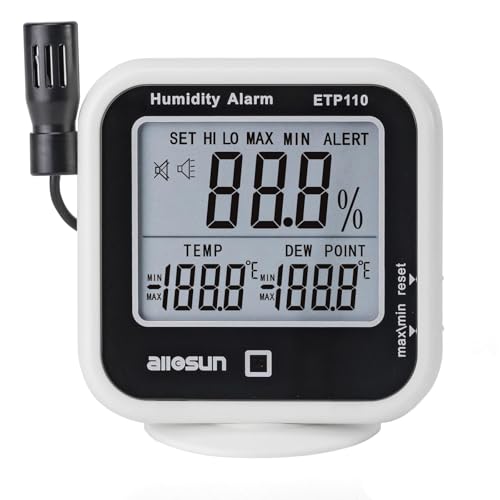
allsun · ALLOSUN Digital Thermometer Hygrometer Indoor Humidity Greenhouse Temperature Monitor Alarm Long Probe Gauge Dew-Point Meter with LCD Display
View on AmazonPrice and availability are shown on Amazon and can change at any time.
A battery powered panel style instrument showing temperature, relative humidity and dew point, with a humidity alarm whose limits you set and which can be switched off, a temperature and humidity sensor that mounts on the side of the case or extends on a lead of about 50 cm, maximum and minimum memory, Fahrenheit and Celsius switching, a large LCD and a wall or desk mount. The sensor lead is the design that distinguishes it. No measuring span and no tolerance appears anywhere in the five bullets.
Half a metre of lead is the whole design
Strip the bullets back and one decision explains the product: the temperature and humidity sensor can either clip to the left side of the case or hang away from it on a lead roughly 50 cm long.
That sounds minor and it is not. A combined display and sensor in one housing has two problems, and both are physics rather than build quality. The housing generates a small amount of its own heat through the display and the electronics, which lifts the sensor slightly above true air temperature. And the housing has to sit on something. Screw it to a wall and the sensor sits inside the boundary layer of air clinging to that wall, which in winter on an external wall is distinctly cooler and more humid than the room, and in summer against a sunlit surface is the reverse.
So a wall mounted one piece hygrometer reports a blend of the room and the wall, and never tells you the proportions. Putting the sensing element on a lead resolves it. The display goes where a person can read it and the sensor goes into the air whose condition you actually want.
The reach sets the limits of that idea honestly. Fifty centimetres gets the sensor clear of the case, clear of the mounting surface, down into a plant canopy, into the middle of a shelf or up away from a floor. It does not reach another room, it does not reach into a sealed cabinet from outside, and it does not reach the roof space from the landing. This is a one room instrument with a sensor you can place properly, which is a real improvement on most of the category and a long way short of a remote probe. Our note on why sensor placement changes your measurements covers how much a short move can shift a reading.
A hygrometer with no span and no tolerance
For an instrument whose only job is to produce two numbers, the specification is remarkably quiet about them.
| Figure | Published in the bullets |
|---|---|
| Quantities shown | Temperature, relative humidity, dew point |
| Temperature units | Fahrenheit and Celsius, switchable |
| Sensor arrangement | Side mounted or extended on a lead |
| Lead length | About 1.64 feet, 50 cm |
| Alarm | Humidity, limits user set, can be disabled, LED indication |
| Memory | Maximum and minimum for temperature and humidity |
| Mounting | Wall or flat surface |
| Power | Two AAA cells, not supplied |
| Humidity measuring span | Not stated in the listing bullets |
| Humidity tolerance | Not stated in the listing bullets |
| Temperature measuring span | Not stated in the listing bullets |
| Temperature tolerance | Not stated in the listing bullets |
| Smallest increment on either reading | Not stated in the listing bullets |
| Dew point tolerance | Not stated in the listing bullets |
| Sensing technology | Not stated in the listing bullets |
| Settling time after a change | Not stated in the listing bullets |
| Alarm limit span | Not stated in the listing bullets |
| Whether the sensor is replaceable | Not stated in the listing bullets |
The blank that does the most damage is the humidity tolerance, and the reason is specific. Capacitive humidity sensors of this kind are normally characterised over a middle portion of the scale and allowed a wider error at the ends, because the physics of a thin polymer film gets awkward when it is nearly dry and worse when it is nearly saturated. Above roughly 85 percent relative humidity is where mould growth, condensation risk and damp investigations all live, and it is the region where a sensor of this grade is least dependable and least often specified.
An instrument with no stated tolerance at all cannot be excluded from that pattern or confirmed as an exception. It can tell you that a room is drier than it was yesterday, which is a comparison against itself and perfectly valid. It cannot tell you that a space is at 78 rather than 85 in any way you could defend. Our guide to digital hygrometers compares what the better specified units in this part of the category actually publish.
Dew point inherits the errors of both inputs
Dew point is the most useful of the three readings and the least robust, because it is not measured.
It is the temperature at which air of the sampled temperature and humidity would reach saturation, and it follows from those two quantities by a fixed relationship. That makes it immediately practical: compare the dew point with the temperature of a cold surface and you know whether water will form there. Window reveals, cold water pipes, uninsulated lintels and the inside face of an external wall are all decided by that comparison rather than by relative humidity alone.
What follows mathematically is that the dew point can be no better than the two readings behind it, and in practice it is worse, because both errors feed into it. At ordinary room temperature a humidity reading a few points high moves the dew point up by over a degree, and a degree is frequently the entire margin in a condensation assessment. A surface at 11 and a dew point at 10 is dry; the same surface with a dew point at 12 is wet.
So the dew point here is a good tool for seeing which of two surfaces is at greater risk, and a weak one for declaring a surface safe. That distinction is the practical consequence of an unpublished tolerance.
A memory is not a record
The fourth bullet offers data memory of maximum and minimum temperature and humidity values. The word data is doing some work there.
Maximum and minimum are extremes without context. They tell you a level was touched at some point since the memory was last cleared, and nothing else. Not when. Not for how long. Not whether it happened once in a heatwave or every night for a fortnight.
For most of the applications the first bullet names, that gap is the difference between useful and decorative. Damage to paper, timber, a stringed instrument, a cigar or a cork is a function of time spent outside a band, not of the worst instant. A humidity peak of 80 for ten minutes while a kettle boiled is irrelevant. Eight hours a night at 72 is a mould problem. A maximum of 80 is the only thing this instrument would show you in either case, and it would show the same figure for both.
That is not a defect, it is the boundary of the product class, and it is worth being clear about before buying for a collection. Anyone who needs to demonstrate conditions over time, to an insurer, a conservator or themselves, needs an interval, a timestamp and an export, which is a logger. Our roundup of humidity data loggers for museums covers that end.
The alarm covers humidity, and signals visually
The second bullet describes a humidity alarm that can be turned on or off, with limits set to suit the application, and an LED alarm.
The settable limits are the right design. A fixed threshold is useless across the range of jobs the bullets name, because a greenhouse, a warehouse and an instrument case all want different bands. Being able to disable the alarm matters too, since an instrument that cannot be silenced ends up in a drawer.
Two things are missing from that picture, and both narrow the use. There is no description of a temperature alarm, so a cold snap in a greenhouse or a hot afternoon in a store room passes without comment. And the alert is described only as an LED, with no mention of an audible sounder, which means it reaches a person who happens to be looking at the instrument. In an occupied workshop that is adequate. In an unattended space it is an alarm with nobody to alarm.
Worth crediting in the same breath: the fifth bullet states plainly that the two AAA cells are not provided by the seller. It is a small disclosure and an unusual one, and it saves somebody an evening.
Where it belongs, and where it will quietly let you down
This fits a space you are in regularly and want to understand better: a greenhouse, a workshop, a store room, a growing area, a basement you are drying out. The settable alarm band, the maximum and minimum memory, the dew point readout and above all the ability to put the sensor in the air rather than against the wall make it a far more honest instrument than a sealed desk hygrometer, and all that honesty asks of you is that you run a short lead.
It will let you down anywhere a figure has to be defended or anywhere nobody is watching. No published tolerance means a reading cannot be quoted to a landlord, a surveyor or an insurer. No logging means conditions over time cannot be evidenced. A visual only alarm means an overnight excursion in an empty room goes unnoticed. If your question is whether a space is getting better or worse while you work on it, this answers it well. If your question is whether conditions stayed within a band all week, it cannot answer at all. Give the sensor a few minutes to settle whenever you move it, and keep it in free air rather than against a surface, and it will do the job it is good at honestly.
Recommended Tools
ALLOSUN Digital Thermometer Hygrometer Indoor Humidity Greenhouse Temperature Monitor Alarm
View on Amazon
Products shown because their documented specifications fit this guide. Price and availability are on Amazon and can change.
Frequently Asked Questions
What does the 50 cm sensor lead actually achieve?
It separates the sensing element from the body of the instrument and from whatever the instrument is mounted on. A display housing warms itself slightly through its own electronics, and a wall is a thermal mass at a different temperature from the air a metre away from it, so a one piece unit screwed to a wall partly reports the wall. Putting the sensor on a lead lets it sit in the air you care about while the display stays where you can read it. Half a metre is enough to clear the box and the surface. It is not enough to reach another room or the inside of a sealed case from outside it.
How accurate is it?
The listing does not say, for either quantity. There is no tolerance on temperature, no tolerance on humidity, no resolution, and no measuring span for either. That absence is more consequential on humidity than on temperature, because capacitive humidity sensors at this level are usually specified over a middle sub range and behave worst at the extremes, which is exactly where damp and condensation questions live.
Is the dew point reading trustworthy?
It is a calculation from the temperature and humidity readings, so it inherits the error of both and is never better than either. Near normal room conditions a humidity reading a few points optimistic shifts the dew point by more than a degree, which is enough to move a condensation assessment from marginal to safe. Without a published humidity tolerance there is no way to bound that, so treat the dew point as indicative.
Does it log readings?
No. It holds maximum and minimum values for temperature and humidity, which is a memory rather than a record. A maximum tells you a level was reached and nothing about when, for how long, or how often. For preserving documents, instruments, cigars or wine the damaging quantity is time spent outside a band, and an extreme on its own cannot express that. Anyone needing that evidence wants a logger with an interval and an export.
What does the alarm cover?
Humidity only, by the description in the second bullet, with limits you set and the option to switch it off. The alert is described as an LED alarm, with no mention of a buzzer, so it signals to somebody who is looking at it. There is no temperature alarm described. For an unattended space that combination is weak, because a visual alert in an empty room informs nobody.
Affiliate disclosure: Akermin earns a commission from qualifying Amazon purchases made through links on this page. Our editorial picks are based on documented specifications and owner feedback, not commissions.
Related Guides

CPS LS790B Leak-Seeker Review: Non Combustible Is the Deciding Word
An ion pump refrigerant leak detector individually calibrated to find a leak rate better than a quarter of an ounce per year, with ten selectable sensitivity ranges, a water vapour filter and a bar graph plus tone display.
Read More→
BW Clip BWC2-H Review: Alarm Points Set Before the Clock Starts
A single gas hydrogen sulfide detector with one button operation, hibernation mode, automatic logging of the 35 most recent gas events and bump test results, and compatibility with IntelliDoX and MicroDock II docking.
Read More→
Ambient Weather WS-2902 Review: Six Quantities and a Feature Marked Coming Soon
A Wi-Fi connected home weather station made up of an Osprey sensor array with a rain cup and a colour LCD console, measuring wind speed and direction, temperature, humidity, rainfall, UV intensity and solar radiation.
Read More→