As an Amazon Associate, Akermin earns from qualifying purchases. Product links on this page are affiliate links.

BBK · CPS LS790B Leak-Seeker - Electronic Leak Detector with 0.25 oz/yr Sensitivity, Flex Probe, and High-Intensity Bar Graph Display
View on AmazonPrice and availability are shown on Amazon and can change at any time.
A handheld refrigerant leak detector built on an ion pump sensing element, individually calibrated to detect a leak rate better than a quarter of an ounce per year, or about 7 g per year, with ten user selectable sensitivity ranges, automatic calibration that removes manual balance and tick rate adjustment, a water vapour filter for stability in humid conditions, and a high intensity bar graph supported by more than a hundred generated tones. The coverage statement is the thing to read twice: non combustible CFC, HCFC and HFC gases and blends.
Non combustible is the word that decides this purchase
The gas coverage claim sounds comprehensive. It says the instrument detects all non combustible CFC, HCFC, HFC gases and blends, and most readers will take all as the operative word.
The operative word is non combustible. It describes the older fluorocarbon refrigerants and it quietly excludes two families that are increasingly what service engineers find when they open a plant.
- The A2L refrigerants, classified as mildly flammable, which are replacing higher impact HFC blends in new air conditioning and heat pump equipment.
- Hydrocarbon refrigerants such as propane and isobutane, straightforwardly flammable, already common in commercial refrigeration and some domestic appliances.
Two separate consequences follow, and they are often confused. The first is a detection question: a sensing element tuned to halogenated molecules may respond weakly or not at all to a hydrocarbon, which contains no halogen whatsoever. The second is a safety question: operating an instrument with a heated element in an atmosphere that may be within its flammable range is a decision that needs a rating behind it, and this listing offers none.
So the instrument has not been mis sold. The bullet is accurate, and the qualifier is printed rather than hidden. It is simply a qualifier that a lot of buyers will read straight past, and it defines the service work this tool belongs on. Our page on A2L refrigerant leak detection covers what the newer gases demand.
Better than seven grams a year, with no standard named beside it
The calibration bullet is the strongest technical statement on the page: individually calibrated to detect a leak rate of better than 0.25 oz per year, or 7 g per year, of HFC.
Leak rate deserves a sentence of explanation, because it is a strange unit to sniff. It describes how fast a system loses mass, not how much gas is in the air at the probe. A loss of 7 g a year is slow enough that a cylinder would take centuries to empty, which means the concentration at the joint is minute and the instrument has to resolve it against the general background of a plant room.
The wording around the figure is better than the figure. Individually calibrated means a check performed on the unit shipped rather than a characteristic claimed for the model, and that is an unusual thing to assert.
What is missing is any named test method. Sensitivity claims for leak detectors are normally made against a published test procedure that specifies the gas, the leak geometry, the airflow and the pass criterion, and the number only becomes comparable between brands once that procedure is cited. Without it, this is a manufacturer figure measured a way the buyer cannot see. It is credible and it is not comparable. Our page on why detectors miss small leaks explains how much the method matters.
Automatic calibration removes the step people get wrong
Two bullets describe a patented automatic calibration circuit that eliminates manual balance and tick rate adjustment. That is worth more than it sounds.
Older sniffers required the user to zero the instrument in clean air and then set a reference tick rate, and both steps were easy to get wrong in the direction that hides leaks. Zero the instrument while standing in a cloud of refrigerant and it treats that cloud as clean air, so the leak you are standing in becomes the new baseline. Set the tick rate too low and small signals disappear into the background.
Taking that judgement away from the user removes a whole class of false negative. It also removes some control, and the ten sensitivity ranges are presumably where the control went.
The claim about optimal performance at all times is marketing language rather than a specification, but the underlying feature is real and addresses a known operator error.
A hundred tones matter because your eyes are on the joint
Over a hundred computer generated tones is an odd thing to count, and the instinct is to dismiss it. The instinct is wrong, for a reason that has nothing to do with the number.
Leak hunting is done with the probe a few millimetres from a fitting, in an awkward position, frequently behind or beneath something. The display is often not visible. Pinpointing is therefore an audible task: you move the probe, the pitch rises, you move it back, the pitch falls, and the peak is the leak.
What that technique needs is a continuous audible gradient rather than a few discrete steps. A detector with four beep rates tells you there is a leak somewhere near. A detector with a fine audible gradient tells you which of two adjacent joints it is. The tone count is a clumsy way of claiming resolution in the channel you are actually using.
The high intensity bar graph is the complement, for the times you can see the unit, and it does the job a bar graph does well: showing direction of change at a glance rather than a number to interpret.
Ten ranges, five bullets, and the blanks between them
| Specification | Published in the listing |
|---|---|
| Sensing technology | Ion pump, stated as patented |
| Calibrated sensitivity | Better than 0.25 oz per year, 7 g per year, of HFC |
| Calibration basis | Individually calibrated per unit |
| Gas coverage | Non combustible CFC, HCFC, HFC gases and blends |
| A2L and hydrocarbon refrigerants | Outside the stated coverage |
| Sensitivity ranges | Ten, user selectable |
| Zeroing | Automatic, no manual balance or tick rate adjustment |
| Humidity handling | Water vapour filter, stated as patented |
| Audible output | Over 100 generated tones |
| Visual output | High intensity bar graph |
| Probe | Flexible |
| Test method behind the sensitivity figure | Not stated in the listing bullets |
| Sensor service life | Not stated in the listing bullets |
| Whether the sensing element is replaceable | Not stated in the listing bullets |
| Warm up time | Not stated in the listing bullets |
| Probe length | Not stated in the listing bullets |
| Power source and run time | Not stated in the listing bullets |
| Response and clearing time | Not stated in the listing bullets |
Three of those blanks follow directly from the technology the listing is proud of. A heated sensing element has a finite life, needs time to stabilise from cold, and eventually needs replacing or the instrument becomes an expensive handle. Naming the sensor type and then publishing nothing about its life, its replaceability or its warm up is the clearest gap on the page.
Clearing time is the other practical absence. A sniffer that takes a long time to recover after finding a leak cannot distinguish adjacent joints, because the second reading is still reporting the first leak. On an instrument sold for pinpointing, recovery is as important as sensitivity.
The systems this covers, and the ones it does not
For legacy fluorocarbon work this is a serious instrument. A published and individually verified sensitivity, ten ranges so the same tool can sweep and then pinpoint, automatic zeroing that removes a classic operator error, and a vapour filter aimed at the humid conditions leak hunting actually happens in. Anyone maintaining older air conditioning, refrigeration or chiller plant charged with HCFC or HFC gas is the intended buyer. Our refrigerant leak detector comparison places it in the category.
Anyone whose work is moving towards new equipment should pause on the coverage sentence. A detector that covers only non combustible refrigerants is a detector with a shrinking share of the installed base ahead of it, and buying one now means buying a second instrument later for the A2L and hydrocarbon systems. That is a planning decision rather than a fault in the product.
Before ordering, ask for the sensor life, whether the element can be replaced, and the warm up time. Those three answers decide what owning it is like, and none of them is on the page.
Recommended Tools

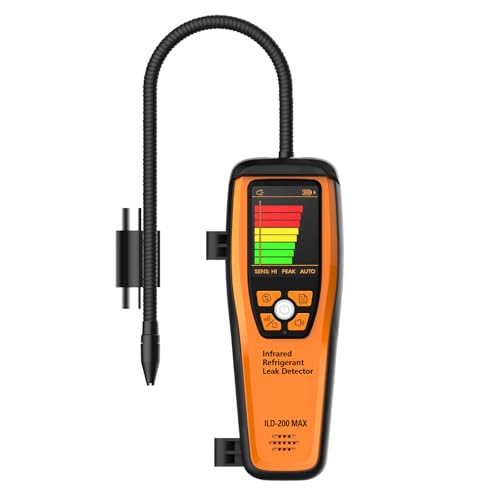

Products shown because their documented specifications fit this guide. Price and availability are on Amazon and can change.
Frequently Asked Questions
What does non combustible actually exclude?
The bullet states coverage of all non combustible CFC, HCFC and HFC gases and blends. That is the legacy fluorocarbon family. It does not include the mildly flammable A2L refrigerants now common in new equipment, and it does not include hydrocarbon refrigerants such as propane and isobutane used in some commercial refrigeration and heat pumps. Two separate questions follow: whether the sensor responds to those gases at all, and whether an instrument not rated for combustible atmospheres should be operated where one may exist.
How good is a quarter of an ounce per year?
It is a strong figure for a handheld sniffer. Leak rate is expressed as mass lost over a year, so 0.25 oz per year or about 7 g per year is a very slow loss, and finding it means detecting a tiny local concentration at the joint. The wording is better than the number: individually calibrated describes a per unit check rather than a model claim, which is more than most listings in this category offer.
What is an ion pump sensor?
A heated sensing element that ionises gas drawn past it and measures the resulting current, which changes when halogenated molecules are present. The practical characteristics of that family are high sensitivity to halogens, a warm up period before readings are stable, and a sensing element that ages. The listing names the technology and claims a patent on it, then publishes nothing about service life, replaceability or warm up time, which are the three things the technology choice makes relevant.
Why do ten sensitivity ranges help?
Because finding a leak and pinpointing it are different tasks. A coarse setting lets you sweep a system without the instrument saturating on the general background around a leaking plant room. Once a region responds, tightening the range narrows what counts as a signal so the exact joint stands out from its neighbours. A detector with one fixed sensitivity makes you choose between the two jobs.
What does the water vapour filter prevent?
False alarms from moisture. Many leak sensing elements respond to water vapour as well as to refrigerant, and the places you hunt leaks are the wettest places in the system: a cold evaporator running with condensation, a sweating suction line, a damp plant room. A filter that keeps vapour off the element addresses a failure that wastes real time, because a false signal at a fitting sends you looking for a leak that is not there.
Affiliate disclosure: Akermin earns a commission from qualifying Amazon purchases made through links on this page. Our editorial picks are based on documented specifications and owner feedback, not commissions.
Related Guides

BW Clip BWC2-H Review: Alarm Points Set Before the Clock Starts
A single gas hydrogen sulfide detector with one button operation, hibernation mode, automatic logging of the 35 most recent gas events and bump test results, and compatibility with IntelliDoX and MicroDock II docking.
Read More→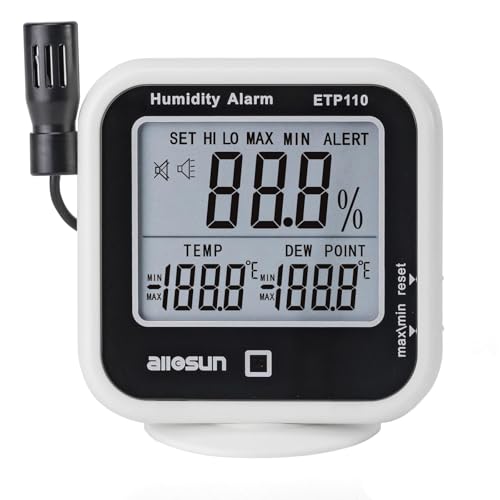
ALLOSUN Thermometer Hygrometer Review: Half a Metre of Lead and No Tolerance
A battery powered thermometer and hygrometer showing temperature, relative humidity and dew point, with a settable humidity alarm, a sensor on a lead of about 50 cm, maximum and minimum memory and a large LCD.
Read More→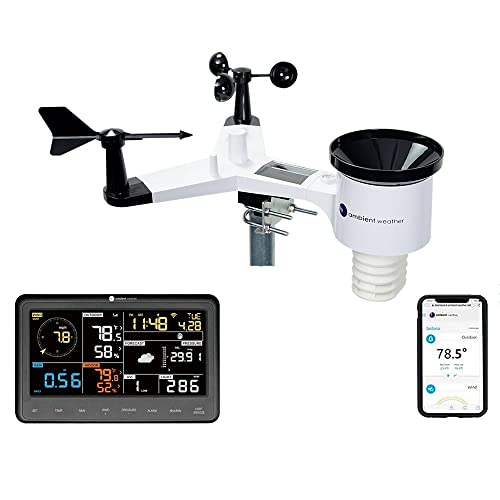
Ambient Weather WS-2902 Review: Six Quantities and a Feature Marked Coming Soon
A Wi-Fi connected home weather station made up of an Osprey sensor array with a rain cup and a colour LCD console, measuring wind speed and direction, temperature, humidity, rainfall, UV intensity and solar radiation.
Read More→