Best Borescopes for Plumbing and Drains: Waterproof Picks for Traps, Stacks and Sewer Lines
A drain borescope has to tolerate water on the probe, reach past the trap and show the pipe wall rather than the dark hole ahead of it. That makes the IP67 rating, cable length and side lens the deciding figures, and it also sets a limit: a 16 ft cable inspects a trap, a branch or a short stack, not a sewer lateral to the street. This guide sorts the listings on those figures and says where a reel camera takes over.
As an Amazon Associate, Akermin earns from qualifying purchases. Product links on this page are affiliate links.
Our Top Picks
These borescopes were compared for plumbing on stated waterproof rating, cable length, probe diameter, side lens, lighting, display and recording, all from manufacturer listings. We did not run laboratory tests or put the tools down a drain; every figure is the manufacturer's own and gaps are marked Not stated.
Best Overall
TGJOR 5-Inch Dual Lens Sewer Inspection Camera, 16.4 ft
16.4 ft IP67 semi-rigid probe, dual lens, 5-inch 1080P screen, no app.
16.4 ft semi-rigid probe that bends and holds shape in pipes and ducts; IP67 for underwater use
Front and side lenses switched instantly; 1080P with a 1.2 to 4 in focus range
5-inch screen with a 170-degree viewing angle; eight adjustable LEDs
No app or Wi-Fi; one-handed use; 2000 mAh battery stated at 3 to 4 hours
All figures come from the manufacturers' Amazon listings at the time of research. Waterproof ratings apply to the probe, not the handset. The Klein ET30 is titled for drain diagnosis but its listing states no ingress rating; treat that as unconfirmed.
How to Choose a Borescope for Plumbing
Four points decide it:
IP67 on the Probe
Five of the six listings state IP67. The Klein ET30 states none. The rating covers temporary immersion of the probe, not the handset or a phone.
Reach Past the Trap
9.8 ft on the NTS500 covers a trap and a short branch; 16.4 to 16.5 ft on the TGJOR, DEPSTECH and T TAKMLY runs farther. None reaches a sewer lateral.
Tip Size for the Opening
A 0.21 in tip enters a small trap or an overflow. An 8 mm tip needs a cleanout or a removed trap arm. Three listings do not state it.
A Record for the Customer
The DS300, DS620 and ET30 record. The TGJOR and T TAKMLY state that they cannot. Decide whether the video matters before the screen size does.
Does IP67 mean I can leave the probe under water in a flooded drain?
Not indefinitely. IP67 describes protection against dust and against temporary immersion in shallow water; it is not a rating for continuous submersion or for pressurized water. The TGJOR and Teslong listings describe underwater and plumbing use, which is what the rating supports for the length of an inspection. Rinse and dry the probe afterwards, and keep the handset and any phone out of the water; the rating applies to the probe only.
How far into a sewer line can a 16 ft borescope reach?
About 16 ft from the opening, minus every bend. That covers a trap, a branch line, a short section of stack or the first stretch past a cleanout. A sewer lateral from the house to the main is typically far longer, and inspecting it is the job of a reel-type sewer camera with a stiff push cable and, usually, a locating sonde. A borescope tells you whether the problem is near the fixture; it does not replace a lateral inspection.
Can a borescope find what is causing a clog?
If the blockage is within reach and the water is clear enough to see through, yes: hair and scale in a trap, a dropped object, a partial collapse, root intrusion at a joint. In standing murky water the camera shows brown, so drain or flush the line first where you can. The side lens on the dual lens units shows the pipe wall where scale and cracks live; the forward lens shows the obstruction ahead.
Which parts of the borescope are waterproof, and how do I clean it after a drain?
The probe and cable carry the rating; the handset, screen, connector housing and any phone do not. Wipe the cable down with a disinfecting cleaner as it comes out, rinse the tip, check the LED window for film that will fog the next image and let it dry before it goes in the case. The Teslong NTS500 states a sealed aerospace-style connector at the probe; on units that do not describe the connector, keep that joint dry.
Why do the TGJOR and T TAKMLY units not record video?
Both listings state plainly that the unit cannot take pictures or video; they are live-view screens only, which keeps them simple and lets the screen be the whole product. For a plumber who needs to show a customer or document a finding, the DEPSTECH DS300 and DS620 record to a microSD card and the Klein ET30 saves to its phone app. If the record matters, buy from that group.
Reviews
TGJOR 5-Inch Dual Lens Sewer Inspection Camera, 16.4 ft Best Overall
The TGJOR is the drain camera for a plumber who wants length, a side view and no phone. The manufacturer states a 16.4 ft semi-rigid probe that bends and holds its shape through a trap and along a branch, IP67 waterproofing that it describes as suitable for underwater tasks, and eight adjustable LEDs for a pipe that has no light of its own. The dual lens tip switches between the forward view down the pipe and the side view of the pipe wall, which is where scale, cracks and root intrusion show.
The 1080P picture lands on a 5-inch screen with a 170-degree viewing angle, and the stated focus range of 1.2 to 4 in is a sensible working distance inside a 2 in or 4 in line. The unit is plug-and-play with no app, and the 2000 mAh battery is stated at 3 to 4 hours.
Two gaps: the listing states outright that the camera cannot take pictures or video, so there is no record for a customer, and it does not state the probe diameter. The DS300 records; the NTS500 states a 0.21 in tip.
Teslong NTS500 Dual Lens Borescope With 5-Inch Monitor Best 9.8 ft Waterproof Dual Lens
The NTS500 is the drain borescope for the small openings the 8 mm units cannot enter: a bathroom sink trap, a tub overflow, a small cleanout plug. Teslong states a 0.21 in (5.5 mm) tip carrying two complete cameras, forward and side, each with its own LED, switched by a button, and an IP67 probe with a sealed aerospace-style connector that the manufacturer says is safe in pools, plumbing and rain.
The 9.8 ft cable is shorter than the 16 ft units but long enough for a trap, a branch to the stack and a short run past a cleanout, and the 5-inch 1280 x 720 IPS screen with a 3500 mAh battery is the same handset that serves the engine and wall jobs in our other guides, which is the point for a plumber who also does general inspection.
The listing does not state photo or video recording or battery hours, and 9.8 ft runs out before a long branch. For length, the TGJOR and DS300 reach 16 ft; for a record, the DS300 states it.
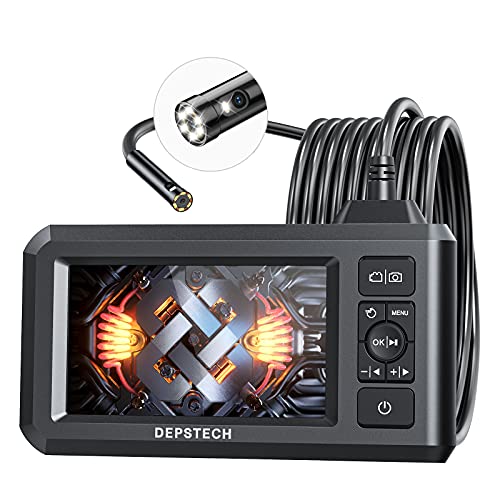
DEPSTECH DS300 Dual Lens Inspection Borescope, 16.5 ft Best Value
The DS300 is the value pick because it is the only one of the three that documents the drain. DEPSTECH states 2 MP photos and 1080P video to a microSD card, so a customer can be shown the crack, the belly or the root ball rather than told about it. The 16.5 ft semi-rigid cable matches the TGJOR for reach, the probe is IP67 with seven adjustable LEDs at three levels, and the front and side cameras show both views at once in split-screen mode.
The stated focal ranges, 1.2 to 3.1 in front and 0.8 to 2.4 in side, suit a 2 in line where the wall is close; a 4 in line puts the far wall beyond sharp focus with the front camera, which is where the side lens earns its place. Battery life is stated at about 4 hours, and a 180-degree rotation setting rights an inverted image.
The probe diameter is not stated, the microSD card is not included and the 4.3-inch screen is the smallest here. For a plumber who needs the video, none of that outweighs the recording.
Short answer: the TGJOR 5-inch sewer camera is the drain borescope for a plumber who wants reach, a side view and no phone, with a 16.4 ft IP67 probe, a 5-inch 1080P screen and stated 3 to 4 hour battery; the Teslong NTS500 is the pick for small traps and overflows, a 0.21 in IP67 dual lens tip on a 9.8 ft cable; and the DEPSTECH DS300 is the value unit that reaches 16.5 ft and is the only one of the three that records the inspection.
What a drain borescope has to do
A plumbing inspection asks three things of the camera that a wall inspection does not. The probe will be wet, so the waterproof rating is not optional. The pipe is a tube, so the interesting surface is beside the tip rather than ahead of it, which makes a side lens or a way to turn the camera worth having. And the pipe is long, so the cable has to reach past the trap and along the branch while still being stiff enough to push. A borescope is also a line-of-sight tool: it sees the pipe wall in clear air or clear water and sees nothing in a line full of dark water. For finding the leak from the other side of the wall, whether thermal imaging can find water leaks covers the camera that comes before the borescope.
IP67: what the rating covers and what it does not
Five of the six listings state IP67 on the probe: the TGJOR, Teslong NTS500, DEPSTECH DS300 and DS620 and T TAKMLY. The Klein ET30 is titled for drain and plumbing diagnosis but its listing states no ingress rating, so treat it as unconfirmed until the manual says otherwise. IP67 describes protection against dust and against temporary immersion in shallow water; it is enough for a trap, a flooded branch or a submerged tip during an inspection, and the TGJOR and Teslong listings describe underwater and plumbing use in those terms. It is not a rating for continuous submersion or for water under pressure, and it applies to the probe, not to the handset, the screen or a connected phone. Teslong states a sealed aerospace-style connector at the probe joint; on the others, keep that connection dry.
Reach: 9.8 ft, 16 ft and where a reel camera starts
The Teslong NTS500’s 9.8 ft cable covers a sink or tub trap, the arm to the stack and a short look past a cleanout. The TGJOR at 16.4 ft, the T TAKMLY at 16.4 ft and the DEPSTECH DS300 and DS620 at 16.5 ft run farther along a branch or down a section of stack, and all state semi-rigid cables that hold a bend so they can be shaped around a trap and pushed. None of these is a sewer camera in the trade sense. A lateral from the house to the main is typically far longer than any cable here, and inspecting it is the job of a reel-type push camera with a stiff cable, a self-leveling head and usually a locating sonde. A borescope tells you whether the problem is at the fixture end; it does not replace the lateral inspection.
Tip size: small traps and cleanouts
The opening decides which probe gets in. A bathroom sink trap, a tub overflow plate or a small cleanout plug takes the NTS500’s 0.21 in (5.5 mm) tip, which Teslong states passes a spark plug hole and which carries two cameras with their own LEDs. The T TAKMLY states an 8.0 mm camera, which wants a removed trap arm, a toilet flange or a cleanout. The TGJOR, DS300 and DS620 do not state a diameter, which is the most common gap in the category; confirm before buying for a specific fitting. Once inside a 2 in line the fixed-focus lenses are working at their design distance: the TGJOR states 1.2 to 4 in, the DS300 1.2 to 3.1 in front and 0.8 to 2.4 in side, the T TAKMLY 2 to 10 cm. In a 4 in line the far wall is beyond sharp focus for the front lens, which is exactly where the side lens earns its place.
Side lens, light and the picture in a pipe
A forward camera looks down a black tube; a side camera looks at the wall where scale builds, joints separate, roots enter and cracks run. The TGJOR, NTS500, DS300 and T TAKMLY all state a side lens switched by a button, the DS300 shows both at once on a split screen and the DS620 adds a third lens. The Klein ET30 is a single auto-focus camera that stays upright as it turns, which is a different answer to the same problem. Light is the other half: a pipe has none, and the listings state eight adjustable LEDs on the TGJOR and T TAKMLY, seven at three levels on the DS300, ten on the DS620, and six front plus a side LED on the NTS500. Resolution is stated as 1080P on the TGJOR and T TAKMLY, 1280 x 720 on the NTS500 and 1080P video on the DEPSTECH units.
Recording: who gets to see the pipe
The listings divide cleanly. The DEPSTECH DS300 and DS620 record 2 MP photos and 1080P video to a microSD card, not included; the Klein ET30 saves to its phone app. The TGJOR and T TAKMLY both state in their own bullets that the unit cannot take pictures or video, and the Teslong NTS500 listing does not mention recording. For a plumber who quotes a repair off what the camera showed, the record is the difference between telling a customer about a root ball and showing them one, and it is the reason the DS300 takes the value slot on this page despite its smaller 4.3-inch screen and unstated tip diameter.
Borescopes were compared on manufacturer listing text: waterproof rating, cable length and construction, probe diameter, lens arrangement, lighting, focal range, display, recording and battery. Owner feedback was reviewed for recurring comments on visibility in murky water and cable stiffness in traps. We did not run laboratory tests, did not put the tools in a drain and publish no measurements of our own. Amazon data supplies images, availability and links only.
A handheld thermal camera with a 160 by 120 infrared detector, a 320 by 240 enhanced image, 40 mK sensitivity, a focus free 40 by 30 degree field of view, a 25 Hz refresh rate and still JPG image capture.
A non contact infrared thermometer for electrical, mechanical, HVAC and automotive surfaces, with dual rotating lasers that mark the edges of the measurement area, minimum, maximum, difference and average readings, and an IP54 rating.
A pinless non invasive moisture meter that reads up to three quarters of an inch into a surface, with scales of 0 to 53 percent for softwood, 0 to 35 percent for hardwood and relative readings on wallboard, drywall and masonry.